Edi Durjana
The highly anticipated release of RetroArch 1.20.0 marks a significant milestone in the realm of video game emulation, introducing advanced features designed to enhance both visual accuracy and immersive gameplay for enthusiasts worldwide. Available for immediate download across various platforms, this latest iteration from the Libretro team underscores a steadfast commitment to user experience, eschewing commercial monetization models in favor of community-driven development and open-source principles. The update’s marquee features include a revolutionary CRT beam simulation shader leveraging "subframe" capabilities and pioneering illuminance sensor support for Linux, promising a more authentic and interactive retro gaming experience than ever before.
RetroArch, as a versatile front-end for the Libretro API, stands as a cornerstone of the modern emulation landscape. It provides a unified interface for numerous "cores," each representing a different game console or computer system, allowing users to play a vast library of classic titles from a single application. Since its inception, the project has championed game preservation and accessibility, offering a robust, feature-rich platform that remains free from in-app advertisements, monetization SDKs, or paywalled functionalities. This ethos, repeatedly affirmed by the development team, is sustained by the invaluable support of its global user base through donations via platforms like Patreon and GitHub Sponsors, as well as merchandise sales through their Teespring store. This community-centric funding model is crucial for maintaining the project’s independence and enabling continuous innovation.
Revolutionizing Visual Fidelity: The Subframe Shader Technology
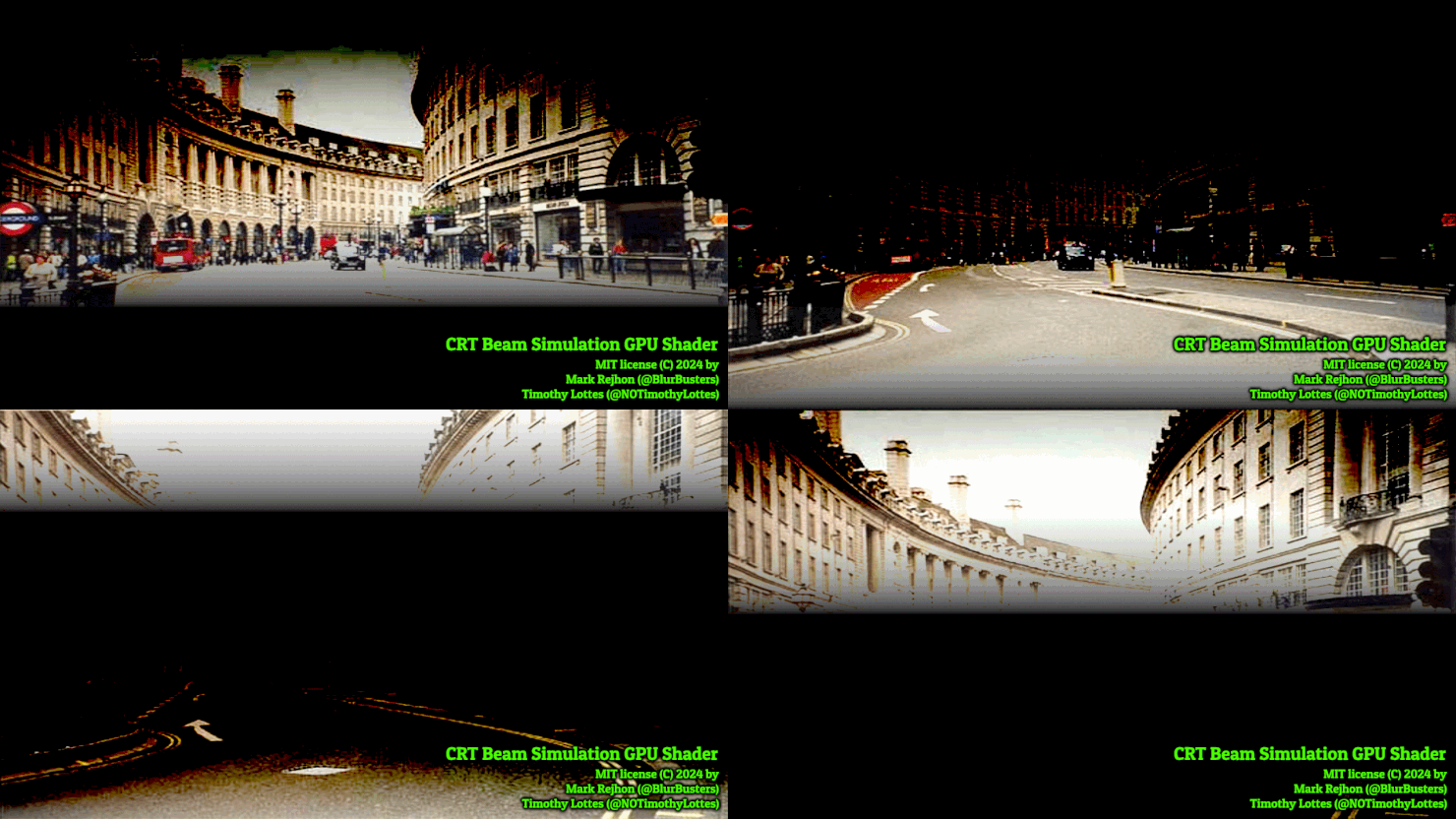
One of the most impactful advancements in RetroArch 1.20.0 is the introduction of a new CRT (Cathode Ray Tube) beam simulation shader, a collaborative effort between renowned display expert Mark Rejhon of BlurBusters and graphics pioneer Timothy Lottes, known for his work on the original FXAA shader and the highly regarded crt-lottes shaders. This innovation directly addresses a long-standing challenge in retro emulation: accurately replicating the unique visual characteristics and motion clarity of classic CRT displays on modern, typically sample-and-hold LCD and OLED panels.
For decades, CRT monitors and televisions were the standard for gaming, offering instantaneous pixel response times and a unique scanning electron beam that created a natural, fluid motion perception. When emulated games are displayed on modern panels, the inherent "sample-and-hold" nature of these displays often results in perceived motion blur, even at high frame rates, which detracts from the original gaming experience. Historically, solutions like Black Frame Insertion (BFI) have been employed to mitigate this by inserting brief black frames between rendered frames, mimicking the dark scanlines of a CRT. However, BFI comes with significant drawbacks: a noticeable reduction in overall screen brightness, dulled colors, and a potential risk of image persistence – a temporary form of "burn-in" – on many common LCD and even some OLED panel types. These compromises often made BFI an imperfect solution for discerning retro enthusiasts.
The new CRT beam simulation shader bypasses these limitations by leveraging RetroArch’s recently integrated "subframe" shader capabilities. This advanced rendering technique allows for the processing and display of multiple rendering passes or visual states within the duration of a single display refresh cycle. Instead of simply inserting a black frame, the subframe shader dynamically simulates the intricate behavior of a CRT’s electron beam, including its illumination, decay, and re-trace characteristics, on a sub-millisecond level. This sophisticated approach creates the illusion of superior motion clarity and authentic scanline effects without sacrificing brightness, color vibrancy, or risking panel damage.
Mark Rejhon, a leading authority on display motion and latency, has extensively researched and documented the nuances of human motion perception and display technology. His involvement, combined with Timothy Lottes’s deep expertise in real-time graphics and shader development, has resulted in a shader that is not merely an aesthetic filter but a scientifically grounded simulation of CRT physics. The RetroArch team states that this technology represents a significant leap forward in visual emulation, asserting that "it significantly improves motion clarity on modern displays without the typical drawbacks associated with black-frame insertion (BFI) implementations." The implications are profound for game preservation, allowing classic titles to be experienced with unprecedented visual authenticity on contemporary hardware. Further technical details and demonstrations are available in a dedicated article on the Libretro website, showcasing the depth of this engineering achievement.
Immersive Emulation: Real-World Sensor Integration for Linux
Beyond visual enhancements, RetroArch 1.20.0 also pushes the boundaries of interactive emulation with the introduction of illuminance sensor support for Linux. This innovative feature, spearheaded by developer Jesse Talavera, addresses a unique challenge presented by games that originally relied on external hardware peripherals, most notably the Boktai series for the Game Boy Advance. Developed by Kojima Productions, the Boktai games famously incorporated a solar sensor directly into their game cartridges, requiring players to expose their Game Boy Advance to real sunlight to charge protagonist Django’s "Gun Del Sol" and progress through certain in-game challenges. This groundbreaking mechanic offered an unparalleled level of immersion and interaction with the real world, but it has historically been difficult to faithfully replicate in emulation without resorting to manual cheats or workarounds.
Jesse Talavera’s work enables Linux users, particularly those with devices like the Steam Deck which often feature integrated ambient light sensors, to experience Boktai and similar titles exactly as their creators intended. The implementation maps real-time ambient light readings from the device’s illuminance sensor directly to the emulated game environment. A compelling demonstration video showcases Lunar Knights (the spiritual successor to Boktai on the Nintendo DS) running on a Steam Deck, with the in-game solar energy levels visibly reacting as the user adjusts the surrounding light. This seamless integration transforms a previously emulated abstraction into a tangible, interactive gameplay element.
The choice of Linux as the initial platform for this feature is particularly strategic, given the operating system’s open-source nature and the growing popularity of Linux-based gaming handhelds like the Steam Deck. The Steam Deck, with its integrated sensors and robust Linux environment, provides an ideal platform for showcasing such innovative hardware-software emulation synergy. The RetroArch team indicates that the melonDS DS core’s next update will include solar sensor support, further broadening the scope of this feature to Nintendo DS titles that utilized similar mechanics. Looking ahead, the development team has also teased broader camera support for more platforms, hinting at the potential for emulating other unique peripherals like the Game Boy Camera or PlayStation’s EyeToy, opening up new avenues for interactive retro gaming.
This feature is not merely a novelty; it represents a significant step in game preservation, ensuring that unique and often overlooked gameplay mechanics, which were integral to the original design intent, can be faithfully experienced by future generations of players. By integrating real-world sensors, RetroArch continues to bridge the gap between classic hardware limitations and modern computing capabilities, fostering a deeper connection to the games of yesteryear.
The Ethos of RetroArch: Community-Driven Development and Open Access
The release of RetroArch 1.20.0 is not just about new features; it’s a testament to the enduring philosophy that underpins the entire Libretro project. From its inception, the developers have prioritized the end-user experience, committing to an open-source model that stands in stark contrast to many commercial software initiatives. The explicit rejection of in-app advertisements, monetization SDKs, and paywalled features is a core tenet, reinforcing the project’s dedication to accessibility and user autonomy. This stance has cultivated a loyal and passionate community that recognizes the value of unbiased, free-to-use software.
The sustainability of such a large-scale, continuously evolving project relies heavily on voluntary contributions. The RetroArch team actively encourages financial support through various channels, including Patreon, where users can offer recurring pledges, and GitHub Sponsors, which provides a direct way for individuals and organizations to support open-source development. Additionally, the sale of official merchandise through the Teespring store offers another avenue for fans to contribute while acquiring unique branded items. This multi-faceted funding strategy empowers the development team to dedicate resources to research, development, and maintenance, ensuring that RetroArch remains at the forefront of emulation technology without succumbing to commercial pressures that could compromise its user-centric mission.
"This project exists for the benefit of our users, and we wouldn’t keep doing this were it not for spreading the love to our users," the RetroArch team stated in their release announcement, encapsulating their guiding principle. This sentiment resonates deeply within the emulation community, where the preservation of gaming history is often seen as a cultural imperative. By maintaining an open and transparent development process, RetroArch fosters a collaborative environment where contributors from around the globe can participate, offering code, bug reports, and ideas that continually refine and expand the platform.
Broader Implications and Future Outlook
The advancements introduced in RetroArch 1.20.0 carry significant implications for the broader emulation landscape and the future of game preservation. The subframe shader technology sets a new standard for visual fidelity, potentially influencing how future display technologies are developed and integrated with retro content. It demonstrates that with innovative software solutions, the unique visual characteristics of vintage hardware can be authentically recreated, bridging the gap between nostalgic aesthetics and modern display capabilities. This could spur further research into sophisticated real-time rendering techniques for historical media.
Similarly, the successful integration of real-world sensors for gameplay opens up exciting possibilities for emulating other hardware-dependent experiences. As gaming hardware becomes increasingly diverse, featuring a myriad of input methods and environmental sensors, the ability of emulation platforms to adapt and integrate these elements will be crucial for complete preservation. This feature highlights the potential for emulation to go beyond merely running old code, striving instead to replicate the full, interactive experience as originally conceived.
As RetroArch continues its trajectory of innovation, it reinforces its position as a critical tool for digital archaeologists, game historians, and casual players alike. The commitment to open-source development, coupled with a relentless pursuit of technical excellence, ensures that the rich tapestry of video game history remains accessible, playable, and faithfully preserved for generations to come. The release of RetroArch 1.20.0 is not just an update; it is a declaration of intent, affirming the project’s dedication to pushing the boundaries of what is possible in the world of emulation. A comprehensive changelog detailing numerous other fixes, performance enhancements, and core updates is available on the official RetroArch website, further illustrating the breadth of improvements in this landmark release.