Edi Durjana
The latest major update to the globally popular multi-system emulation frontend, RetroArch 1.20.0, has officially been released to the public, bringing with it a suite of advanced display technologies, operating system integrations, and performance enhancements designed to elevate the retro gaming experience on modern hardware. Available immediately across a vast array of platforms via the official Libretro website, version 1.20.0 underscores the development team’s long-standing commitment to user-centric software design, completely eschewing in-app advertisements, monetization development kits, and paywalled features in favor of community-driven support models such as Patreon, GitHub Sponsors, and merchandise sales.
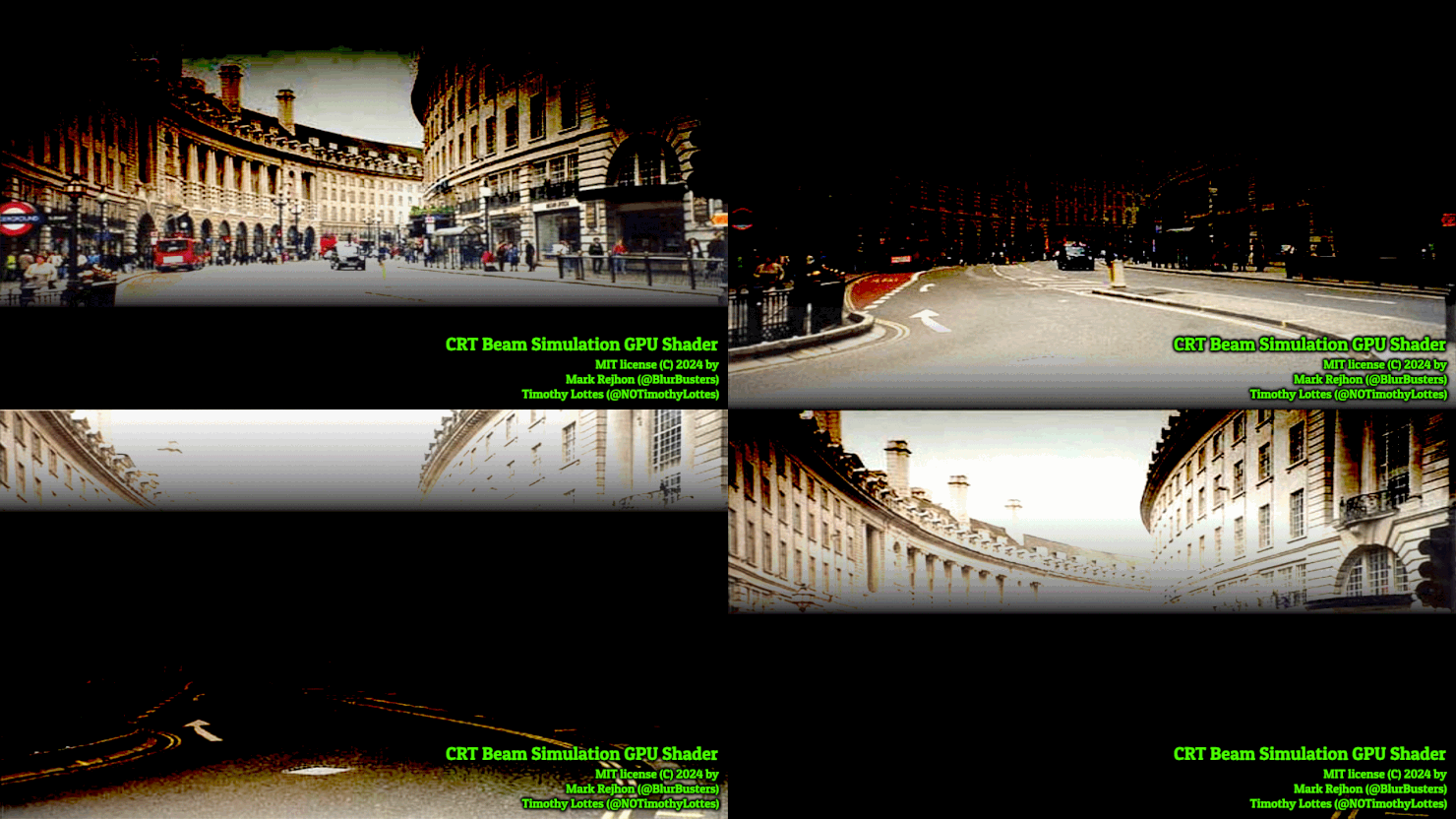
At the forefront of this release is the introduction of a groundbreaking CRT beam simulation shader, developed collaboratively by Mark Rejhon of BlurBusters and Timothy Lottes, creator of the original FXAA and the popular crt-lottes shaders. This new technological addition utilizes RetroArch’s recently deployed subframe shader capabilities to address a fundamental challenge in retro gaming: motion blur on modern high-refresh-rate LCD and OLED displays. Traditionally, gamers seeking authentic cathode-ray tube motion clarity have relied on black-frame insertion (BFI). While effective at reducing motion blur, BFI historically carried severe trade-offs, including dramatic reductions in panel brightness, dulled color saturation, and a heightened risk of image persistence—a temporary form of panel ghosting or retention that resembles permanent display burn-in on common liquid-crystal displays. By implementing subframe shaders combined with BlurBusters’ CRT beam racing techniques, RetroArch 1.20.0 successfully bypasses these limitations, delivering pristine motion fidelity without compromising visual vibrancy or hardware safety.
Complementing the graphical advancements in version 1.20.0 is a novel hardware integration spearheaded by developer Jesse Talavera, who has introduced native illuminance sensor support for Linux-based operating systems. This feature bridges the gap between classic handheld software limitations and modern portable gaming hardware, such as the Steam Deck. Most notably, the inclusion of ambient light sensor support allows modern devices to dynamically interact with games specifically designed around real-world lighting conditions. A prime historical example is Konami’s Boktai: The Sun Is in Your Hand originally released for the Game Boy Advance, which featured a physical photovoltaic sensor on the game cartridge to encourage players to venture outdoors into sunlight to power in-game mechanics. With the release of RetroArch 1.20.0 and upcoming corresponding updates to emulators like melonDS, players can now utilize built-in or external light sensors on Linux devices to dynamically alter gameplay elements—such as adjusting in-game solar energy meters by shining a flashlight or adjusting room lighting—thereby restoring an authentic gameplay loop that has been largely inaccessible since the twilight of the GBA era. Libretro developers have also confirmed that camera support for additional platforms is slated for rollout shortly following the 1.20.0 deployment.
The release of RetroArch 1.20.0 follows a meticulous, multi-year developmental timeline focused on refining the libretro API architecture and expanding cross-platform compatibility. Over the past decade, the Libretro ecosystem has evolved from a simple graphical interface for a handful of emulators into a comprehensive framework supporting dozens of core architectures, ranging from fifth-generation home consoles to obscure microcomputers and arcade hardware. Version 1.20.0 represents the culmination of countless hours of volunteer contributions, bug testing, and algorithmic optimization by an open-source community that prioritizes historical software preservation and archival accuracy.
The economic model underpinning RetroArch and its parent organization, Libretro, remains an anomaly in modern software development. In an industry increasingly dominated by subscription models, aggressive digital rights management (DRM), and microtransactions, the project relies entirely on voluntary financial contributions from its user base. Operating costs for hosting comprehensive asset databases, buildbots, and community forums are defrayed solely through crowdfunding platforms. Project maintainers have reiterated their steadfast dedication to this ethos upon the launch of version 1.20.0, emphasizing that the software will remain entirely free of commercial intrusion, tracking SDKs, and paywalls. Users wishing to financially sustain the ongoing development of the platform can contribute via Patreon, GitHub Sponsors, or by purchasing official merchandise through the project’s designated storefronts.
From an industry and preservationist perspective, the release of RetroArch 1.20.0 carries significant implications for the digital archiving community and the broader video game industry. As vintage hardware degrades due to natural capacitor failure, disc rot, and chemical breakdown of optical media, software emulation remains the primary viable method for future generations to study and experience interactive media history. By pioneering advanced display technologies like subframe CRT simulation, RetroArch addresses the growing aesthetic disparity between legacy cathode-ray tube phosphors and flat-panel displays. Modern gamers often critique emulation for looking overly sterile or introducing undesirable frame-pacing artifacts when played on high-resolution monitors. By simulating the precise scanning beam behavior of physical CRTs at a subframe level, developers are bridging the gap between historical hardware accuracy and contemporary display technology.
Furthermore, the integration of ambient environmental sensors points toward a broader trend in emulation software: the holistic capture of peripheral hardware inputs. Emulating software code alone is frequently insufficient to recreate the unique experience of playing a title that relied on specialized physical input devices, such as light guns, tilt sensors, or solar meters. By opening up native Linux support for environmental sensors, the Libretro team has established a standardized pipeline for modern handheld PCs and laptops to interface with eccentric hardware requirements of the past. Industry analysts note that as portable PC gaming hardware continues to saturate the market, features that leverage native device telemetry—such as accelerometers, gyroscopes, and ambient light meters—will become increasingly vital for maintaining the integrity of portable console emulation.
As the open-source community begins downloading and deploying RetroArch 1.20.0 across Windows, macOS, Linux, Android, and various console ports, the immediate focus of the development team shifts toward stabilizing minor platform-specific bugs and preparing upcoming core updates. With the imminent arrival of solar sensor support in melonDS and expanded camera integration for additional operating systems on the horizon, the momentum surrounding the Libretro ecosystem shows no signs of slowing down. Users are encouraged to visit the official RetroArch platform directory to download the latest iteration, review detailed installation guides, and explore contribution avenues to ensure the ongoing viability of this monumental software preservation project.