Indra Gunadi
Unpacking the Gameplay Loop: A Deep Dive into Ouroboros’ Mechanics
At its core, Ouroboros is a meticulously crafted puzzle game that embraces its namesake, the ancient symbol of a serpent eating its own tail, by challenging players with circular logic and self-referential problems. The game presents 50 distinct levels, each designed to escalate in complexity and demand increasingly sophisticated problem-solving skills. Unlike many traditional puzzle games that enforce a linear progression, Ouroboros grants players immediate access to all 50 puzzles from the outset. This design choice is a significant departure from conventional retro gaming structures, where progression is often gated by completing preceding levels. The decision to unlock all stages immediately serves multiple purposes: it mitigates frustration by allowing players to skip a particularly difficult puzzle and return to it later, fostering a more relaxed and explorative playstyle; it caters to players with limited time, enabling them to jump directly to challenges that appeal to them; and it implicitly trusts the player to manage their own learning curve, rather than forcing a predefined path.
Complementing this non-linear progression is an unlimited undo function, a feature that further underscores Aardvark Soup’s commitment to penalty-free experimentation. In puzzle games, the fear of making a wrong move or reaching an unwinnable state can often deter players from trying unconventional solutions. The unlimited undo removes this barrier entirely, empowering players to experiment freely, test hypotheses, and learn through trial and error without the punitive consequences of restarting a level or suffering a significant time penalty. This modern design sensibility, seamlessly integrated into a retro platform, positions Ouroboros as a thoughtful bridge between classic gaming aesthetics and contemporary user experience principles.
The game’s progression of mechanics is thoughtfully structured. A new major gameplay mechanic is introduced every 10 levels, providing a clear developmental arc and ensuring that the puzzles remain fresh and engaging. Each new mechanic is then thoroughly explored from various angles over the subsequent levels, allowing players to fully grasp its nuances and strategic implications before the next layer of complexity is introduced. This methodical approach to content delivery prevents feature bloat and ensures that each mechanic feels purposeful and well-integrated into the overall puzzle design. While the specific nature of these mechanics remains to be fully explored by players, such a structured introduction suggests elements that could range from new environmental interactions, different types of blocks or entities, or even changes to the player character’s movement or interaction capabilities. This tiered learning system is crucial for a game with 50 levels, preventing repetition and maintaining a steep but fair difficulty curve.
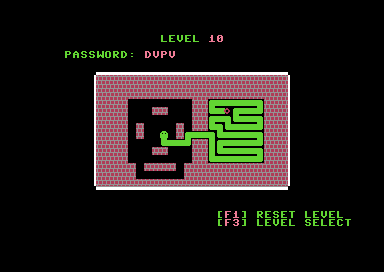
To preserve player progress across sessions, Ouroboros incorporates a simple password system. This choice is historically authentic to the Commodore 64 era, where elaborate save files were often impractical due to hardware limitations and the common distribution methods of the time. The password system, typically a string of characters that encodes the player’s progress, offers a pragmatic and nostalgic solution for tracking completed stages. It aligns with the retro aesthetic while providing essential functionality for a game designed for extended play.
The Enduring Legacy of the Commodore 64: A Contextual Framework
The release of Ouroboros for the Commodore 64 is not merely another game launch; it is a testament to the enduring appeal and vibrant longevity of one of computing history’s most iconic machines. Introduced in January 1982 by Commodore International, the C64 quickly became the best-selling single computer model of all time, with estimates of total sales ranging from 12.5 to 17 million units worldwide. Its immense popularity was driven by its competitive pricing, advanced graphics and sound capabilities for its era (thanks to the VIC-II graphics chip and the legendary SID sound chip), and a massive software library spanning productivity applications, educational tools, and, most importantly, games.
Despite its discontinuation in 1994, the Commodore 64 has maintained a dedicated and passionate global community. This community is not merely nostalgic; it is actively engaged in preserving the platform’s history, developing new hardware enhancements, and, crucially, creating new software. The homebrew scene for the C64 is remarkably robust, with independent developers like Aardvark Soup continuing to push the boundaries of what can be achieved on the nearly four-decade-old hardware. This ongoing development is fueled by a blend of technical challenge, artistic expression, and a desire to contribute to a beloved platform.
Modern tools, such as cross-compilers and emulators, facilitate development, allowing creators to design games on contemporary PCs and then compile them for the C64, often incorporating features that would have been complex or impossible for developers in the 1980s. The distribution channels for these new games have also evolved, moving from physical media like floppy disks and cartridges to digital platforms such as itch.io, CSDB (Commodore Scene Database), and various online forums, making these new creations accessible to a global audience of C64 enthusiasts who often play on emulators or modern C64 recreations like THEC64 Mini/Maxi.
Aardvark Soup’s Vision and Craft: A Developer’s Perspective
While Aardvark Soup operates with a relatively low public profile, typical of many independent retro game developers, the design choices evident in Ouroboros offer insight into their likely philosophy. The name "Aardvark Soup" itself suggests a quirky, perhaps humble, but certainly distinctive approach to game development. Their decision to develop for the C64 indicates a deep appreciation for the platform’s characteristics and challenges.
It can be inferred that Aardvark Soup is driven by a desire to create engaging experiences that respect the limitations of the C64 while simultaneously injecting modern design sensibilities. The focus on a pure puzzle mechanic, devoid of complex narratives or action elements, suggests a dedication to core gameplay and intellectual challenge. The developer’s emphasis on player-friendly features—unlocked levels, unlimited undo—demonstrates an understanding of contemporary player expectations for accessibility and frustration management, even within a retro context. This approach aims to make the game appealing not just to hardcore C64 purists but also to a broader audience of puzzle game aficionados who might be exploring retro platforms for the first time.
Developing for the C64 presents a unique set of constraints and opportunities. Memory limitations (64KB RAM), CPU speed (1MHz), and sprite limitations (8 hardware sprites per scanline) necessitate clever optimization and creative problem-solving. Aardvark Soup’s ability to craft 50 "increasingly mind-bending puzzles" within these constraints speaks volumes about their technical prowess and design ingenuity. The structured introduction of new mechanics every 10 levels further suggests a methodical and deliberate development process, ensuring that each new element is polished and integrated effectively. This level of craft is a hallmark of dedicated homebrew developers who treat retro platforms not as relics, but as viable canvases for new creative works.
From Concept to Cartridge (Digital): A Development Timeline (Inferred)
The journey of a game like Ouroboros from conception to release on the Commodore 64 typically follows a structured, albeit often informal, timeline for independent developers.
- Conception & Ideation (Likely Late 2024 – Early 2025): The initial spark for Ouroboros would have involved defining the core "biting your own tail" puzzle mechanic and how it translates into interactive gameplay. This stage would involve sketching out initial puzzle ideas, perhaps on paper or using simple digital prototyping tools, and exploring the potential for a circular, self-referential challenge. The decision to build for the Commodore 64 would have been made early, influencing every design choice thereafter.
- Engine & Tooling Setup (Early 2025): Aardvark Soup would have selected their preferred C64 development environment, which could range from assembly language (6502/6510) with cross-assemblers like ca65, to higher-level languages like C with cc65, or even specialized game creation systems designed for the C64. Setting up the graphics pipeline, sound integration (utilizing the SID chip), and input handling would be critical.
- Core Mechanics Implementation & Prototyping (Mid 2025): The basic movement, interaction, and puzzle elements would be coded and tested. This phase would involve creating a handful of proof-of-concept levels to validate the core gameplay loop and ensure it functions as intended on the C64 hardware. The implementation of the unlimited undo function and the password system would be key technical challenges addressed here.
- Content Creation – Level Design (Mid 2025 – Early 2026): This would be the most extensive phase, involving the creation of all 50 puzzles. The structured introduction of new mechanics every 10 levels would guide this process, ensuring a logical progression of difficulty and complexity. Iterative design and testing would be crucial, with puzzles being refined based on playtesting feedback. The C64’s visual and auditory constraints would heavily influence the aesthetic design of the game.
- Alpha & Beta Testing (Early 2026): Before a public release, Aardvark Soup likely engaged in internal or small-group beta testing. This process is vital for identifying bugs, balancing difficulty, and gathering feedback on user experience. For C64 homebrew, beta testers are often fellow enthusiasts or members of online retro computing communities.
- Polishing, Documentation & Release Preparation (Mid 2026): This final stage involves refining graphics and sound, optimizing code for performance, writing the game’s accompanying documentation (if any), and preparing the release package. For digital distribution, this typically means creating a .d64 disk image or .prg executable file. The game was then released and made available on platforms such as itch.io, indicating a preference for accessible digital distribution over physical media, though physical releases are also common in the C64 scene. The image accompanying the article, dated "2026/06," suggests a June 2026 release or announcement period, aligning with this inferred timeline.
Implications for the Retro Homebrew Scene and Beyond
The release of Ouroboros by Aardvark Soup carries several significant implications for the contemporary retro gaming landscape. Firstly, it reinforces the vitality and ongoing creative output of the Commodore 64 homebrew scene. Each new release, particularly one of this quality and design sophistication, adds to the platform’s modern library, demonstrating that the C64 is far from a museum piece and remains a viable platform for new game development. This continuous influx of new content helps attract new enthusiasts to the scene and keeps existing members engaged.
Secondly, Ouroboros serves as an excellent example of how modern game design principles can be successfully integrated into vintage hardware. The emphasis on player-friendly features like unlocked levels and unlimited undo, while commonplace in contemporary gaming, is a progressive approach for a C64 title. This demonstrates that developers are not merely replicating past experiences but are actively innovating within the constraints of the old systems, creating experiences that are both nostalgic and fresh. This approach helps to broaden the appeal of retro gaming beyond pure nostalgia, drawing in players who appreciate thoughtful game design regardless of the platform.
Thirdly, the game’s distribution via itch.io highlights the critical role of digital platforms in democratizing access to homebrew retro games. These platforms provide an easy, low-cost method for developers to share their creations with a global audience, bypassing the logistical challenges and costs associated with physical media production. This accessibility fosters a more diverse and prolific development community, as barriers to entry are significantly reduced.
Finally, Ouroboros contributes to the growing niche of puzzle games within the C64 library. While the C64 is often associated with action games, platformers, and adventure titles, sophisticated puzzle games like this offer a different kind of intellectual engagement. This diversification of genres enriches the overall C64 experience and caters to a broader range of player preferences. It also encourages other developers to explore less-trodden genres on retro platforms, potentially leading to a renaissance of unique and innovative titles.
In conclusion, Ouroboros by Aardvark Soup is more than just a new puzzle game for the Commodore 64. It is a testament to the enduring creativity of the retro computing community, a demonstration of thoughtful game design bridging eras, and a valuable addition to the C64’s ever-expanding legacy. Its circular challenges, player-centric features, and meticulous design underscore the fact that even decades after its prime, the Commodore 64 continues to be a fertile ground for engaging and innovative interactive experiences.