Johny Imanuel
The landscape of physics-based puzzle games is set to expand significantly in the summer of 2026 with the release of Namco Legendary Mountains, the latest project from the Japanese development studio Bexide. Building upon the mechanics established in their previous "Mountain" titles, this new entry integrates iconic intellectual properties from the Bandai Namco archives, offering a nostalgic yet modern twist on the genre that captured global attention with the "Suika Game" phenomenon. Namco Legendary Mountains is scheduled for a worldwide launch on the Nintendo Switch, the highly anticipated Nintendo Switch 2, and PC platforms, marking a significant milestone in Bexide’s strategy to diversify its puzzle portfolio through high-profile collaborations.
Core Gameplay Mechanics and 3D Evolution
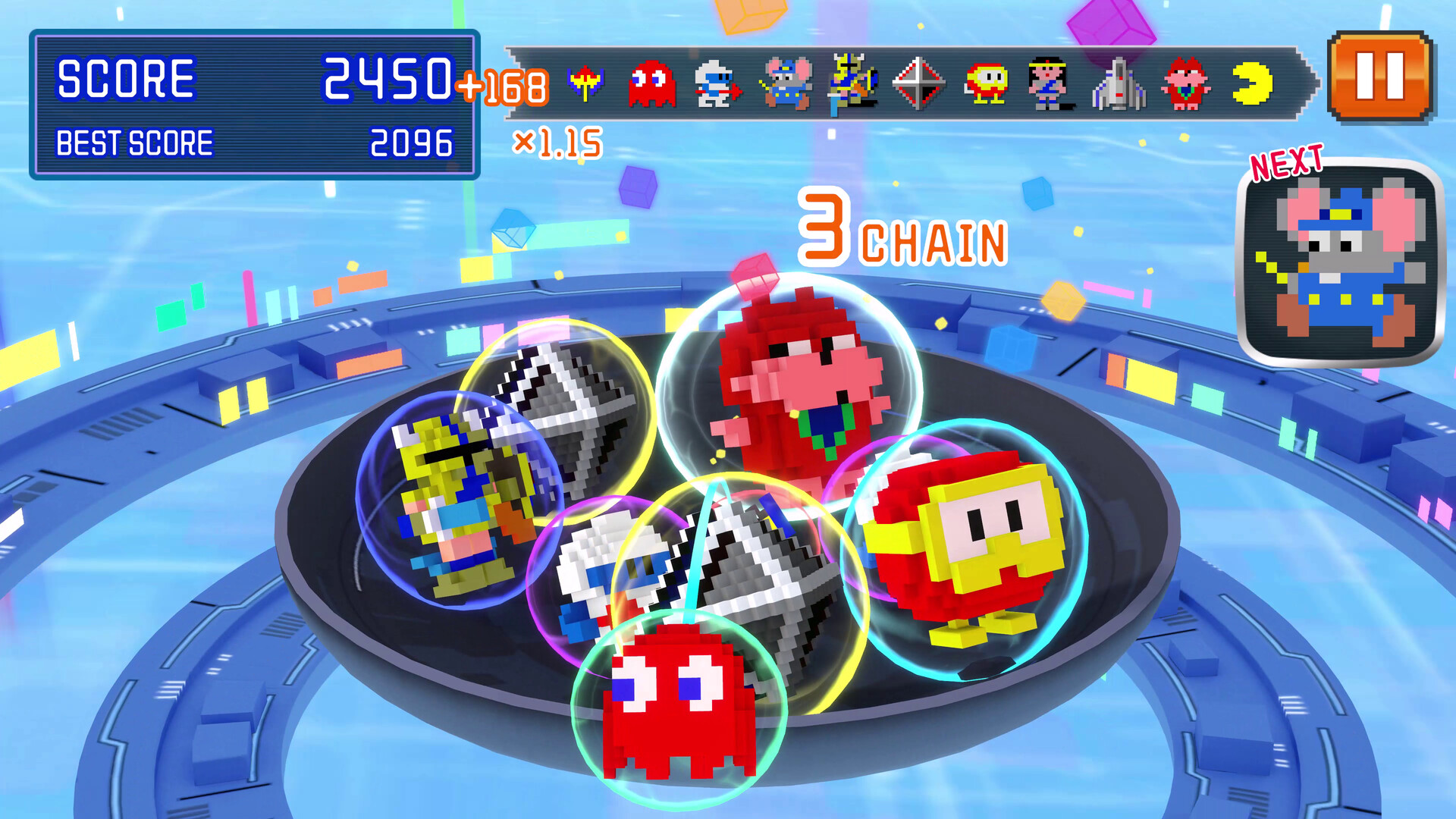
Namco Legendary Mountains operates on the fundamental principles of the "Suika" or "Watermelon Game" subgenre, where players drop objects into a container to match identical items, causing them to merge into larger, more complex forms. However, Bexide distinguishes this title by utilizing the three-dimensional physics engine first introduced in their 2024 hit, Fruit Mountain. Unlike 2D variants that restrict movement to a horizontal axis at the top of the screen, Namco Legendary Mountains utilizes a 3D space centered around a circular black plate.
Players are tasked with tossing clear bubbles containing classic Namco icons onto the plate. The game introduces a layer of tactical depth by allowing players to navigate around the edges of the play area, shooting items from various angles and trajectories. This 360-degree approach requires a sophisticated understanding of momentum, friction, and spatial management. When two identical icons collide, they undergo a "Legendary Synthesis," transforming into a character from a different Namco franchise.
The official trailer illustrates this progression with several of the company’s most recognizable figures. For instance, combining two Pac-Man icons results in the creation of Taizo Hori, the protagonist of the 1982 arcade classic Dig Dug. If two Taizo Hori icons are successfully merged, they evolve into Mappy, the micro-police mouse. The progression continues through a lineage of gaming history, with confirmed appearances of items and characters from The Tower of Druaga and the seminal vertical-scrolling shooter Xevious. The ultimate goal is to manage the mounting pile of icons without allowing any to fall off the central plate or exceed the play boundaries, all while striving for the highest possible score through chain reactions.
The Chronology of Bexide’s Mountain Series
The announcement of Namco Legendary Mountains represents the fourth major installment in Bexide’s physics-puzzle ecosystem. The studio’s trajectory in this space began in March 2024 with the release of Fruit Mountain. That title served as a proof of concept for the 3D "stacking" mechanic, moving away from the flat, container-based limits of traditional Suika-style games and toward an open-platform physics model.
Following the success of Fruit Mountain, Bexide capitalized on the growing intersection of gaming and digital creator culture by releasing Hololive Treasure Mountain. This version featured VTubers from the massive Hololive production agency, replacing fruit with stylized character heads and thematic items. The collaboration proved to be a significant driver of visibility for the studio, as streamers across the globe showcased the game to millions of viewers.
In April 2026, Bexide expanded the franchise’s technical capabilities with Fruit Mountain Party, which introduced multiplayer functionality and competitive modes. This evolution paved the way for Namco Legendary Mountains, which seeks to combine the refined 3D mechanics of its predecessors with the broad market appeal of legacy gaming brands. By securing the rights to use Bandai Namco’s "Legendary" IP, Bexide is positioning itself as a premier developer of licensed puzzle content in the mid-tier market.
Strategic Significance of BitSummit PUNCH
Before the game’s global release in the summer of 2026, Namco Legendary Mountains will be showcased at the Kyoto BitSummit PUNCH, held between May 22 and May 24, 2026. BitSummit has long been regarded as Japan’s leading independent game festival, serving as a critical launchpad for titles that blend traditional Japanese game design with innovative mechanical hooks.
The appearance at BitSummit is a strategic move for Bexide, allowing for hands-on feedback from a dedicated community of enthusiasts and industry professionals. For Bandai Namco, the showcase serves as a testament to the company’s willingness to license its classic "back catalog" to smaller, specialized studios that can reinterpret 40-year-old characters for a modern, casual audience. Analysts suggest that this partnership reflects a broader trend in the Japanese industry where major publishers leverage their legacy assets to maintain brand relevance across various demographic segments, particularly the "hyper-casual" and "puzzle" markets.
Hardware Transition and the Switch 2
One of the most notable aspects of the Namco Legendary Mountains announcement is its confirmed support for the "Switch 2." While Nintendo has remained tight-lipped regarding the specific technical specifications of its next-generation hardware, Bexide’s commitment to a dual-generation release on both the original Switch and its successor indicates a shift in the development landscape for 2026.
The inclusion of the Switch 2 as a launch platform suggests that Namco Legendary Mountains may feature enhanced performance metrics on the newer hardware, such as higher frame rates for more fluid physics calculations or improved texture resolution for the iconic character models. For PC players, the game is expected to support a wide range of configurations, ensuring that the physics engine remains stable even as the "mountain" of Namco characters grows increasingly complex and resource-intensive.
The Legacy of Bandai Namco Icons
The selection of characters for Namco Legendary Mountains acts as a curated tour of the "Golden Age" of arcades. By using Pac-Man as the entry-level icon, Bexide taps into the most recognizable brand in gaming history. The inclusion of Dig Dug and Mappy further reinforces the retro aesthetic, while deeper cuts like Xevious and The Tower of Druaga appeal to veteran gamers who hold the Namco System 1 and System 2 eras in high regard.
The Tower of Druaga, in particular, holds a legendary status in Japan as a pioneer of the action-RPG genre. Its inclusion suggests that the "Legendary" moniker in the game’s title is not merely marketing fluff but a deliberate nod to the titles that defined the Namco brand before its merger with Bandai. The challenge for Bexide lies in balancing the sizes and physics properties of these diverse characters—ensuring that a pixel-perfect Xevious ship interacts realistically with a spherical Pac-Man.
Market Analysis and Broader Implications
The rise of the "Suika-like" genre has been one of the most unexpected trends in the mid-2020s. What began as a simple browser and mobile distraction evolved into a dominant force on the Nintendo eShop. Bexide’s innovation was to take the core satisfaction of "merging" and translate it into a 3D space, which adds a layer of unpredictability and "emergent gameplay" that 2D versions lack.
Namco Legendary Mountains is poised to capitalize on three distinct market forces:
- The Nostalgia Economy: The continued demand for retro-themed content among older gamers and the curiosity of younger players toward "classic" aesthetics.
- The Physics Puzzle Craze: The enduring popularity of games that are easy to pick up but difficult to master, characterized by high "replayability" and viral potential on social media platforms like TikTok and YouTube.
- Cross-Platform Accessibility: By launching on PC and both generations of Nintendo hardware, Bexide ensures the widest possible "top-of-funnel" for potential players.
From a business perspective, the collaboration between Bexide and Bandai Namco serves as a blueprint for how legacy IP can be revitalized without the need for high-budget remakes or sequels. By placing these characters in a popular puzzle format, the IP remains active in the public consciousness, potentially driving interest in separate Namco Museum collections or future standalone entries in the respective franchises.
Conclusion and Future Outlook
As the gaming industry moves toward the mid-point of the decade, titles like Namco Legendary Mountains highlight the importance of mechanical refinement and brand synergy. Bexide has successfully carved out a niche for itself with the "Mountain" series, and by integrating the "Legendary" Namco roster, they are set to elevate the physics-puzzle genre to its most visible platform yet.
With the worldwide release set for Summer 2026, the upcoming showcase at BitSummit PUNCH will be the first true test of how these classic characters handle the jump into a 3D physics environment. Whether it is the tactical positioning of a Mappy bubble or the satisfying clatter of a Xevious ship hitting the plate, Namco Legendary Mountains promises to be a definitive entry in the puzzle genre, bridging the gap between gaming’s storied past and its multi-platform future.