Jia Lissa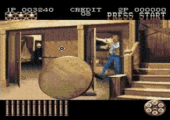
Lethal Enforcers II: Gun Fighters represents a significant milestone in the evolution of the light gun genre, serving as the 1994 sequel to Konami’s groundbreaking arcade hit, Lethal Enforcers. While the original title immersed players in a contemporary urban setting of high-stakes police procedural action, the sequel pivoted sharply to the American Old West of 1873. This transition was not merely cosmetic; it reflected a broader trend in mid-90s gaming toward historical and thematic experimentation. Released for both the Sega Genesis and the Sega CD, the latter version leveraged the storage capacity of compact discs to offer an experience that aimed to mirror the high-fidelity audio of the arcade original. Despite the shift in scenery, the core mechanical DNA remained intact: a reflex-driven test of precision where players must neutralize threats while exercising restraint toward innocent bystanders.
Historical Context and Development
The early 1990s were a period of intense scrutiny for the video game industry, particularly regarding realistic depictions of violence. The original Lethal Enforcers was a central figure in the 1993 Congressional hearings on video games, alongside titles like Mortal Kombat and Night Trap. Its use of digitized photographs of real actors and weapons drew the ire of lawmakers, eventually contributing to the formation of the Entertainment Software Rating Board (ESRB). Interestingly, while the first game carried a more restrictive MA-17 rating on Sega’s internal rating system, Lethal Enforcers II: Gun Fighters was granted an MA-13 rating. This shift was largely attributed to the change in setting; the historical context of the Old West was perceived as more "theatrical" and less "gritty" than the modern-day inner-city violence depicted in its predecessor.
Konami’s development team focused on refining the "Digitized Sprite" technology that had become their signature style. By photographing actors in period-accurate costumes and digitizing them into 16-bit environments, they created a visual style that was highly distinct from the hand-drawn or pixel-art aesthetics of the era. On the Sega CD platform, this was augmented by the ability to stream high-quality audio directly from the disc, providing a level of immersion that the standard Genesis cartridge struggled to match.
Hardware Requirements and Peripheral Support
To experience Lethal Enforcers II: Gun Fighters as intended, players in 1994 were encouraged to use the Konami Justifier. This light gun peripheral, often bundled with the first game or sold separately in a striking blue (Player 1) or pink (Player 2) plastic, was designed to mimic the feel of a service revolver. From a technical standpoint, the Justifier relied on the timing of the cathode-ray tube (CRT) television’s electron beam. As the beam scanned the screen, the light gun’s photodiode would detect the burst of light, allowing the console to calculate the exact coordinates of the shot.
This reliance on legacy technology means that modern players using LED, LCD, or OLED displays cannot use the Justifier, as these screens do not utilize the same scanning process. While the game supports a standard Genesis D-pad controller, the difficulty curve increases exponentially. The speed at which enemies appear on screen—often from multiple elevations and corners simultaneously—makes the slow movement of a screen reticle a significant disadvantage. In a professional gaming context, the Justifier is considered the "native" way to engage with the title, offering the necessary responsiveness to survive the game’s later stages.
Chronology of Gameplay: The Five Stages of 1873
The narrative structure of Lethal Enforcers II: Gun Fighters is divided into five distinct stages, each recreating a classic trope of Western cinema.
Stage 1: The Bank Robbery
The game opens with a high-stakes heist in progress. Players are tasked with clearing out a local bank occupied by a gang of outlaws. This stage serves as an introductory tutorial, teaching players to distinguish between "bandits" and "innocents." The stage culminates in a confrontation with a boss stationed in a reinforced covered wagon equipped with three cannons. This encounter introduces a "multitasking" mechanic where the player must shoot incoming projectiles (cannonballs) while simultaneously chipping away at the boss’s health bar.
Stage 2: Stagecoach Pursuit
The action moves to the open trail, where players defend a stagecoach under heavy fire. This stage increases the complexity by introducing high-speed movement; most enemies are mounted on horseback, requiring the player to lead their shots. The boss encounter features an antagonist who hurls barrels at the player, a mechanical nod to early arcade classics like Donkey Kong, albeit with a lethal firearm twist. Following this stage, the player enters the first bonus round: a saloon-based target gallery where shooting bottles and sliding drinks earns extra points and life recovery.
Stage 3: The Saloon Shootout
Returning to a more static but cluttered environment, the saloon stage is a test of rapid identification. Enemies hide behind bars, banisters, and piano players. This level introduces a variety of weapon types among the enemies, including knife-throwers and hatchet-wielding bandits. The climax of the stage is a "Quick Draw" duel, a classic Western standoff where timing is everything. Players must wait for the prompt to fire, simulating the tension of a midday street duel.
Stage 4: The Great Train Robbery
Set aboard a moving locomotive, this stage requires players to fight their way from the caboose to the engine. The environment is narrow, forcing more vertical movement of the light gun. The boss is a "demolitions expert" who utilizes dynamite. Precision is paramount here, as shooting the dynamite mid-air is the only way to prevent taking damage. A second bonus stage follows, focusing on high-altitude bottle tossing to test vertical tracking.
Stage 5: The OK Mine Company
The final stage takes players into the depths of a gold mine. This level takes a sudden turn toward the supernatural, a common trope in Konami’s 90s output. The final antagonist summons skeletal warriors—undead miners who throw their own heads and knives at the player. This stage is notorious for its difficulty, as the skeletal minions act as "bullet sponges" or distractions, while the boss remains the only target that actually depletes the stage’s progress meter.
Technical Analysis: Audio and Visual Performance
The Sega CD version of Lethal Enforcers II: Gun Fighters is often cited as the definitive home console port of the era. The primary differentiator is the audio. Utilizing Redbook CD audio, Konami included a full orchestral-style soundtrack and high-fidelity voice samples. In the Genesis cartridge version, voice lines like "Get the bad guys!" or "Reload! Reload!" often sounded muffled due to the limited ROM space for samples. On the Sega CD, these calls are crisp, providing better situational awareness for the player.
Visually, the game faces the inherent limitations of the Sega hardware. The Genesis/Sega CD architecture possessed a limited color palette of 512 colors, with only 64 available on-screen at once. This results in a somewhat "grainy" or "dithered" look for the digitized actors compared to the arcade’s much deeper color depth. However, the frame rate remains remarkably stable, even during the chaotic Stage 2 horse chases, ensuring that the gameplay remains fair and predictable.
Scoring, Accuracy, and Ranking Systems
Unlike the first game, which enforced a strict minimum accuracy percentage to progress between levels, Lethal Enforcers II: Gun Fighters allows players to continue regardless of their performance, provided they have remaining credits. To compensate for this, the enemies are significantly more aggressive. The "draw time"—the window between an enemy appearing and them firing—is noticeably shorter than in the previous title.
At the conclusion of the game, players are ranked based on their accuracy and their "Innocent Victim" count. The hierarchy is as follows:
- 90% or above: U.S. Marshal
- 80-89%: Deputy Marshal
- 70-79%: Sheriff
- 60-69%: Deputy
- 59% and under: Posse
This ranking system provided significant replay value for the home market, as players sought to achieve the U.S. Marshal rank. The inclusion of nine continues (up from five in the original) balanced the increased difficulty, making the game more accessible to casual players while still rewarding high-level precision.
Legacy and Impact on the Genre
Lethal Enforcers II: Gun Fighters stands as one of the final "pure" 2D digitized light gun games before the industry transitioned to 3D polygonal graphics with titles like Virtua Cop and Time Crisis. Its contribution to the Sega CD library is particularly noteworthy, as it remains one of the few titles that effectively utilized the hardware’s audio capabilities without relying on grainy Full-Motion Video (FMV) which plagued many other Sega CD games.
In the broader context of gaming history, the title remains a testament to Konami’s dominance in the arcade-to-home port market during the 1990s. It successfully captured the "quarter-munching" intensity of the arcade while offering enough home-exclusive refinements to justify its place in a collector’s library. While the light gun genre has largely migrated to VR or specialized arcade cabinets in the modern era, Lethal Enforcers II: Gun Fighters remains a definitive example of the 16-bit era’s technical ambitions and the timeless appeal of the Western frontier.