Indra Gunadi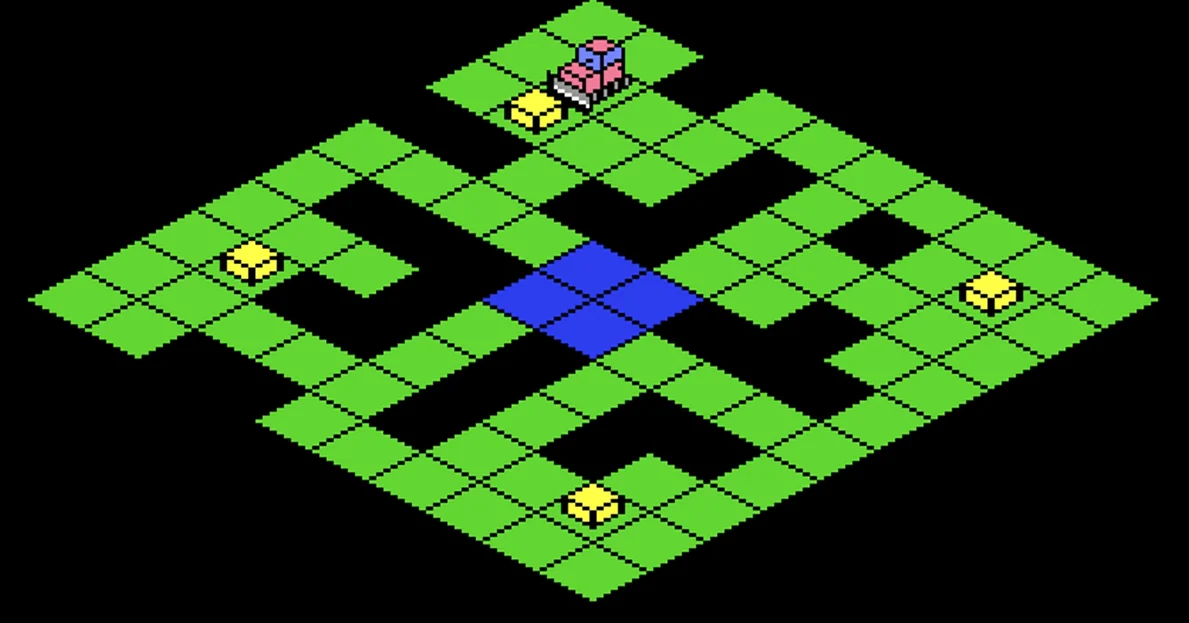
A Deep Dive into Isosokoban: Gameplay and Innovation
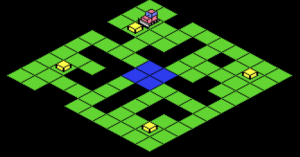
At its core, Isosokoban builds upon the established mechanics of Sokoban, a Japanese puzzle game first introduced in 1981, where a warehouse keeper must push crates to designated storage locations within a confined grid. The elegance of Sokoban lies in its deceptive simplicity: crates can only be pushed, never pulled, and only one crate can be moved at a time, often leading to complex sequences of moves required to achieve the objective. The "isometric view" heralded in Isosokoban, however, is where the game truly distinguishes itself. Unlike traditional top-down or orthogonal perspectives common in many Sokoban implementations, the isometric projection adds a third dimension to the visual representation, creating an illusion of depth and spatial complexity. This not only enhances the game’s aesthetic appeal on the Commodore 64’s 8-bit graphics capabilities but also subtly alters the player’s perception of the puzzle space, potentially requiring a different approach to spatial reasoning and planning. The shift in perspective can make pathways and potential blockages appear differently, adding an extra layer of cognitive challenge to the already intricate puzzle designs.
The sheer volume of content—over 200 levels—is a remarkable feat for any puzzle game, let alone one developed for an 8-bit platform with inherent memory and processing constraints. Such an extensive level count suggests a deep commitment to providing enduring replayability and a progressively challenging experience. Designing over 200 unique, solvable, and engaging Sokoban puzzles is a monumental task, demanding a blend of mathematical precision, creative ingenuity, and a thorough understanding of puzzle design principles. Each level must introduce new obstacles, require novel strategies, and avoid repetition, all while maintaining a consistent difficulty curve that gradually escalates. The collaboration between Armin Kielack on the coding front and Elena Kielack on the musical composition highlights a holistic approach to game development, where gameplay, visuals, and audio converge to create a cohesive and immersive experience within the technical limitations of the Commodore 64.
The Rigor of Development: Ensuring a Frustration-Free Experience
One of the most critical aspects highlighted by the developers of Isosokoban is the meticulous testing phase. The statement that "The huge amount of levels were tested by different people, to make sure every level has a solution and the game doesn’t end up in frustration" speaks volumes about the project’s dedication to player experience. In puzzle games, particularly those with intricate mechanics like Sokoban, the presence of an unsolvable level or a progression-halting bug can be devastating to player morale and lead to abandonment of the game. For a title boasting over 200 levels, the complexity of ensuring solvability for each one is multiplied. This testing process likely involved a diverse group of testers, each approaching the puzzles with different problem-solving styles, thereby increasing the likelihood of identifying potential pitfalls or unintended dead ends.
The importance of such rigorous quality assurance cannot be overstated in the realm of puzzle game development. It prevents what is often termed "player frustration," which arises when a game’s design leads to perceived unfairness or insurmountable obstacles rather than engaging challenges. The iterative nature of this testing—identifying an issue, modifying the level design or code, and retesting—is a time-consuming but essential component of creating a high-quality product. For games released on retro platforms, where post-release patches might be more complex or less accessible to the entire user base, getting it right the first time is even more paramount. This commitment to a frustration-free experience reflects a deep respect for the players and an understanding that true enjoyment in puzzle games stems from overcoming well-designed challenges, not from battling against design flaws.
The Enduring Legacy of the Commodore 64
The release of Isosokoban is not merely a new game; it is a vibrant testament to the enduring legacy of the Commodore 64. Launched in August 1982, the C64 quickly rose to prominence, becoming the best-selling single computer model of all time, with estimated sales ranging from 17 to 22 million units worldwide. Its success was largely attributed to its competitive pricing, advanced graphics (including hardware sprites and scroll capabilities), and a powerful sound chip (the MOS Technology SID 6581/8580), which allowed for unprecedented audio experiences on a home computer of its era. For millions, the C64 was their first introduction to computing, programming, and, crucially, video games. It fostered a generation of enthusiasts, developers, and artists, many of whom continue to celebrate and create for the platform decades later.
Even today, nearly four decades after its debut, the C64 maintains a remarkably active and passionate community. This includes collectors, hardware modders, software archivists, and, significantly, a vibrant demoscene and homebrew development community. New games, utilities, and even operating systems are still being created for the machine, pushing its capabilities in ways that were unimaginable during its commercial heyday. Isosokoban fits perfectly into this modern retro movement, demonstrating that the C64 is far from a mere museum piece. Instead, it remains a viable and inspiring platform for creative expression, proving that great gameplay and innovative design transcend technological obsolescence. The continued development for the C64 highlights a unique symbiotic relationship between nostalgia and innovation, where developers honor the past by building new futures on classic foundations.
Poland’s Role in Retro Computing and Gaming Development
The declaration "fresh from Poland!" for Isosokoban underscores the significant contributions of Polish developers and enthusiasts to the global retro computing and gaming scene. Poland has a particularly rich history with 8-bit computers, including the Commodore 64, Atari, and ZX Spectrum, largely due to historical and economic factors that shaped technology adoption in the region during the late 20th century. This history fostered a deep-seated appreciation for these machines and cultivated a highly skilled community of programmers, graphic artists, and musicians who pushed the boundaries of what was possible on limited hardware.
The Polish demoscene, in particular, has long been renowned for its technical prowess and artistic creativity, producing breathtaking audio-visual demonstrations that often extracted every ounce of power from 8-bit and 16-bit systems. This culture of technical excellence and creative problem-solving has naturally extended into the homebrew game development arena. Polish developers are frequently at the forefront of creating new, high-quality titles for retro platforms, often characterized by innovative concepts, robust coding, and attention to detail. The Kielacks’ contribution with Isosokoban is a continuation of this proud tradition, showcasing the ingenuity and passion that defines the Polish retro computing community and solidifies its reputation as a hub for cutting-edge retro development.
The Modern Retro Gaming Renaissance
The release of Isosokoban is emblematic of a broader phenomenon: the modern retro gaming renaissance. This resurgence of interest in classic video games and vintage hardware is driven by multiple factors. For many, it’s a powerful wave of nostalgia, a desire to revisit the games and experiences of their youth. For others, particularly younger generations, it’s an appreciation for the foundational principles of game design, the elegant simplicity, and the often-challenging gameplay that defined early titles. There’s also a growing recognition of the artistic and historical significance of these early digital artifacts, leading to preservation efforts and a scholarly interest in their evolution.
The ecosystem supporting this renaissance is multifaceted. Emulation software allows games from decades past to be played on modern computers and devices. Flash cartridges and FPGA-based hardware provide ways to play original games on original hardware with enhanced convenience. Online communities, forums, and events dedicated to retro gaming thrive globally. Platforms like itch.io, where Isosokoban is hosted, have become crucial digital storefronts for independent developers, including those working on retro platforms. These platforms offer an accessible avenue for creators to distribute their work to a global audience without the traditional barriers of publishing. The development of entirely new games for old systems, such as Isosokoban, is perhaps the most exciting facet of this renaissance, proving that these machines are not just relics to be admired but active canvases for contemporary creativity.
Developer Insights and Creative Vision (Inferred)
While direct statements from Armin and Elena Kielack regarding their creative process for Isosokoban are not explicitly provided in the initial announcement, several inferences can be made about their motivations and vision. Developing a game for the Commodore 64 in the 21st century is rarely a commercial decision driven by vast profit margins; rather, it is almost invariably a passion project. The Kielacks likely share a deep affection for the C64, appreciating its unique hardware quirks and its place in computing history. Their decision to tackle an isometric Sokoban puzzle suggests a desire to innovate within a familiar genre, pushing the graphical and spatial capabilities of the C64 beyond common expectations for an 8-bit puzzle game.
For Armin Kielack, the challenge of coding for the C64 would have involved navigating its limited memory (64 KB RAM), relatively slow CPU (MOS 6510), and specific programming paradigms. Optimizing graphics routines for the VIC-II chip to render an isometric view efficiently, managing sprite multiplexing, and ensuring smooth gameplay within these constraints requires significant technical skill and an intimate understanding of the hardware. Elena Kielack’s work on the music for the SID chip would have presented its own set of creative and technical challenges. The SID chip is renowned for its distinctive, powerful sound, but composing for it requires a specialized approach, often involving tracking software and a deep appreciation for its unique synthesis capabilities. Together, their collaboration likely represents a harmonious blend of technical expertise and artistic vision, aimed at delivering a game that not only functions flawlessly but also provides an engaging audio-visual experience on the venerable C64.
The Broader Implications for the C64 Community
The release of a high-quality, substantial title like Isosokoban carries significant implications for the Commodore 64 community. Firstly, it injects new life and fresh content into a platform that officially ceased production decades ago. This continuous flow of new software ensures that the C64 remains a dynamic and relevant system, rather than just a historical artifact. It provides long-time enthusiasts with new challenges and experiences, rekindling their passion for the machine. Secondly, such releases serve as powerful demonstrations of what is still possible on the C64, inspiring other aspiring developers and hobbyists within the community to embark on their own projects. It fosters a culture of innovation and shared learning, where knowledge and techniques are exchanged to push the boundaries of the hardware.
Furthermore, new releases help to attract new blood to the retro computing scene. Younger individuals who might be curious about the origins of gaming can discover that these older platforms are not static, but living ecosystems with ongoing creative output. This ensures the longevity and continued growth of the C64 community, helping to preserve its history and evolve its future. The positive reception and discussion surrounding games like Isosokoban also contribute to the overall visibility and appreciation of retro computing in the wider technological landscape, demonstrating that value and enjoyment are not solely tied to the latest advancements but can be found in the enduring appeal of classic design and dedicated craftsmanship.
Accessibility and Distribution in the Digital Age
The distribution method for Isosokoban, hosted on itch.io, highlights a crucial aspect of modern retro game development: accessibility. The URL provided, https://kielack.itch.io/isometric-sokoban, points to a platform that has become a vital hub for independent game developers, particularly those operating outside mainstream commercial channels. Itch.io offers an easy-to-use interface for developers to upload their creations and for players to discover and acquire games, often with flexible pricing models including "pay what you want." This contrasts sharply with the original distribution model for C64 games, which relied on physical media like cassette tapes and floppy disks, sold through retail stores or mail order.
The digital availability of Isosokoban means that it can be instantly accessed by anyone with an internet connection, regardless of their geographical location. Players can download disk images to be used with C64 emulators on modern computers, or load them onto modern storage solutions like SD card-based flash cartridges for use with original hardware. This ease of access significantly broadens the potential audience for retro games, making it simpler for both seasoned veterans and curious newcomers to experience new titles for classic systems. It also provides developers with a direct channel to their audience, fostering a more intimate relationship between creators and players. This modern distribution infrastructure is an indispensable component of the ongoing retro gaming renaissance, ensuring that the fruits of passionate development can reach the hands of enthusiasts worldwide.
In conclusion, Isosokoban’s arrival on the Commodore 64 is far more than just another puzzle game release. It is a powerful affirmation of the C64’s enduring appeal, a showcase of dedicated craftsmanship from Polish developers Armin and Elena Kielack, and a shining example of the innovation thriving within the global retro gaming community. With its distinctive isometric perspective, challenging gameplay across 200 meticulously tested levels, and commitment to player enjoyment, Isosokoban represents a significant contribution to the C64’s continually expanding library. Its release underscores the vibrant spirit of creation that persists for these classic machines, reinforcing their status not merely as nostalgic artifacts, but as active and inspiring platforms for contemporary creativity.