Farhan hamdan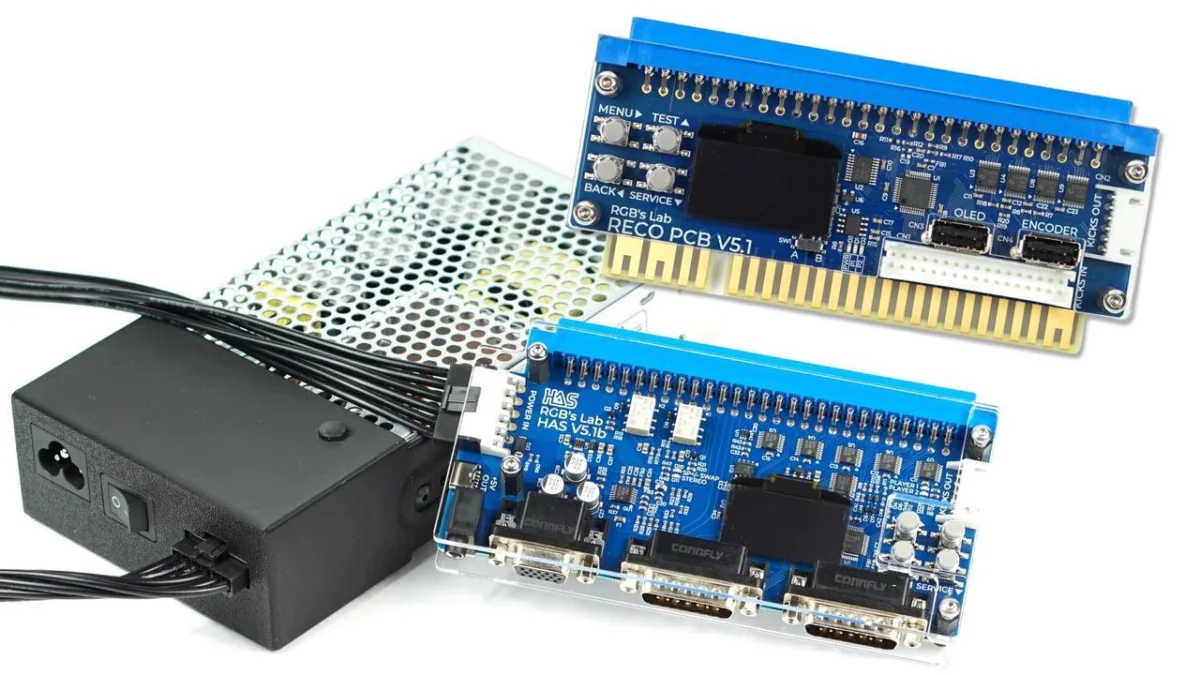
The highly anticipated restock of the Home Arcade Supergun (HAS) in its latest V5.1 iteration, alongside an updated version of the RECO, has been officially announced, signaling renewed availability for enthusiasts seeking to bridge the gap between vintage arcade hardware and modern home entertainment setups. Widely acclaimed within the retro gaming community, the HAS is consistently ranked among the most sophisticated and feature-rich superguns available, offering unparalleled control and video fidelity for original arcade game boards (PCBs). Its companion, the RECO, provides a specialized controller circuit designed for seamless integration into existing JAMMA arcade systems, extending the advanced functionality of the HAS to a broader range of setups. This replenishment addresses significant demand, with nearly all associated accessories also back in stock, creating a comprehensive offering for both seasoned collectors and new entrants to the world of authentic arcade gaming.
The Enduring Appeal of Arcade Hardware and the Rise of Superguns
To understand the significance of devices like the HAS and RECO, one must first appreciate the historical trajectory of arcade gaming and its enduring cultural impact. The golden age of arcades, spanning from the late 1970s through the 1990s, cemented the arcade cabinet as a cultural icon and the ultimate platform for cutting-edge interactive entertainment. Titles like Pac-Man, Street Fighter II, and Metal Slug captivated millions, fostering a unique social gaming environment distinct from the nascent home console market. However, with the proliferation of increasingly powerful home consoles and the economic shifts of the late 20th century, dedicated arcade establishments began a gradual decline.
Despite this decline, a dedicated community of enthusiasts and collectors emerged, driven by a desire to preserve and experience these seminal games in their original, uncompromised form. Playing original arcade PCBs offers an authenticity that emulation, while convenient, often struggles to replicate entirely. This authenticity extends beyond visual and audio fidelity to the tactile experience of playing on genuine hardware, with the precise timing and unique characteristics inherent to the original circuitry.
The challenge for these collectors, however, lay in adapting these industrial-grade game boards, designed for large, dedicated cabinets, to a home environment. Arcade PCBs operate on specific power requirements and output video signals in formats not directly compatible with standard home televisions or monitors. This is where the "supergun" emerged as an ingenious solution. A supergun is essentially an adapter that provides the necessary power, converts arcade controls to a home joystick/gamepad interface, and routes video and audio signals from the JAMMA (Japan Amusement Machine and Marketing Association) standard connector – the industry standard for most arcade boards from the mid-1980s onwards – to a home display. Early superguns were often rudimentary, DIY affairs, but over time, they evolved into sophisticated, professionally engineered devices, with the HAS standing as a prime example of this evolution.
The Home Arcade Supergun (HAS) V5.1: Precision and Performance
The Home Arcade Supergun (HAS) V5.1 represents the pinnacle of supergun design, integrating advanced features that cater to the exacting standards of retro gaming aficionados. At its core, the HAS facilitates the connection of a JAMMA-standard arcade PCB to a domestic display and controller setup. The V5.1 revision builds upon a legacy of continuous improvement, incorporating refinements that enhance performance, usability, and safety.
One of the HAS’s most celebrated attributes is its comprehensive suite of controller options. Beyond basic input, the device offers programmable buttons, rapid-fire functionality, and the ability to remap controls. These features are not merely conveniences; they significantly enhance gameplay, particularly for genres like shoot ’em ups (shmups) where rapid-fire is crucial for competitive play, or fighting games where custom button layouts can provide a tactical advantage. The programmability ensures that players can tailor their experience precisely to their preferences and the demands of specific games, a level of customization rarely found in standard consumer gamepads.
Video output is another critical area where the HAS excels. The unit features an HD-15 (VGA-style) port that outputs RGBs (Red, Green, Blue, Sync) signals. RGBs is the gold standard for video fidelity in retro gaming, providing a much cleaner, sharper image compared to composite or S-Video, especially when displayed on a Cathode Ray Tube (CRT) monitor or television. The HAS’s robust video output capabilities ensure that the vibrant colors and intricate pixel art of classic arcade games are rendered with maximum clarity and accuracy. For users with PAL (Phase Alternating Line) CRTs, a newly available SCART cable can be purchased directly from the same vendor, offering integrated power. Furthermore, compatibility extends to existing solutions like the RetroTINK HD15 to SCART cable or the HD15-to-SCART dongle, although these might not provide integrated power for PAL CRTs. This flexibility in video output options underscores the HAS’s commitment to supporting diverse display setups, from authentic CRT experiences to modern upscalers like the RetroTINK-5X Pro or OSSC, which can convert the RGBs signal for high-definition displays.
Safety and stability are paramount when dealing with vintage electronics, and the HAS V5.1 incorporates robust design principles to protect valuable PCBs. While it ships with settings in the safest default positions—particularly concerning sync, audio, and RGB video voltage—the manufacturer strongly advises users to consult the detailed instruction manual before connection. This emphasis on user education highlights a commitment to preventing potential damage from incorrect configurations. The manual provides crucial information on proper wiring, voltage adjustments, and general best practices, ensuring that even complex setups can be managed safely.
The RECO: Empowering Existing Arcade Setups
Complementing the HAS is the RECO, a specialized "controller circuit" designed to integrate directly into the JAMMA harness of an existing arcade setup. The RECO essentially extracts the advanced controller functionalities of the HAS—including rapid-fire, programmable buttons, and remapping—and makes them available to users who already own an arcade cabinet or another supergun but desire these enhanced control options.

This standalone design makes the RECO an invaluable upgrade for a specific segment of the retro gaming community. Owners of original arcade cabinets can install the RECO inline with their JAMMA harness to elevate their gameplay experience without altering the core structure of their cabinet. Similarly, users of simpler superguns can augment their existing setups, effectively adding the sophisticated control layer of the HAS without needing to purchase an entirely new supergun unit. The RECO democratizes access to advanced controller features, allowing a wider array of enthusiasts to benefit from the innovations developed for the HAS platform.
Supply Chain and Market Dynamics
The current restock of the HAS V5.1 and RECO is indicative of a robust and growing niche market for retro arcade hardware. Products of this caliber are often manufactured in smaller batches, reflecting the specialized nature of the demand. The recurring pattern of stock depletion followed by highly anticipated replenishments points to consistent high demand within the retro gaming community. This market is characterized by discerning consumers who prioritize quality, authenticity, and technical precision.
The sales model, primarily direct-to-consumer through dedicated platforms like retrorgb.link/has, allows for a close relationship between developers and end-users. This direct channel facilitates rapid feedback loops, enabling continuous product refinement and ensuring that subsequent revisions, such as the V5.1, directly address community needs and incorporate technological advancements.
Essential Accessories and Power Solutions
A complete HAS setup requires several critical components beyond the supergun itself. The availability of accessories such as JAMMA harnesses, custom enclosures, and power supply covers ensures that users can assemble a fully functional and aesthetically pleasing system. These accessories are designed to integrate seamlessly with the HAS, providing both protection and structural integrity.
Crucially, users must acquire a power supply separately. The HAS is designed to operate with specific, reliable industrial power supplies, namely the Mean Well RT-65A, RT-85A, or RT-125A models. These power supplies are essential for providing the correct voltage and amperage to the arcade PCBs, which typically require +5V, +12V, and sometimes -5V. The explicit warning to match the exact model numbers (e.g., RT-65A, not RT-65B) underscores the critical importance of electrical compatibility and safety. Using an incorrect or substandard power supply can lead to unstable operation, poor video quality, or, in the worst-case scenario, permanent damage to valuable arcade PCBs. The links provided direct users to verified Amazon listings for these specific Mean Well units, simplifying the procurement process while emphasizing caution.
The Imperative of Safety and Technical Proficiency
The developer’s strong recommendation to thoroughly read the HAS instruction manual before connecting any components is not merely a formality but a critical safety directive. While the HAS ships with all settings in the safest default positions, particularly for sync, audio, and RGB video voltage, the complexity of arcade hardware necessitates a cautious approach. Misconfigurations, even seemingly minor ones, can lead to irreversible damage to sensitive vintage PCBs or connected display equipment.
Beyond the manual, the suggestion that "every supergun owner should learn how to test themselves with a cheap scope" highlights a proactive approach to maintaining and troubleshooting arcade setups. An oscilloscope is a diagnostic tool that allows users to visualize electrical signals, making it possible to verify proper voltage levels, check sync signals, and identify potential issues before they cause damage. While not mandatory for basic operation, this recommendation speaks to a broader ethos within the retro arcade community: fostering technical literacy and self-sufficiency among enthusiasts. This level of engagement ensures not only the longevity of the equipment but also a deeper understanding and appreciation for the intricacies of arcade technology.
Broader Implications for Retro Gaming Preservation
The continued development and availability of high-quality devices like the HAS and RECO have significant implications for the broader retro gaming preservation movement. By providing reliable, accessible, and feature-rich solutions for playing original arcade PCBs at home, these products contribute directly to the longevity of arcade hardware. They empower collectors to safely enjoy their acquisitions, fostering an environment where original boards are not merely static display pieces but actively playable artifacts.
The attention to detail in the HAS, from its robust video output to its advanced controller options and comprehensive safety guidelines, sets a high bar for the industry. It demonstrates that passion for retro gaming can coexist with professional engineering and a commitment to user safety. As the retro gaming market continues to expand, driven by nostalgia, historical appreciation, and the inherent quality of classic titles, products like the Home Arcade Supergun and RECO will remain indispensable tools for ensuring that the golden age of arcades continues to be celebrated and experienced in its most authentic form for generations to come. The current restock is more than just a commercial event; it is a reaffirmation of the vitality and dedication within a unique and passionate segment of the gaming world.