
 Jia Lissa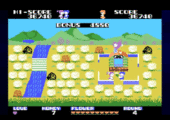
The game places players in the role of Papri, a young girl on a mission to win the affection of her crush, Minto. The central conflict is driven by a romantic rivalry: Minto is also being pursued by another girl named Cocco. To secure Minto’s heart, Papri must navigate a series of hazardous environments to collect a bouquet of ten flowers before Minto reaches Cocco at the opposite end of the screen. This narrative framework serves as a creative replacement for a traditional timer, grounding the gameplay loop in a relatable, if simplified, emotional context.
Technical Specifications and Hardware Context
To understand the achievement of Girl’s Garden, one must examine the technical limitations of the SG-1000 hardware. The system was built around the Zilog Z80A CPU running at 3.58 MHz and utilized the Texas Instruments TMS9918A video display processor. This specific video chip was common in the era, also powering the ColecoVision and MSX1 computers. It supported a palette of 15 colors plus a "transparent" layer, but it faced a significant limitation: it could only display a maximum of four sprites on a single horizontal scanline before flickering occurred. Furthermore, the hardware lacked a dedicated scrolling register, making smooth background movement an immense programming challenge.
Despite these hurdles, Girl’s Garden features a simulated parallax scrolling effect that was highly advanced for 1985. By manipulating the background tiles (character patterns) in the VRAM, the development team created the illusion of depth. The clouds in the sky move at a different rate than the mountains in the distance and the grass in the foreground. While the scrolling is noticeably "choppy" compared to the smooth hardware scrolling of the Famicom, the fact that it exists at all on the SG-1000 is a testament to the technical ingenuity of the young development team.
The Genesis of a Programming Legend
Girl’s Garden is historically significant primarily because it served as the entry point for Yuji Naka, who would later go on to create Sonic the Hedgehog and lead Sonic Team. Naka joined Sega in the mid-1980s and was tasked by his superiors with creating a game that would appeal to girls—a demographic that was largely ignored by the male-centric marketing of the early arcade and console era.
Naka did not work alone; the project was a collaborative effort involving other future Sega luminaries. Hiroshi Kawaguchi, who would eventually become one of the most celebrated composers in gaming history with soundtracks for OutRun, After Burner, and Space Harrier, served as a programmer on this title. The musical score was handled by Tohru Nakabayashi and Katsuhiro Hayashi. The development cycle for Girl’s Garden was approximately five months, a standard duration for the time, but the polish reflected in the final product suggested a level of care that exceeded many of its contemporaries.
In later interviews, Naka recalled that the project was initially intended as a training exercise. However, the quality of the prototype was so high that Sega management decided to move forward with a full commercial release. This decision validated Naka’s approach to game design, which emphasized visual flair and "hidden" technical tricks to overcome hardware bottlenecks.
Gameplay Mechanics and Objective-Based Design
The gameplay of Girl’s Garden is structured around risk-reward cycles. Each stage requires Papri to collect exactly ten fully-bloomed flowers. The flowers themselves follow a cyclical growth pattern, transitioning through six stages of animation. If Papri picks a flower that is too young or has already wilted, she is penalized, often losing half of her collected bouquet. This requires the player to exercise patience and timing, rather than simply rushing through the stage.
The primary antagonists are bears that roam the garden. Unlike the predictable patterns found in many 1985 titles, the bears in Girl’s Garden exhibit a degree of aggressive AI, actively pursuing Papri if she enters their line of sight. To counter this, Papri can collect honey pots dropped by bees. These honey pots serve as a distraction; when dropped, bears will gravitate toward the honey, allowing Papri to safely navigate tight corridors.
The environment also introduces hazards such as lakes and rocks. Falling into water results in the loss of a life and a reduction in the flower count. As the player progresses through the game’s rounds, the frequency of these hazards increases, and the layout of the garden becomes more labyrinthine. The "timer"—represented by Minto walking toward Cocco—also accelerates, leaving the player with less time to curate the perfect bouquet.
Presentation, Audio, and Aesthetic Cohesion
Visually, Girl’s Garden is one of the most vibrant titles on the SG-1000. The use of color is deliberate, with bright pinks and greens defining the foreground characters and lush blues and purples defining the background scenery. The game avoids the "black background" aesthetic common in early 80s games, opting instead for a fully realized world.
The character animations add a layer of personality that was rare for the era. When Papri is caught by a bear, her sprite animates into a crying state, a small detail that enhances the player’s emotional connection to the character. The title screen itself is a miniature cutscene, showing Papri and Minto together under a heart, which establishes the game’s stakes before the player even presses start.
The soundtrack contributes significantly to the game’s charm. Despite the limited three-channel PSG (Programmable Sound Generator) of the SG-1000, the composers crafted a variety of upbeat, melodic tunes. The inclusion of a digital rendition of Felix Mendelssohn’s "Wedding March" upon the successful completion of a level provides a satisfying auditory reward for the player’s efforts.
Chronology and Market Strategy
The release of Girl’s Garden followed a specific timeline within Sega’s early corporate evolution:
- July 1983: Sega launches the SG-1000 in Japan on the same day Nintendo launches the Famicom.
- 1984: Yuji Naka joins Sega Enterprises as a programmer.
- Late 1984: Development of Girl’s Garden commences as a response to the need for software variety.
- February 1985: Girl’s Garden is released on cartridge for the SG-1000.
- 1985-1986: The game is distributed in select international markets where the SG-1000 and its successor, the Mark III, had a presence.
- 2016: The game receives a modern revival as a hidden unlockable in Sega 3D Reprint Archives 3: Final Stage for the Nintendo 3DS.
The market strategy behind the game was an early attempt at "blue ocean" thinking. By targeting girls, Sega hoped to expand the total addressable market for home consoles. While it is difficult to track exact sales figures from the mid-80s, the game’s enduring reputation and its inclusion in modern retro collections suggest it was a critical success that helped define Sega’s identity as a developer willing to take creative risks.
Analysis of Implications and Legacy
Girl’s Garden served as a proof of concept for several ideas that would become staples of Sega’s golden age. It demonstrated that home console games could have "personality" and narrative weight, even within the confines of a simple action-loop. The game’s focus on fluid movement and technical showmanship (such as the simulated parallax) became hallmarks of Yuji Naka’s later work.
Furthermore, the game’s "Challenging Stage," which features oversized sprites, showcased a technique Naka would refine in later years. By using a specific mode of the TMS9918 chip to double the size of sprites, the game offered a visual spectacle that differentiated it from the more static titles of the time. This interest in "speed" and "scale" would eventually manifest in the 16-bit era with the "Blast Processing" marketing of the Sega Genesis.
From a modern journalistic perspective, Girl’s Garden is more than just a retro curiosity. It is a historical artifact that marks the beginning of a legendary career and the birth of a specific philosophy of game design. It proved that a game could be "cute" and "accessible" while still maintaining a high level of challenge and technical sophistication.
Today, the game is sought after by collectors and historians alike. Its rarity on original hardware has made it a centerpiece of Sega’s early history. Whether played on an original SG-1000 or through modern emulation, Girl’s Garden remains a bright spot in the 8-bit era, reminding the industry that innovation often comes from the most unexpected of mandates. The legacy of Papri’s quest for flowers lives on, not just in the code of the game itself, but in the DNA of the many Sega classics that followed in its footsteps.








