Jia Lissa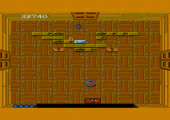
Historical Context and Genre Evolution
The block-breaking genre, often referred to as "ball-and-paddle" games, was popularized by Atari’s Breakout in 1976 and its subsequent 1978 sequel, Super Breakout. These titles were defined by a simple yet addictive loop: players controlled a horizontal bar at the bottom of the screen to deflect a bouncing projectile into a wall of destructible bricks. A critical component of the early success of these games was the input method. The Atari 2600 utilized paddle controllers, which employed potentiometers to measure rotational movement. Unlike the digital on/off inputs of a standard joystick or directional pad, the paddle allowed for analog precision, enabling players to move their on-screen avatar with a speed and accuracy that mirrored real-world physics.
By the mid-1980s, the genre underwent a renaissance with Taito’s Arkanoid. This 1986 arcade hit introduced power-ups, varied enemy types, and complex brick configurations, effectively revitalizing the format for a new generation. However, when the genre transitioned to home consoles like the Nintendo Famicom, a technical hurdle emerged. Nintendo’s standard hardware did not include a paddle controller, forcing Taito to bundle a proprietary peripheral with its home ports. Sega, seeking to maintain its reputation for arcade-quality home experiences, followed a similar trajectory by developing its own paddle controller for the Mark III.
Technical Specifications of the Sega Paddle Controller
The Sega Paddle Controller (Model HAA-2640) was engineered to provide the same granular control found in arcade cabinets. Internally, the device utilized a potentiometer to regulate voltage, translating the physical rotation of the knob into precise horizontal positioning on the screen. This hardware was essential for games requiring rapid, variable-speed reactions.
Sega’s commitment to this peripheral was significant, though limited in scope. While the Atari 2600 supported over 30 titles with paddle functionality, Sega’s support for the Mark III was restricted to a specific library of seven games:
- Woody Pop: Shinjinrui no Block Kuzugi
- Alex Kidd BMX Trial
- Galactic Protector
- Megumi Rescue
- Riddle of Pythagoras
- BMX Trial Alex Kidd (Gold Cartridge version)
- Night Soccer (Homebrew and limited distribution contexts)
Among these, Woody Pop and Alex Kidd BMX Trial were the primary drivers for the hardware’s adoption, often sold in bundles that included the controller to ensure players could experience the intended level of responsiveness.
Gameplay Mechanics and Innovations
Woody Pop: Shinjinrui no Block Kuzugi—which translates roughly to "Woody Pop: New Generation Block Breaker"—introduces a protagonist named Woody, a wood spirit. The narrative follows Woody as he navigates the "Bizarre Mansion" to rescue his companion, Gumball. This character-driven approach was a departure from the sterile, industrial aesthetic of Arkanoid.
The game incorporates several mechanical deviations from its predecessors:
Branching Level Architecture
Unlike the linear progression typical of the genre, Woody Pop features a non-linear stage select system. Upon completing a room, players are often presented with multiple exits. This branching path system adds a layer of replayability, allowing players to encounter different challenges and room configurations in subsequent playthroughs. Each path is associated with varying bonus point rewards, suggesting a tiered difficulty system, though the mechanical variance between paths remains subtle.
Visual Indicators and Physics
One notable technical improvement over Arkanoid is the inclusion of visual feedback for multi-hit bricks. In Woody Pop, bricks that require multiple strikes to destroy will visibly crack, providing the player with immediate data on their progress. Furthermore, the game features complex environmental hazards, such as moving trains and invincible obstacles placed in the lower half of the screen. These elements are designed to disrupt the ball’s trajectory, requiring the player to use the paddle’s high-speed movement to intercept the ball in unconventional positions.
Power-up Synergies
The power-up system is triggered by collecting bubbles released from shattered crystal bricks. Standard enhancements include a size-doubling effect for Woody, a "diamond ball" capable of piercing through multiple bricks, and a "shot" power-up that allows the player to fire projectiles directly at the wall. A unique feature of Woody Pop is the ability to combine certain power-ups. For instance, the "Glue" item (which allows the player to catch and hold the ball) can be used simultaneously with the "Flame" item (which sets the ball on fire). This synergy creates a tactical advantage, as the player can aim a high-damage projectile with manual precision.
Visual and Auditory Analysis
From a graphical standpoint, Woody Pop utilizes a distinct color palette dominated by earth tones—specifically browns and oranges—meant to evoke the "wood spirit" theme. While this provides the game with a cohesive identity, it has been noted by historians that the lack of contrast between the background and the paddle can occasionally impede gameplay. The 4:3 aspect ratio of the home console version creates a wider playfield compared to the vertical "tate" orientation of arcade block breakers, placing a higher demand on the player’s lateral movement speed.
The auditory experience of Woody Pop is unconventional. Rather than a traditional melodic soundtrack, the game relies on a percussive arrangement of sound effects. These "dinks" and "bloops" are synchronized with the ball’s collisions, creating a rhythmic soundscape that functions as both music and feedback. This design choice reflects a pragmatic approach to the Master System’s sound chip limitations, prioritizing clear audio cues for gameplay over background music that might be drowned out by the constant sound of brick destruction.
Market Positioning and Legacy
The release of Woody Pop was part of a broader strategy by Sega to capture the segment of the market that valued arcade-accurate controls. In the late 1980s, the "console wars" between Sega and Nintendo were often fought through peripherals. While Nintendo focused on the R.O.B. (Robotic Operating Buddy) and the NES Zapper, Sega’s focus remained on translating its arcade pedigree—characterized by high-speed action and specialized inputs—into the home.
However, the specialized nature of the paddle controller ultimately limited the game’s reach. In Western markets, the Sega Paddle Controller was never officially released, and Woody Pop remained a Japanese exclusive for the Mark III. When the game eventually reached the West via the Game Gear handheld, the controls were adapted for a digital D-pad, which many critics argued fundamentally altered the difficulty and feel of the game.
Chronology of the Block-Breaker Era (1976–1987)
To understand the position of Woody Pop, one must look at the timeline of the genre’s development:
- 1976: Atari releases Breakout in arcades, establishing the core mechanics.
- 1977: The Atari 2600 launches with paddle support, making the genre a staple of home gaming.
- 1986: Taito releases Arkanoid, introducing power-ups and a sci-fi narrative.
- 1987 (Early): Taito ports Arkanoid to the Famicom with a bundled paddle.
- 1987 (Mid): Sega releases the Paddle Controller for the Mark III.
- 1987 (Late): Woody Pop: Shinjinrui no Block Kuzugi is released as a flagship title for the Sega Paddle.
Implications for Game Design
Woody Pop serves as a case study in the challenges of peripheral-dependent software. While the paddle controller offered superior input, the requirement of additional hardware created a barrier to entry. Logically, this led to a smaller install base, which in turn discouraged developers from creating a wider library of supported titles.
The game’s design flaws—such as the "warp holes" that can lead to long periods of player inactivity and the "toy box" blocks that release endless waves of distracting enemies—highlight the experimental nature of the era. Developers were still grappling with how to balance the increased speed of 8-bit processors with the limitations of home television displays.
Despite these challenges, Woody Pop remains a significant chapter in Sega’s history. It represents an era where the company was willing to innovate with hardware to provide a niche, high-fidelity experience. While it may not have achieved the legendary status of Alex Kidd or Sonic the Hedgehog, its contribution to the refinement of the ball-and-paddle genre and its role in the history of console peripherals provide valuable insights into the technical ambitions of 1980s game development. For collectors and historians, the game stands as a reminder of a time when the "new generation" of gaming was defined as much by the way players touched the machine as by the pixels on the screen.