Jia Lissa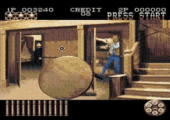
Historical Context and Development Background
The early 1990s represented a period of rapid technological transition and intense public scrutiny for the video game industry. Konami’s decision to move from the modern-day setting of the original Lethal Enforcers to a historical Western setting for the sequel was not merely a creative choice but also a strategic one. The original game had been a central figure in the 1993 United States Senate hearings on video game violence, led by Senators Joe Lieberman and Herb Kohl. These hearings eventually led to the creation of the Entertainment Software Rating Board (ESRB) and the Sega-specific Videogame Rating Council (VRC).
Interestingly, while the first game was often cited for its "photorealistic" violence and carried an MA-17 rating on Sega systems, Lethal Enforcers II: Gun Fighters was assigned a more moderate MA-13 rating. This shift occurred despite the gameplay remaining fundamentally identical, suggesting that the historical context of the Old West was viewed as less provocative or "threatening" by contemporary standards than the modern urban combat depicted in its predecessor.
Technical Specifications and Hardware Requirements
The Sega CD version of Lethal Enforcers II serves as a technical showcase for the platform’s unique capabilities, specifically its ability to handle "Red Book" high-quality audio and increased storage capacity compared to the standard Genesis cartridge. However, to achieve the intended arcade experience at home, players were required to navigate specific hardware constraints that remain relevant to retro-gaming enthusiasts today.
The Justifier Peripheral
The primary method of interaction for Lethal Enforcers II is the Konami Justifier, a proprietary light gun shaped like a stylized revolver. While the game supports the standard three-button or six-button Genesis controllers, the experience is significantly hampered by the lack of precision and speed inherent in a D-pad-controlled reticle. The Justifier utilizes a photocell to detect the light emitted from the television screen, a technology that requires a Cathode Ray Tube (CRT) television to function. Because modern LCD, LED, and Plasma displays do not utilize the same scanning electron beam technology, the Justifier is incompatible with contemporary screens, making a legacy hardware setup essential for an authentic playthrough.
Audio-Visual Architecture
The Sega CD version offers a distinct advantage over the Sega Genesis cartridge version in terms of its auditory fidelity. Utilizing the CD-ROM format, Konami was able to include a soundtrack and voice samples that are nearly indistinguishable from the arcade original. The music features high-fidelity instrumentation appropriate for the Western theme, and the digitized voice acting—including the iconic "Get bit, varmint!" and "Don’t shoot the innocent!"—is rendered with professional clarity.
Visually, the game utilizes digitized sprites and backgrounds, a hallmark of early 90s Konami arcade titles. While the Sega CD’s color palette is limited to 64 simultaneous colors on screen, resulting in a somewhat muted and grainy appearance compared to the arcade’s more vibrant output, the transition is smoother than many other "full-motion video" or digitized ports of the era.
Detailed Stage Chronology and Gameplay Mechanics
Lethal Enforcers II: Gun Fighters is structured into five distinct stages, each representing a classic Western scenario. The core loop involves neutralizing armed threats while exercising trigger discipline to avoid hitting civilians, known in-game as "innocents."
Stage 1: The Bank Robbery
The narrative begins in a frontier town where a gang of outlaws has seized the local bank. Players must navigate the dusty streets and the bank’s interior, facing enemies who pop out from behind teller windows and balconies. The stage culminates in a boss encounter involving a fortified covered wagon equipped with three cannons. This encounter introduces the "defensive shooting" mechanic, where the player must prioritize destroying incoming projectiles (cannonballs) before they impact the screen, while simultaneously chipping away at the boss’s health bar.
Stage 2: The Stagecoach Pursuit
The second stage increases the kinetic energy of the game, placing the player in a high-speed chase involving a stagecoach and a covered wagon. The mechanical challenge here is the introduction of moving targets on horseback, which requires lead-shooting and faster reaction times. The boss of this stage utilizes environmental hazards, throwing an infinite supply of barrels at the player. The victory animation—a dramatic explosion that sends the antagonist hurtling through the air—serves as a transition to the first bonus stage.
Stage 3: The Saloon and the Quick Draw
The interior of the saloon provides a denser, more claustrophobic environment. Players must distinguish between bandits wielding firearms, knives, and hatchets, while avoiding "ladies of the evening" who frequently cross the line of fire. The climax of this stage departs from the standard rail-shooter format, offering a "Quick Draw" duel against three black-clad gunfighters. This requires precise timing and represents the purest distillation of the Western "showdown" trope.
Stage 4: The Great Train Robbery
A staple of Western cinema, the train robbery stage moves the action from the caboose to the locomotive. The verticality and shifting perspectives as the train moves through the landscape increase the difficulty. The boss is a deranged engineer who utilizes dynamite as his primary weapon. Success in this stage requires the player to shoot the dynamite sticks out of the air, a feat that demands high accuracy and rapid-fire capability.
Stage 5: The OK Mine Company
The final stage takes the player into the subterranean depths of a gold mine. This level shifts the tone toward the supernatural, as the primary antagonist summons skeletal warriors. These enemies introduce unique movement patterns, heaving their own heads and knives at the player. The final confrontation requires the player to ignore the regenerating skeletal minions and focus fire entirely on the boss, whose defeat triggers a transformation sequence and the game’s conclusion.
Difficulty Calibration and Scoring Metrics
Konami increased the difficulty of Lethal Enforcers II compared to the original, though they balanced this with a more forgiving progression system. In the first game, players were required to maintain a minimum accuracy percentage to advance to the next level. In the sequel, this requirement was removed, allowing players to progress regardless of their skill level, provided they had remaining credits.
To compensate for the lack of an accuracy gate, the enemy AI is significantly more aggressive. Enemies draw their weapons faster and, in many cases, require multiple hits to be neutralized. This "double-tap" requirement forces players to manage their ammunition more carefully, as the six-shooter must be reloaded by "shooting" off-screen.
The game’s ranking system provides a post-stage evaluation based on hits, misses, and civilian casualties:
- 90% and above: U.S. Marshal
- 80-89%: Deputy Marshal
- 70-79%: Sheriff
- 60-69%: Deputy
- 59% and under: Posse
Arsenal and Power-Up System
While the player begins with a standard six-shot revolver, the environment contains destructible objects—such as lanterns, signs, and vases—that reveal weapon upgrades. These power-ups are essential for managing the increased enemy density of the later stages:
- Dual Pistols: Increases the rate of fire and ammunition capacity.
- Rifles and .50-Caliber Sharps: Provides higher damage output for "heavy" enemies.
- Shotguns: Offers a wider hit detection area, ideal for clearing clusters of projectiles.
- Gatling Guns: Provides rapid-fire capabilities.
- Cannons: Offers massive area-of-effect damage.
Each weapon upgrade is temporary, lost either when the player is hit by an enemy or after a set amount of ammunition is expended.
Broader Impact and Industry Implications
Lethal Enforcers II: Gun Fighters represents the apex of the 2D digitized light gun era. Shortly after its release, the industry began a wholesale transition toward 3D polygonal graphics, as seen in Sega’s Virtua Cop (1994) and Namco’s Time Crisis (1995). These newer titles offered dynamic camera angles and hit-zone detection that made the static, digitized backgrounds of Lethal Enforcers feel archaic.
However, the legacy of Lethal Enforcers II remains significant for several reasons. First, it demonstrated the viability of the "premium peripheral" model, where a specific piece of hardware (the Justifier) was marketed alongside a flagship title. Second, it showcased the Sega CD’s ability to bridge the gap between arcade and home audio, a feat that standard cartridges could not match.
Finally, the game’s move to an MA-13 rating highlighted the evolving relationship between the gaming industry and regulatory bodies. By utilizing a "historical" setting, Konami was able to maintain the core mechanical violence of their franchise while mitigating the social backlash that had targeted the first game’s contemporary police setting. For modern collectors and historians, the Sega CD version of Lethal Enforcers II: Gun Fighters remains the definitive way to experience this chapter of Konami’s history, offering a rare blend of arcade-perfect sound and challenging, reflex-based gameplay that defined the 16-bit era.