Jia Lissa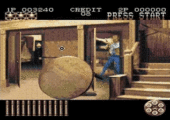
Lethal Enforcers II: Gun Fighters arrived on home consoles in 1994 as the highly anticipated sequel to Konami’s 1992 arcade hit, Lethal Enforcers. Developed and published by Konami, the title represented a significant pivot for the franchise, trading the gritty, modern-day urban policing of its predecessor for the dusty, lawless frontier of the American Old West in 1873. Released during a period of intense scrutiny for the video game industry regarding violent content, the game managed to maintain its core "light gun" mechanical identity while navigating a changing regulatory landscape. The Sega CD version, in particular, sought to bridge the gap between the fidelity of the arcade experience and the technical limitations of home hardware, utilizing the expanded storage of the CD-ROM format to deliver superior audio quality.
Historical Context and Regulatory Shift
The release of the original Lethal Enforcers in 1993 had been a focal point of the United States Senate hearings on video game violence, led by Senators Joe Lieberman and Herb Kohl. That game, which featured digitized images of real people and modern firearms, was one of the primary reasons for the creation of the Entertainment Software Rating Board (ESRB) and Sega’s own Videogame Rating Council (VRC).
While the first game carried the restrictive MA-17 rating on Sega platforms—the equivalent of an adult-only or mature rating—Lethal Enforcers II: Gun Fighters was granted an MA-13 rating. Industry analysts suggest this shift was likely due to the historical setting. By moving the violence to 1873, the imagery of six-shooters and stagecoaches was perceived as "cinematic" or "western fantasy" rather than the realistic, contemporary violence that had alarmed lawmakers a year prior. Despite this lower age rating, the core gameplay remained a visceral test of reflexes, requiring players to eliminate hostile bandits while protecting innocent civilians.
Hardware Integration: The Justifier and CRT Requirements
A defining characteristic of Lethal Enforcers II: Gun Fighters on the Sega CD is its reliance on specialized hardware to achieve the intended experience. While the game is fully playable using a standard three-button or six-button Genesis controller, the software was specifically optimized for the Konami Justifier. The Justifier, a revolver-style light gun peripheral, was famously produced in a bright blue color for the primary player to comply with toy gun safety regulations, while a second "Player 2" gun was available via mail-order in pink.
From a technical standpoint, the light gun functionality relies on the timing of the cathode-ray tube (CRT) television’s electron beam. When the trigger is pulled, the game screen flashes white for a fraction of a second, allowing the photodiode in the Justifier to detect the exact moment the scanning beam passes its field of vision. Because modern liquid crystal displays (LCD) and organic light-emitting diode (OLED) screens do not utilize this scanning method, the light gun functionality of Lethal Enforcers II is non-functional on contemporary displays without specialized third-party adapters. For enthusiasts seeking the 1994 experience, the use of a vintage CRT remains a necessity for accuracy, as the standard D-pad controller is often criticized for being too slow to keep pace with the game’s aggressive enemy AI.
Chronology of Gameplay: The Five Stages of the Frontier
The narrative of Lethal Enforcers II: Gun Fighters follows a linear progression through five distinct stages, each representing a classic trope of the Western genre.
Stage One: The Bank Robbery
The game opens in a small frontier town where a local bank is under siege. Players must navigate the interiors and exteriors of the bank, clearing out bandits who appear behind counters and windows. The stage concludes with a confrontation against a boss positioned in a reinforced covered wagon. This boss utilizes three mounted cannons, forcing the player to balance defensive fire—shooting down incoming cannonballs—with offensive strikes against the boss himself.
Stage Two: The Stagecoach Rescue
The second stage shifts to a high-speed pursuit. Players must defend a stagecoach and a covered wagon from mounted outlaws. The increased speed of the scrolling background and the movement of the targets on horseback significantly raise the difficulty. The boss of this encounter utilizes environmental hazards, throwing an endless supply of barrels at the player. The stage ends with a dramatic explosion, a hallmark of Konami’s digitized transition effects of the era.
Stage Three: The Saloon and Quick-Draw
This stage moves the action indoors, featuring a mixture of gunfighters, knife-throwers, and hatchet-wielding bandits. It also introduces higher stakes for civilian safety, as "ladies of the evening" frequently cross the line of fire. The conclusion of this stage deviates from standard shooting gallery mechanics, presenting an "Old West Standoff." Players are pitted against three black-clad gunfighters in a quick-draw duel, emphasizing timing over sustained fire.
Stage Four: The Great Train Robbery
The penultimate stage takes place on a moving locomotive. Starting at the caboose, the player must fight their way forward to the engine. The enemies here use the verticality of the train cars to ambush the player. The boss is a "psycho" character who hurls sticks of dynamite. Similar to the Stage One cannonballs, the dynamite must be shot out of the air to prevent player damage, requiring high precision under pressure.
Stage Five: The OK Mine Company
The final mission leads players into the depths of a gold mine. This stage is notable for its departure from semi-realism, introducing more frantic and stylized encounters. The final antagonist summons "skeletal warriors" who attack with knives and even their own detached heads. While the skeletons serve as a distraction, the player must focus fire on the primary boss to deplete his life meter. The game concludes with the boss’s defeat and a final animation sequence depicting his demise.
Technical Performance and Audio Superiority
The Sega CD version of Lethal Enforcers II: Gun Fighters exists in a unique middle ground between the 16-bit Sega Genesis cartridge and the original arcade hardware. Due to the Genesis’s limited color palette of 64 simultaneous colors from a total of 512, the digitized graphics appear somewhat grainy and muted compared to the arcade version. This "dull" visual aesthetic was a common critique of FMV and digitized games on the platform.
However, the Sega CD version is widely considered the definitive home port due to its audio. By utilizing the CD-ROM’s Redbook Audio capabilities, Konami included high-fidelity music, crisp sound effects, and clear voice samples. In the cartridge version, voice lines like "Get the bad guys!" or "Don’t shoot me!" were often muffled or heavily compressed. On the Sega CD, these samples are near-arcade quality, providing an immersive atmosphere that the base Genesis hardware could not replicate.
Ranking Systems and Difficulty Analysis
Konami designed Lethal Enforcers II: Gun Fighters to be more punishing than the original. Enemies appear on screen for shorter durations before firing, and several standard enemies require multiple hits to be neutralized, a mechanic intended to drain the player’s ammunition and force frequent reloading (accomplished by aiming the Justifier away from the screen).
A significant mechanical change in the sequel is the removal of the minimum accuracy requirement to progress between stages. In the first game, failing to maintain a certain percentage of hits would result in an immediate "Game Over" regardless of lives remaining. In the sequel, this is replaced by a more forgiving credit system—granting nine continues compared to the original’s five—but the player’s performance is still tracked via a rigorous ranking system:
- 90% or above: U.S. Marshal
- 80-89%: Deputy Marshal
- 70-79%: Sheriff
- 60-69%: Deputy
- 59% and under: Posse
These ranks serve as a metric for player skill and are heavily influenced by "innocent victim" penalties, where shooting a civilian results in an immediate rank demotion or loss of life.
Legacy and Impact on the Light Gun Genre
Lethal Enforcers II: Gun Fighters stands as a relic of a transitional era in gaming. It was one of the final major successes for the digitized-sprite aesthetic before the industry shifted toward fully 3D rendered environments with the arrival of the PlayStation and Sega Saturn. The game’s inclusion of bonus stages—such as shooting bottles in a saloon or mid-air targets thrown by a civilian—added variety that would later become a staple in franchises like Time Crisis and The House of the Dead.
While the "Lethal Enforcers" brand eventually faded, with Konami later rebranding its light gun efforts under titles like Police 911, the second entry remains a high point for 16-bit era peripherals. It demonstrated that while home consoles of the mid-90s could not yet match the visual processing power of high-end arcade boards, the use of CD technology could at least bridge the gap in sensory immersion through superior sound and expanded content. For collectors and historians, the title remains a primary reason for the continued ownership of CRT televisions and the iconic blue Justifier.