Jia Lissa
The global amusement industry stands at a pivotal crossroads as 1980 marks the transition from simple electromechanical novelties to the sophisticated era of digital entertainment. In a comprehensive discussion regarding the strategic trajectory of Sega Enterprises, Ltd., Executive Vice President Hayao Nakayama has detailed the company’s internal restructuring, its aggressive stance on intellectual property, and a manufacturing philosophy that prioritizes the burgeoning television game market. As the arcade "Golden Age" reaches its zenith, Sega’s alignment with its American parent organization, Gulf & Western (G&W), and its subsidiary, Gremlin Industries, highlights a burgeoning trans-Pacific synergy intended to dominate the international leisure sector.
The Corporate Hierarchy: Sega as a Global Conglomerate
Since 1974, Sega Enterprises has operated as a vital component of the Gulf & Western Corporation, a New York-based industrial titan. G&W, which currently ranks 52nd in the United States with annual sales exceeding $5.3 billion, provides Sega with a level of financial stability and industrial reach rare in the nascent video game industry. While G&W is traditionally associated with manufacturing, energy, and automotive sectors—and notably owns Paramount Pictures—its stewardship of Sega represents a significant bet on the future of interactive leisure.
The corporate architecture of Sega is complex, reflecting its international operations. Following its listing on the U.S. stock market, Sega of America was established under the leadership of President David Rosen. Under this structure, Sega of Japan technically functions as a "grandchild" subsidiary of Gulf & Western, though Nakayama emphasizes that it remains functionally integrated within the G&W group. This hierarchy was further bolstered by the 1976 and 1979 acquisitions of Gremlin Industries in the United States and Esco Trading in Japan, respectively. These moves have effectively created a unified production and distribution pipeline capable of servicing the world’s two largest gaming markets simultaneously.
Financial Performance and Operational Expansion
The fiscal year ending in April 1979 proved to be a landmark period for Sega in Japan. The company reported annual sales of 24 billion yen, with a declared income of 5.37 billion yen. This robust financial health has facilitated a massive expansion of the company’s physical infrastructure and workforce. Sega currently employs 1,200 personnel and maintains an extensive domestic network consisting of three branch offices in Sapporo, Osaka, and Fukuoka, supported by four sales offices and 89 operational centers.

Nakayama noted that Sega occupies a unique dual role as both a manufacturer and an operator of amusement centers. While this dual-track approach is common in the Japanese market, it requires a delicate balancing act. As a manufacturer, Sega must protect the interests of third-party operators who purchase its machines; as an operator, it must maintain a competitive edge in its own facilities. The company’s current operational philosophy emphasizes "economies of scale," focusing on long-term sustainability and consistent revenue rather than short-term speculative hits.
The Shift Toward TV Games and Digital Innovation
A cornerstone of Sega’s 1980 business policy is the prioritization of television-based games. Nakayama revealed that 70% to 80% of the company’s research and development resources are now dedicated to TV game machines. This shift is driven by the global trend toward digital novelty and the high entertainment value inherent in visual software. Despite some industry criticism regarding an over-reliance on visual content, Sega maintains that the creative possibilities of the medium far outweigh the limitations of traditional mechanical cabinets.
The partnership between Sega of Japan and Gremlin Industries in the U.S. serves as the engine for this innovation. The two entities cooperate on cross-border development; for instance, a game developed in San Diego by Gremlin may be manufactured and sold by Sega in the Japanese market, while Sega-developed titles are adapted by Gremlin for American audiences. This synergy allows Sega to capitalize on localized hits while maintaining a global product catalog.
Comparative Market Analysis: Japan vs. The United States
The global export market for video games is currently a duopoly controlled by Japanese and American manufacturers. While Europe has become a major consumer, the primary innovations are stemming from a small group of leaders. In the U.S., Sega/Gremlin competes directly with Atari and Midway, alongside specialized firms like Cinematronics and Exidy.
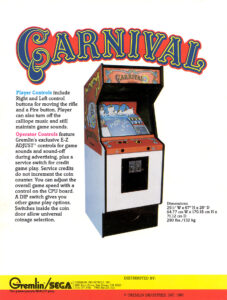
One of the most intriguing aspects of Nakayama’s report is the divergence in player preferences between regions. For example, the title Mini Monaco—a compact driving game—was a commercial failure in Japan but became a massive success in the United States and Europe. Nakayama attributes this to the American market’s newfound appreciation for space efficiency and two-player competition. Conversely, the shooting game Carnival, which features the industry’s first "bonus round" mechanic, received a lukewarm reception in Japan despite being hailed as a superior title to Missile Command by American critics.

Addressing the Hardware Format: The Tabletop Dominance
In the Japanese market, the "table-type" cabinet has become the standard for arcade games, largely due to the unique spatial requirements of Japanese game centers and coffee shops. While Sega continues to produce upright machines, such as Car Hunt and Deep Scan, the company has had to adapt to the market’s demand for table-based units.
Nakayama admitted that while upright cabinets offer more "added value" through elaborate cabinet art and physical presence, the screen is the primary driver of revenue in the current climate. Sega remains in a period of "trial and error" regarding hardware formats, refusing to abandon upright models entirely but acknowledging that the flexibility of table-top conversions is currently more profitable for operators.
The Legal Front: A War on Counterfeit Products
The late 1970s "Invader" boom led to a proliferation of unauthorized clones and copycat machines, a trend that Sega is now aggressively combating. Nakayama articulated a firm stance on intellectual property, noting that the industry has matured beyond the point where supply shortages could justify the production of clones.
A major legal victory occurred in the United States when Sega/Gremlin successfully sued Exidy over the game Head-On. The settlement, in which Exidy admitted fault, has set a pivotal precedent for the industry. Sega is now utilizing a combination of trademark law, copyright, and unfair competition prevention laws to target counterfeiters.
Nakayama warned that the prevalence of copy products creates a negative feedback loop for the entire industry:
- Decline in Product Image: Cheap clones degrade the perceived value of high-quality games.
- Excessive Competition: Over-saturation of identical games leads to lower earnings for legitimate operators.
- Increased Costs: To deter copying, manufacturers must invest in more complex, expensive hardware, which ultimately raises the purchase price for the operator.
Sega has pledged to continue catching "copycats" in Japan, noting that the era of open defiance from counterfeiters is coming to an end as legal frameworks tighten.
Future Outlook: Beyond the Video Screen
While TV games are the priority, Sega is not abandoning traditional amusement sectors. The company plans to maintain a consistent supply of pinball machines, leveraging its relationships with American manufacturers like Williams and Stern. Additionally, Sega is focusing on the "medaling" market—machines that dispense tokens for prizes—by improving and recycling existing hardware to offer more affordable options to operators.
The company is also refining its distribution strategy. By training and empowering major local distributors across Japan’s various regions, Sega aims to provide more "attentive service" that a centralized Tokyo office cannot manage alone. This decentralization of sales is intended to better address the diverse needs of regional arcade owners.
Broader Impact and Industry Implications
Sega’s 1980 strategy reflects a broader professionalization of the video game industry. By aligning with a major American conglomerate and taking a hardline stance on legal protections, Sega is transitioning from a niche manufacturer of mechanical novelties into a modern technology firm. The emphasis on software-driven "TV games" presages the company’s eventual pivot toward the home console market later in the decade.
The insights provided by Nakayama suggest that the future of gaming lies in the intersection of American hardware innovation and Japanese operational efficiency. As Sega continues to leverage its "economies of scale," the industry can expect a more consolidated market where originality is fiercely protected and technological novelty remains the primary currency of success. For operators and players alike, the message from Sega’s executive leadership is clear: the digital revolution is no longer a temporary trend, but the permanent foundation of the amusement business.