Jia Lissa
The release of Landstalker: The Treasures of King Nole in 1992 marked a pivotal shift for Climax Entertainment, representing both a technical breakthrough in 16-bit software engineering and a significant strategic departure from the studio’s established Shining franchise. Following the success of Shining in the Darkness and Shining Force, Climax sought to push the hardware of the Sega Mega Drive beyond traditional 2D limitations. This ambition led to the creation of the Diamond-Shaped Dimension System (DDS520), an engine that facilitated a pseudo-3D isometric perspective. While the game initially began development as a continuation of the Shining series, internal creative shifts and technical requirements eventually transformed it into a standalone property that remains a cornerstone of the action-RPG genre.
The Strategic Formation of Sonic Co. Ltd
In June 1991, the success of Climax’s early Mega Drive titles led to the formation of Sonic Co., Ltd, a joint venture between Climax and Sega. This move was designed to streamline the RPG development process by recruiting specialized talent from various creative industries, including marketing, traditional art, and game design. For Hiroyuki Takahashi and Kan Naitō, the co-founders of Climax, this expansion provided the necessary resources to manage multiple high-profile projects simultaneously.
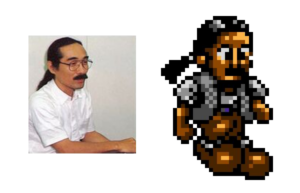
While Hiroyuki Takahashi led the development of Shining Force, Kan Naitō turned his attention to a project tentatively titled Hero Lancelot: Legend of Shining. Naitō, a programmer with a long-standing fascination with 3D environments, felt that the first-person perspective of Shining in the Darkness, while revolutionary, was too restrictive. He envisioned a world where players could move with verticality and diagonal freedom, a concept that had little precedent on home consoles at the time.

The Genesis of the Isometric Perspective
The inspiration for Landstalker’s unique viewpoint reportedly came to Naitō as he observed traffic and pedestrians from his tenth-floor apartment window. The diagonal, high-angle perspective provided a sense of depth and immersion that he compared to the cinematography of the Indiana Jones films. However, implementing this "electronic diorama" on the Mega Drive presented immense technical hurdles.
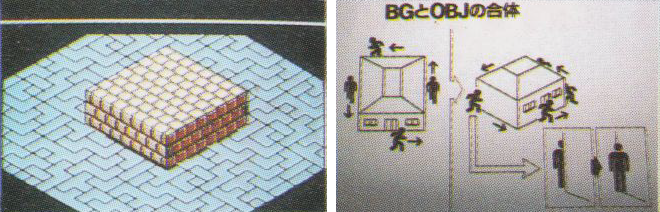
At the time, most isometric games, such as Solstice on the NES, were confined to single-screen rooms due to the limitations of Video Random Access Memory (VRAM). The Mega Drive’s hardware was designed for horizontal and vertical scrolling, making diagonal calculations and object prioritization (deciding which objects appear in front of or behind the player) computationally expensive. Naitō spent the first several months of 1991 working in isolation, developing the mathematical formulas required to make diagonal scrolling smooth and efficient.
Technical Architecture: The DDS520 and Mirage III
The resulting engine was dubbed the Diamond-Shaped Dimension System 520 (DDS520). The name referenced the diamond-shaped 64×64 pixel panels that composed the game’s floor surfaces. Initially, the engine was designed to handle a maximum of 520 maps, but as the scope of the project expanded, the final version of the game utilized approximately 850 individual maps. To manage this massive volume of data, Climax developed a proprietary graphics tool called Mirage III.
Mirage III allowed designers to build 3D structures using wireframe models, which were then populated with textures based on artist Yoshitaka Tamaki’s drawings. A major challenge during development was spatial awareness. The team experimented with adding shadows to Nigel (the protagonist) and environmental objects to assist with platforming. However, Naitō ultimately vetoed the inclusion of shadows. His analysis showed that the additional processing required for dynamic shadows would halve the game’s vertical height steps and significantly reduce the number of NPCs and enemies that could be displayed on screen simultaneously. To compensate, the team focused on meticulous map design and visual cues to help players navigate the pseudo-3D space.

The Divergence from the Shining Series
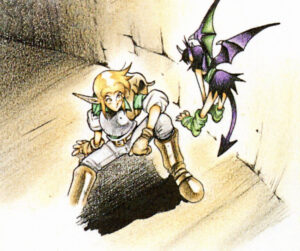
Chronologically, Landstalker was conceptualized as a direct sequel to Shining in the Darkness. Early design documents by Yoshitaka Tamaki reveal that the protagonist, Nigel, was intended to be a forest elf from the same species as the character Pyra. The game’s antagonists, Wally and Ink, were originally designed as species encountered in the Labyrinth of Thornwood.
However, by the time the game was presented to the press in June 1992, all direct ties to the Shining lore had been excised. The project was renamed Landstalker to signify its status as a new franchise. While official statements at the time suggested the change was due to the gameplay being too distinct from the Shining series, later interviews with staff members, including composer Motoaki Takenouchi, hinted at internal creative friction within Climax. These philosophical differences eventually led to a split between Naitō and Takahashi, with the latter continuing the Shining series under the Camelot Software Planning banner, while Naitō retained leadership of Climax to pursue further isometric projects.

Narrative Design and Character Development
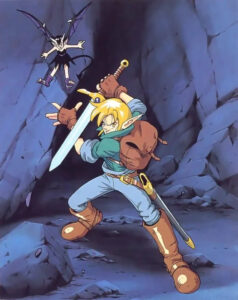
The creative direction of Landstalker was heavily influenced by Yoshitaka Tamaki, who sought to move away from the "chosen hero" trope common in 1990s RPGs. Nigel was designed as a professional treasure hunter—a nimble, self-interested adventurer motivated by wealth rather than prophecy. This personality was balanced by Friday, a palm-sized nymph who served as Nigel’s guide and conscience.
The game’s narrative structure utilized what Chief Map Designer Kenji Orimo called the "flexible scenario method." Rather than adhering to a rigid script, the writers, including Shinya Nishigaki, often expanded the story based on the maps provided by the designers. For example, the character of Princess Lara was added late in production simply because a designer had created a tall tower in the Duke’s castle that seemed to require a captive inhabitant. This iterative approach resulted in a world that felt lived-in and reactive, filled with incidental details like the castle gardener or the bumbling rival treasure hunter, Pockets.

The Aural Landscape of Motoaki Takenouchi
The soundtrack for Landstalker was composed by Motoaki Takenouchi, a protégé of the legendary Koichi Sugiyama. Takenouchi sought to maximize the potential of the Mega Drive’s Yamaha YM2612 sound chip by blending orchestral arrangements with rhythmic, percussion-heavy tracks.
Unlike many composers of the era who relied on short, looping melodies, Takenouchi pushed for longer, more complex compositions. "A Ballad for Princess Loria," for instance, was a nearly two-minute piano-style piece that played during a non-interactive event, requiring players to simply listen and observe. Takenouchi’s meticulous approach to sound levels and data compression ensured that the audio remained crisp despite the heavy processing demands of the DDS520 engine.
Release, Commercial Performance, and Global Impact
Landstalker: The Treasures of King Nole was released in Japan on October 30, 1992. The game was an immediate commercial success, selling an estimated 35,000 units in its first week. Critics praised the game for its visual depth and challenging puzzles, though some noted the inherent difficulty of diagonal platforming without a shadow for positioning.
The game was localized for North American and European markets in 1993. While certain elements were censored—most notably a bathhouse scene involving the nymph Friday—the core gameplay remained intact. The success of the title cemented Climax’s reputation as a premier developer for Sega hardware and established a template for future isometric titles.
Legacy and the End of an Era
In the years following Landstalker’s release, Climax explored spiritual successors. Dark Savior, released for the Sega Saturn in 1996, utilized a similar isometric perspective but incorporated 3D polygons. A spinoff for the Super Famicom, Ladystalker (1995), removed the jumping mechanic and shifted toward a more traditional RPG structure, but it never saw an official Western release.
In 2005, Naitō attempted to revive the franchise for the Sony PlayStation Portable (PSP). A fully 3D remake was showcased at the Tokyo Game Show, promising to resolve the spatial awareness issues of the original through modern camera controls. However, the project was ultimately canceled. Climax Entertainment eventually ceased operations in 2014, following years of financial instability.

Despite the studio’s closure, the impact of Landstalker persists. The game has been preserved through numerous re-releases on the Wii Virtual Console, Steam, and the Sega Genesis Mini. Its influence can be seen in modern "2.5D" titles that utilize isometric viewpoints to blend platforming with environmental puzzles. As a feat of 16-bit engineering, Landstalker remains a testament to a period of gaming history where technical constraints were met with radical, geometry-driven innovation.