Jia Lissa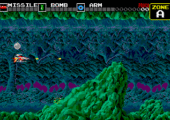
The release of the Darius Extra Version physical cartridge for the Sega Mega Drive in 2021 represents a significant milestone in the history of retro gaming preservation and software engineering. Developed by the emulation and porting specialists at M2 and published through a collaboration between Taito, Columbus Circle, and Strictly Limited Games, this title serves as a comprehensive expansion of the 2019 Mega Drive Mini version. While the 2019 release was hailed as a "timeline correction" that finally brought a native port of the 1986 arcade classic to Sega’s 16-bit hardware, the 2021 cartridge iteration transcends its predecessor by addressing long-standing balance issues, refining technical performance, and incorporating three distinct arcade revisions into a single, cohesive package.
Historical Context and Development Chronology
The journey of Darius to the Sega Mega Drive is one of the most protracted in the industry. When the original Darius debuted in arcades in 1986, it was famous for its massive three-screen cabinet and vibrating "Body Sonic" seat. While competing platforms like the PC Engine received several high-quality ports (such as Darius Plus and Super Darius), Sega fans were left without a direct conversion for decades.
The chronology of this specific version began in earnest around 2019, when Taito commissioned developer Hidecade to create a brand-new port for the Sega Mega Drive Mini. This version was built from the ground up to run on original hardware constraints despite being distributed digitally. However, that version was primarily based on the "Old" and "New" arcade revisions. In 2021, M2 took the foundation laid by Hidecade and performed a second, more intensive pass on the software. This effort was aimed at integrating the "Extra" revision—a version of the game that had historically been divisive among arcade players due to its extreme difficulty and credit-extorting mechanics—while simultaneously fixing graphical and audio limitations found in the Mini version.
Technical Refinements and Hardware Utilization
One of the most notable aspects of the Darius Extra Version is its optimized use of the Mega Drive’s YM2612 FM synthesis chip and the Video Display Processor (VDP). M2 collaborated with sound artist WING☆, a veteran known for his work on the Space Harrier themes for the Mega Drive Mini 2 and his associations with legendary composer Yuzo Koshiro.
The audio overhaul in the 2021 cartridge is substantial. In the 2019 Mini version, many sound effects, including the iconic "WARNING" prompt, were rendered using low-quality PCM samples that suffered from muffling. The 2021 version recreates these sounds using the YM2612 and the DCSG (Programmable Sound Generator), resulting in a much higher fidelity that mimics the arcade’s "boom and rumble" atmosphere. The FM mix was also rebuilt to restore low-end frequencies and increase stereo separation, bringing tracks like "Captain Neo" and "Chaos" closer to the original arcade output.
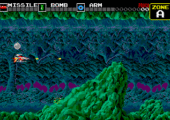
Visually, M2 addressed several edge-case bugs that occurred on real hardware. The original Mini version occasionally displayed Color RAM (CRAM) dots—tiny graphical artifacts—and suffered from minor sprite flicker when the screen became overcrowded. The Extra Version utilizes unorthodox, dynamic VRAM management to allow massive bosses, such as the seahorse-inspired Green Coronatus, to move with a fluid, undulating motion that was previously thought to be beyond the console’s capabilities. Furthermore, the game maintains a consistent frame rate even during the Extra revision’s denser bullet patterns, which originally caused slowdown even on arcade hardware.
The Three Arcade Revisions: A Comparative Analysis
The cartridge includes three distinct versions of the game, each offering a different mechanical experience. Understanding these revisions is crucial to appreciating the "Extra" version’s role as the definitive edition.
The Old and New Versions
The "Old" version represents the initial 1986 release, characterized by its strict checkpoint system and specific boss patterns. The "New" version was Taito’s first attempt at balancing, adjusting boss health and player power-up distribution. In the Mega Drive port, these modes serve as the "standard" experience, though they are notably less forgiving than the Extra mode, as they offer no continues.
The Extra Version
The namesake of this release, the Extra version, was originally designed to increase arcade revenue. It introduced more aggressive enemy formations, such as the "red roe" that tracks the player’s ship before boss encounters. However, it also introduced several quality-of-life improvements that M2 has refined for this home release.
In the original arcade Extra version, certain zones were deemed "punishment" stages. Zone M, an asteroid field, was notorious for debris and enemies attacking from unavoidable angles. Zone L was similarly criticized by Japanese players for its overwhelming difficulty. M2’s 2021 version rebalances these stages. In Zone M, enemy formations are slightly reduced to ensure that deaths are the result of player error rather than unfair circumstances. Underwater routes, which previously featured turrets firing impenetrable walls of bullets, have been adjusted to allow players to weave through patterns.
Gameplay Mechanics and Scoring Innovations
Darius Extra Version introduces a sophisticated scoring system that rewards high-level play. A primary addition is the "Remained Player Bonus," which awards one million points for every ship remaining in the player’s stock upon completion. This encourages a "no-miss" playstyle, a mechanic that would later become a staple in Darius Gaiden.
The boss fights have also been tightened. M2 worked with a renowned arcade "superplayer" known as KZS, a regular at the Takadanobaba Mikado Arcade Center, to ensure that boss behaviors felt authentic yet fair. For example, the Zone X Octopus boss had its fixed three-way flame spread changed to a four-way spread that tracks the player, removing "safe spots" where players could previously camp to milk the timer for points.
The cartridge also offers two distinct boss structures:
- Arcade Bosses: This maintains the original 11-boss rotation, where several bosses are reused across different branches of the map due to original ROM limitations.
- 26 Bosses: This mode provides a unique boss for every single zone on the map. This includes bosses adapted from the PC Engine version, such as Steel Spine, though they have been reprogrammed here to behave more like their canonical appearances in later Darius sequels.
Pro-Tier Features and Secret Modes
To cater to the most dedicated segment of the shmup (shoot ’em up) community, M2 included a hidden "Arcade Mode." Activated via a specific button sequence at the title screen (R, L, B, R, L, B, L, R, B), this mode imposes a strict ruleset:
- Pausing and soft resets are disabled.
- Rapid-fire is capped at 10 Hz (compared to the 30 Hz allowed in standard modes).
- Players are restricted to the "Proco" (Normal) difficulty and the original 11-boss structure.
- The mode features its own dedicated high-score ranking tables.
Additionally, the cartridge features a robust Boss Rush mode for each of the three revisions. In this mode, power-up distribution is altered; bosses drop one of each color orb upon defeat, forcing players to adapt their strategies as they gradually power up their ship across successive encounters.
Market Impact and Critical Reception
The release of Darius Extra Version is viewed by industry analysts as a gold standard for how legacy software should be handled. By providing a physical cartridge that runs on 30-year-old hardware while offering features typically reserved for modern "remastered" collections, Taito and M2 have set a high bar for the "retro-modern" market.
The inclusion of multiple difficulty tiers—Tiat (Easy), Proco (Normal), and Extra—ensures accessibility. Notably, the Tiat mode in this version has been adjusted so that players no longer lose power-ups upon death, though their scores are ineligible for the global leaderboards. This balance allows casual players to see the end of the game while preserving the integrity of the competitive scoring scene.
Broader Implications for the Mega Drive Library
Darius Extra Version is more than just a port; it is a technical showcase. It demonstrates that the Mega Drive, when pushed by modern development tools and a deep understanding of its architecture, is capable of rendering complex arcade experiences that were thought impossible in the early 1990s. The removal of input lag—a common complaint with the Mega Drive Mini’s emulation—further cements the cartridge version as the preferred method of play for enthusiasts.
The project also highlights the importance of collaboration between developers and the player community. By involving superplayers like KZS and sound artists like WING☆, M2 ensured that the final product met the exacting standards of the community that has kept the Darius franchise alive for over three decades.
In conclusion, Darius Extra Version stands as one of the most significant modern releases for the Sega Mega Drive. It successfully bridges the gap between 1980s arcade intensity and modern gameplay sensibilities. With its deep mechanical layers, significant technical upgrades, and high replay value through its branching paths and 26-boss mode, it remains a definitive example of the "shmup" genre and a vital piece of Sega’s 16-bit legacy.