Jia Lissa
Following the commercial success of Shining in the Darkness and the strategic depth of Shining Force, Climax Entertainment sought to push the technical boundaries of the Sega Mega Drive by venturing into pseudo-three-dimensional environments. This ambition culminated in the 1992 release of Landstalker: The Treasures of King Nole, a title that deviated significantly from the studio’s established RPG lineage to offer a specialized action-platforming experience. Led by programmer and co-founder Kan Naitō, the development of Landstalker represented a pivotal moment in 16-bit game design, introducing sophisticated isometric geometry and a proprietary engine that challenged the hardware limitations of the era.
The Strategic Expansion of Climax Entertainment
By early 1991, Climax Entertainment had established itself as a premier developer for Sega’s 16-bit console. The surprise success of Shining in the Darkness prompted a reevaluation of the studio’s business model, leading to the formation of Sonic Co., Ltd. in June 1991. This joint venture between Climax and Sega was designed to streamline the RPG development process by recruiting specialized talent from across the industry to focus on marketing, artwork, and technical design.
This expansion allowed Climax to diversify its output. While Hiroyuki Takahashi led the development of the traditional strategy-RPG Shining Force, Kan Naitō focused on a project initially titled Hero Lancelot: Legend of Shining. Naitō, an engineer obsessed with 3D spatial representation, aimed to move beyond the claustrophobic first-person corridors of his previous work. His goal was to create a "diorama world" that offered verticality, depth, and diagonal movement—a feat rarely attempted on consoles due to the immense processing power required for non-linear scrolling and object priority.

Technical Foundation: The DDS520 Engine
The realization of Landstalker depended entirely on the creation of a new game engine capable of simulating a 3D environment on 2D hardware. Naitō began work on this system in February 1991. The resulting technology was named the Diamond-Shaped Dimension System 520 (DDS520). The name "520" originally referred to the intended number of maps the engine could support, though this figure was eventually eclipsed as the project grew in scope.
The DDS520 utilized diamond-shaped panels—64×64 pixel units—as the fundamental building blocks of the game world. Unlike standard horizontal and vertical scrolling, the DDS520 required the Mega Drive to calculate diagonal vectors constantly. This presented a significant bottleneck for the console’s Motorola 68000 processor. To maintain a fluid frame rate, Naitō developed optimized formulas that treated diamonds as vectors rather than static pixel data, allowing for smooth scrolling without the slowdown typically associated with high-data volume environments.
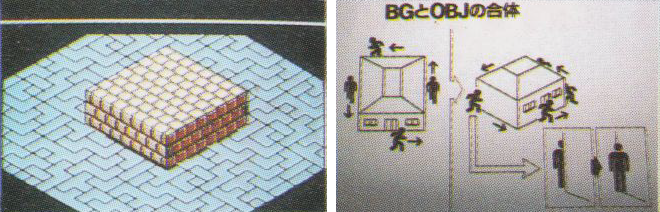
One of the most complex hurdles was "object priority." In an isometric view, the engine must constantly determine whether a character should be rendered in front of or behind an object, such as a tree or a wall. Naitō ensured that every object in the game had a "thickness" data point, creating a virtual 3D space where characters could move freely behind structures. While the lack of character shadows became a point of contention for players struggling with depth perception, Naitō made the executive decision to omit them to preserve processing cycles for more complex traps, enemies, and townspeople.
Chronology of Development and Design
The development cycle for Landstalker spanned approximately 20 months, characterized by several distinct phases:

- March 1991: Initial conceptualization begins. Naitō draws inspiration from the diagonal perspective of his 10th-floor apartment window and childhood dioramas.
- October 1991: Yoshitaka Tamaki begins character designs for the protagonist, Nigel (Lyle in Japan), and his companion Friday.
- Autumn 1991: Yasuhiro Ōhori joins as an external map designer. His experience in arcade game research helps the team refine combat mechanics and enemy movement patterns within the isometric grid.
- Winter 1991 – Spring 1992: The team utilizes "training camps" at the Yomiuri Land Hotel to finalize scenarios. The "flexible scenario method" is adopted, where newly designed maps frequently inspire changes to the plot.
- June 11, 1992: Climax officially unveils Landstalker to the press at the Tokyo Prince Hotel. The game is roughly 50% complete.
- September 1992: The ROM is finalized at 16 Megabits, a substantial size for the time, containing 850 total maps.
- October 30, 1992: Landstalker is released in Japan.
Artistic Direction and Character Archetypes
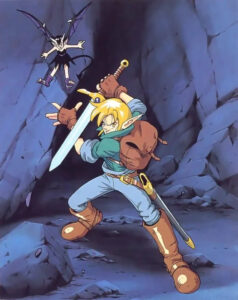
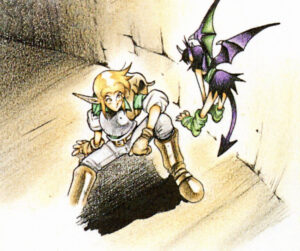
Artist Yoshitaka Tamaki was tasked with creating a protagonist who embodied the spirit of a "free-spirited adventurer" akin to Indiana Jones. Nigel was designed as a forest elf and a professional treasure hunter, a departure from the traditional "chosen one" or "royal knight" archetypes common in 1990s RPGs. His companion, Friday, was originally conceived as a nameless fairy but was refined into a nymph with a tragic backstory involving the villainous King Nole.
To manage the animation of these characters, Climax utilized a proprietary tool called Mirage III. Graphic Designer Ryushiro Miyazaki had to hand-draw animation frames for every action—walking, jumping, attacking, and climbing—from four different diagonal perspectives. This resulted in a significantly higher frame count than standard side-scrolling titles, contributing to the game’s fluid, cartoon-like aesthetic.

The Naming Controversy and the Shining Connection
A persistent point of historical discussion is Landstalker’s relationship to the Shining series. Early design documents and promotional mentions referred to the project as Shining Rogue or Shining Spirit. Internal evidence confirms that the game was originally intended to be a direct sequel to Shining in the Darkness. Nigel was established as the same species as the character Pyra, and the setting of Mercator Island was positioned south of the Kingdom of Thornwood.
However, during the June 1992 press conference, the game was presented as a standalone franchise. Industry analysts and former staff, such as composer Motoaki Takenouchi, have suggested that internal friction between Climax co-founders Hiroyuki Takahashi and Kan Naitō led to the separation of the projects. Naitō publicly stated the change was due to the gameplay being too distinct from the Shining series, but the sudden removal of all lore connections suggests a more complex institutional shift within the studio.

Soundtrack and Audio Engineering
The Landstalker soundtrack was composed by Motoaki Takenouchi, a protege of Dragon Quest composer Koichi Sugiyama. Takenouchi utilized a mix of orchestral arrangements and rhythmic elements to create a unique soundscape for the Mega Drive’s FM synthesis chip. Unlike his previous work on Jewel Master, Takenouchi had access to a refined development environment that allowed him to adjust audio levels with extreme precision.
Notably, the game features several tracks that exceed standard length for 16-bit titles, such as "A Ballad for Princess Loria," which plays for two minutes during a non-interactive event. Takenouchi’s insistence on musical quality occasionally put him at odds with the technical staff, but the resulting score is now considered one of the highlights of the Mega Drive library.
Market Reception and Legacy
Upon its Japanese release, Landstalker was a significant success, moving approximately 35,000 units in its first week. It received high marks from critics for its visual innovation and challenging puzzles, though its diagonal controls remained a polarizing element for some players. The game was later localized for North American and European markets in 1993, where it earned a reputation as one of the Sega Genesis’s premier action-adventures.
The legacy of Landstalker is marked by several "spiritual successors" and missed opportunities:
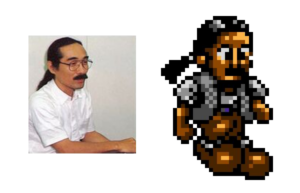
- Dark Savior (1996): A Sega Saturn title that utilized a similar isometric perspective and served as Kan Naitō’s next major project.
- Lady Stalker (1995): A Super Famicom spin-off that altered several core mechanics, including the removal of jumping.
- The Canceled PSP Remake: In 2005, a full 3D remake was announced for the PlayStation Portable, featuring the original development team. However, the project was quietly canceled, and Climax Entertainment eventually ceased operations in 2014.
Broader Impact on Game Design
Landstalker remains a landmark title for its successful implementation of 3D logic within a 2D framework. The DDS520 engine proved that the Mega Drive was capable of sophisticated spatial calculations, provided the software was sufficiently optimized. The game’s focus on environmental puzzles and platforming within an RPG structure influenced later titles like Alundra (developed by Landstalker map designer Yasuhiro Ōhori’s company, Matrix Software).
Today, Landstalker is preserved through numerous re-releases on platforms such as the Wii Virtual Console, Steam, and the Sega Mega Drive Mini. It stands as a testament to a period of intense creativity at Climax Entertainment, where technical limitations were viewed not as barriers, but as opportunities for geometric and mathematical innovation.