Cecilia Chamidah Nur
As Sonic the Hedgehog’s 35th anniversary approaches, a pivotal moment in Sega’s history warrants revisiting—an event that spectacularly showcased the company’s audacious marketing prowess and cultural omnipresence: the 1993 Formula One European Grand Prix, officially known as the XXXVIII Sega European Grand Prix. This unprecedented fusion of cutting-edge video game branding and elite motorsport not only cemented Sega’s status as a global entertainment powerhouse but also created one of Formula 1’s most indelible races, indelibly linked to the legend of Ayrton Senna.
Sega’s Zenith: A Gaming Giant in the Early 90s
In the early 1990s, Sega was not merely a video game company; it was a cultural phenomenon, challenging Nintendo’s long-held dominance in the burgeoning home console market. Its 16-bit console, the Mega Drive (known as the Genesis in North America), had become a formidable competitor to Nintendo’s Super Nintendo Entertainment System. Sega’s success was largely propelled by its charismatic mascot, Sonic the Hedgehog, who debuted in 1991. Sonic embodied a "cool," rebellious attitude, directly contrasting with Nintendo’s more family-friendly image embodied by Mario. This aggressive, youth-oriented marketing strategy saw Sega not only capturing significant market share but also infiltrating mainstream popular culture in ways few gaming companies had before. The company’s revenues were soaring, and its brand recognition was at an all-time high, fueling a desire for even greater global visibility.
Formula 1 in 1993: A Season of Technological Supremacy and Shifting Tides
The Formula 1 season of 1993 presented a fascinating landscape. It was an era defined by sophisticated electronic driver aids, including active suspension, traction control, and semi-automatic gearboxes, which transformed the sport into a high-tech spectacle. The Williams-Renault team, with its technically superior FW15C chassis, was the undisputed titan, having dominated the previous season. However, their reigning world champion, Nigel Mansell, had departed for the American CART IndyCar series, leaving a void. Williams had brought in four-time world champion Alain Prost, a fierce rival of Ayrton Senna, and paired him with rookie Damon Hill, son of the legendary Graham Hill.
Meanwhile, Ayrton Senna, a three-time world champion with McLaren, found himself in a challenging position. McLaren’s engine supplier, Honda, had withdrawn, leaving them with a less powerful Ford engine compared to the formidable Renault units in the Williams cars. Senna, arguably the sport’s greatest talent, was driving a car that was notably inferior to the Williams-Renault FW15C. Despite this, his sheer driving genius and unparalleled commitment meant he remained a potent force, capable of extracting performances far beyond the car’s apparent capabilities. The season was poised for a battle between Williams’ technological advantage and Senna’s raw talent.
The Donington Park Gamble: Securing the XXXVIII Sega European Grand Prix
It was against this backdrop of Sega’s soaring ambition and Formula 1’s intense competition that the XXXVIII Sega European Grand Prix materialized. The event, held on April 11, 1993, at the historic Donington Park circuit in Leicestershire, UK, was originally designated as a "floating" Grand Prix, meaning it lacked a dedicated sponsor and venue until late in the planning stages. This presented a unique opportunity for Sega. As former Sega UK marketing director Simon Morris recounted, "It was a ‘floating’ Grand Prix, and no one else wanted to sponsor it." This allowed Sega to step in with a substantial financial commitment, securing not just a prominent sponsorship but the highly coveted naming rights for the entire race weekend.
Sega’s investment was not merely a passive branding exercise. It was a strategic, multi-faceted marketing blitz designed to saturate the global consciousness. The company had already forged a lucrative partnership with the dominant Williams F1 team, making them a headline sponsor. This meant Sega logos adorned the sleek bodywork of the FW15C cars driven by Prost and Hill, a potent visual association with the sport’s leading contenders. The total financial outlay for these combined sponsorships was significant, estimated to be in the millions of pounds—a testament to Sega’s belief in the power of sports marketing to elevate its brand. This deep integration went beyond simple logos, signaling a commitment to a full-scale promotional offensive.
The Race Day: A Maestro in the Rain
The morning of April 11, 1993, at Donington Park was characterized by typical British spring weather: cold, damp, and unpredictable. The circuit, a flowing, undulating track known for its challenging corners, was made even more treacherous by intermittent rain showers. These conditions, however, were precisely what would set the stage for one of Formula 1’s most legendary performances, forever etching the Sega brand into motorsport folklore.
As the lights went out, the conditions were wet, favoring drivers with exceptional car control and strategic acumen. Ayrton Senna, starting from fourth position on the grid, behind Prost, Hill, and Schumacher, unleashed a masterclass in wet-weather driving. On the opening lap alone, he executed a series of audacious overtakes that have become the stuff of legend. He first swept past Michael Schumacher’s Benetton, then dispatched Karl Wendlinger’s Sauber, before seizing second place from Damon Hill’s Williams. Finally, with a daring move into the Melbourne Hairpin, Senna overtook his arch-rival Alain Prost, taking the lead before the end of the first lap. This phenomenal demonstration of skill, widely acclaimed as the greatest opening lap in F1 history, showcased Senna’s unparalleled ability to exploit challenging conditions and his McLaren-Ford’s nimbleness despite its power deficit.
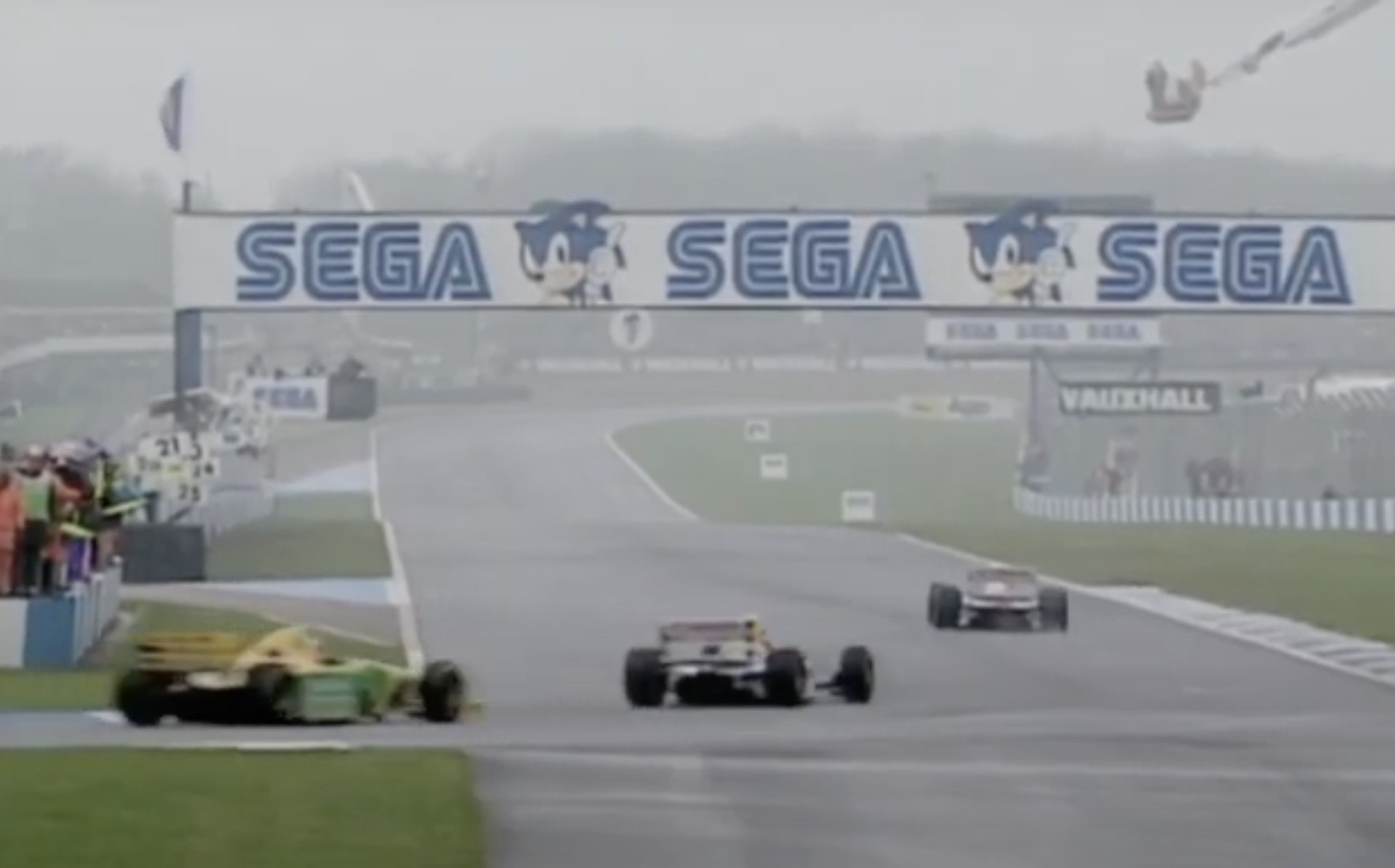
Throughout the race, the weather remained capricious, oscillating between heavy rain and light drizzle, forcing teams into multiple pit stops for tire changes. Senna, however, consistently made the right calls, often pitting at precisely the opportune moment or staying out when others scrambled. His pit crew executed flawlessly, but it was Senna’s judgment and relentless pace that truly set him apart. He drove with an almost ethereal command, navigating the treacherous track with a precision and speed that his rivals simply could not match. By the race’s end, Senna had lapped every car on the circuit except for Damon Hill, who finished a distant second, over a minute behind. It was a crushing victory, one of the most dominant performances of his illustrious career, and a stark reminder of his extraordinary talent even in an uncompetitive car.
Sonic’s Presence: Branding Beyond the Track
Sega’s marketing investment ensured that its presence at Donington Park was unmistakable. The Williams-Renault FW15C cars, already technological marvels, were transformed into high-speed billboards for the Sega brand. Large Sega logos were emblazoned across the cars’ bodywork, prominently displayed for the global television audience. A particularly creative touch, as detailed by Simon Morris, was the inclusion of a fake "cutaway" section on the side of the cockpit, revealing Sonic’s distinctive red-and-white shoes as if the speedy hedgehog himself was behind the wheel. Morris even recalled attempts to sponsor the underside of Damon Hill’s car, anticipating potential rollovers to maximize exposure—a testament to the aggressive and often humorous nature of Sega’s marketing at the time.
The contractual obligations for Williams drivers Alain Prost and Damon Hill extended beyond the track. They were required to participate in promotional photoshoots with Sonic the Hedgehog, often pictured holding Sega Game Gear handheld consoles. These images, featuring legendary sportsmen interacting with a video game character and console, were a vivid illustration of how deeply video games had permeated popular culture. For long-time gamers and Sega fans, this felt like a natural fit. Sega had a strong heritage in motorsport games, notably with the critically acclaimed Super Monaco GP and Super Monaco GP 2, the latter famously endorsed by Ayrton Senna himself. The irony, however, was not lost on observers: despite Sega’s deep sponsorship of Williams and its association with their drivers, it was Senna, driving a rival team’s car, who delivered the most iconic performance of the Sega-sponsored race.
The post-race podium ceremony provided perhaps the most enduring image of the entire weekend. As Senna stood atop the rostrum, celebrating his momentous victory, he was handed a unique, bespoke trophy: a gold-colored statuette of Sonic the Hedgehog. This image, of a stoic Ayrton Senna holding aloft the cheerful gaming mascot, quickly became iconic, transcending both motorsport and gaming circles. It fueled speculation about its authenticity and value, leading many to believe it was the official race trophy. However, as Morris clarified, the Sonic trophy was primarily for promotional purposes. Senna was later presented with the actual, official race trophy. The Sonic trophy, a promotional item, eventually found its way into a McLaren storeroom, only to be rediscovered years later, reaffirming its legendary status.
The Aftermath and Legacy: A Defining Moment
The 1993 Formula One European Grand Prix at Donington Park proved to be a defining moment for all involved. For Ayrton Senna, it was a confirmation of his unparalleled talent and a testament to his ability to triumph against technological disadvantages. Despite driving a less powerful McLaren, his victory was so comprehensive that it solidified his reputation as a "rain master" and one of the sport’s all-time greats. Senna would leave McLaren at the end of the 1993 season to join Williams, ironically the team Sega had so heavily sponsored. He sought the superior Williams chassis as his best chance for a fourth world championship. Tragically, his life and career were cut short at the 1994 San Marino Grand Prix, where he suffered a fatal accident, forever cementing his legendary status.
For Williams, despite Damon Hill’s distant second place, the season ultimately ended in triumph. Alain Prost secured his fourth and final world championship, and Williams clinched its sixth constructor’s championship, largely due to the technological superiority of the FW15C.
Sega’s fortunes following the 1993 season, however, proved more mixed. While 1994 continued to be a strong year for its 16-bit Mega Drive/Genesis platform, the company’s strategic decisions regarding next-generation hardware began to erode consumer confidence. The release of expensive and confusing add-ons like the Mega CD and 32X fragmented the market and diluted the brand’s focus. The subsequent launch of the 32-bit Sega Saturn in late 1994 (Japan) and 1995 (West) was overshadowed by Sony’s highly anticipated entry into the video game market with its phenomenally successful PlayStation console. The PlayStation’s aggressive pricing, developer-friendly architecture, and sophisticated marketing effectively halted Sega’s momentum as a hardware leader. Despite later efforts with the innovative Dreamcast, Sega eventually transitioned out of the console manufacturing business, becoming a third-party software developer.
Sega’s Enduring Impact in Sports Sponsorship
Despite the eventual shift in its core business, the XXXVIII Sega European Grand Prix remains the pinnacle of Sega’s promotional adventures. It was a bold, high-stakes gamble that paid off in terms of global visibility and brand association with excellence. While Sega would dabble in other significant sports sponsorships later, notably adorning the shirts of Premier League football club Arsenal (as well as other teams worldwide) with its logo and that of the Dreamcast console, none quite captured the same zeitgeist as Donington Park.
Simon Morris’s reflections underscore the unique, almost anarchic spirit of that era’s marketing. He recalled a charming anecdote about the McLaren team subtly adding a "squashed hedgehog" insignia to Senna’s car after his wins, a playful counterpoint to the "Pirate TV" insignia Sega put on Damon Hill’s car for his victories. Such spontaneous, organic acts of branding are almost unimaginable in today’s highly scrutinized, social-media-driven sports landscape. "Can you imagine that happening in the sport today, with the incredible sharing power of the internet and social media? It would go wild! Like so much of our promotional activity at the time, it was one of those things that simply came together," Morris mused.
The XXXVIII Sega European Grand Prix stands as a powerful testament to a specific moment in time: an era when a video game company, at the peak of its powers, dared to stake its claim on the global stage of Formula 1. It was a collision of speed, technology, and marketing brilliance, forever intertwining the iconic image of Ayrton Senna with the vibrant, rebellious spirit of Sonic the Hedgehog, leaving an indelible mark on both motorsport and popular culture.