
 Jia Lissa
The release of Landstalker: The Treasures of King Nole in October 1992 marked a pivotal shift in the trajectory of Climax Entertainment, a studio that had previously defined itself through the first-person dungeon crawling of Shining in the Darkness and the tactical strategy of Shining Force. Developed during a period of rapid expansion and technical experimentation, Landstalker represented a radical departure from established role-playing game (RPG) conventions on the 16-bit Sega Mega Drive. By abandoning traditional perspectives in favor of a complex, isometric "pseudo-3D" environment, director Kan Naito and his team sought to create an "electronic diorama" that would challenge the hardware limitations of the era and redefine player immersion.
The Genesis of an Isometric Vision
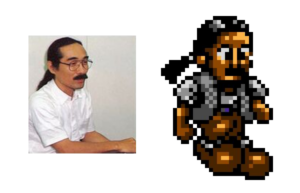
The development of Landstalker began in March 1991, at a time when Climax Entertainment was navigating its newfound success. Following the debut of Shining in the Darkness, the studio’s co-founder Hiroyuki Takahashi entered negotiations with Sega that resulted in the formation of Sonic Co., Ltd., a joint venture designed to bolster Sega’s RPG portfolio. This partnership allowed Climax to expand its staff and concurrently manage multiple high-profile projects. While Takahashi led the development of Shining Force, co-founder and lead programmer Kan Naito was granted the creative freedom to pursue a project that would eventually be titled Hero Lancelot: Legend of Shining, the precursor to Landstalker.
Naito’s primary obsession was the representation of three-dimensional space. Having been influenced by early PC-6001 titles like 3D Maze and his own work on the MSX title Midnight Brothers, Naito felt that the "corridor-based" 3D of his previous games was too restrictive. He envisioned a world where players could move vertically, diagonally, and with a tangible sense of depth. The inspiration for this perspective famously came to Naito while gazing out of his 10th-floor apartment window; watching the diagonal movement of traffic and pedestrians below, he realized that an oblique viewpoint could offer a cinematic, "Indiana Jones-esque" level of immersion.

The Technical Foundation: DDS520 and Mirage III
Translating an isometric vision to the Mega Drive was an immense technical undertaking. At the time, Japanese consoles rarely utilized oblique perspectives due to the strain on Video Random Access Memory (VRAM) and the complexity of horizontal and vertical sprite alignment. Naito spent nearly a year developing the "Diamond-Shaped Dimension System 520" (DDS520), a proprietary engine named for its use of 64×64 pixel diamond panels to compose the game world.
The DDS520 was designed to calculate height and depth constantly. Because the Mega Drive lacked native 3D hardware, Naito had to develop mathematical formulas to represent diamonds as vectors, optimizing processing speed to prevent the screen scrolling from lagging. A significant challenge was "priority order"—ensuring that characters correctly appeared in front of or behind objects. To manage this, every object in the game world was treated as a six-faced data block, including surfaces the player would never see.
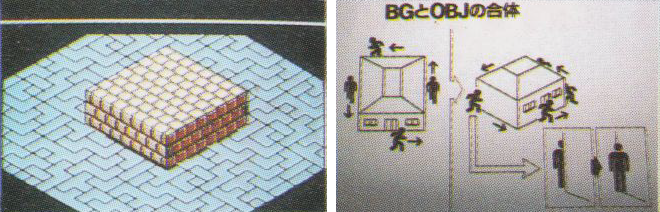
To streamline the creation of these environments, the team utilized Mirage III, a specialized graphics tool programmed by Yasuhiro Kumagi. This software allowed designers to view the game world as a wireframe, enabling them to detect geometric inconsistencies that would break the DDS520’s logic. By the end of development, the map capacity had expanded from an initial goal of 200 to a staggering 850 individual maps, which Naito estimated would be the size of the Tokyo Dome if laid out in a single continuous image.
Chronology of Development and the "Training Camp" Methodology
The development cycle of Landstalker lasted approximately 20 months, characterized by intense periods of collaboration known as "training camps." Naito, drawing on his experience at Chunsoft during the development of Dragon Quest, would sequester the team in the Yomiuri Land Hotel. These sessions involved 24-hour access to meeting rooms, where programming, planning, and design staffs worked until the early hours of the morning to finalize scenarios and map layouts.

Timeline of Key Milestones:
- March 1991: Project inception under the working title Hero Lancelot.
- October 1991: Artist Yoshitaka Tamaki begins character designs; Nigel (Lyle) and Friday are conceptualized.
- Autumn 1991: Yasuhiro Ohori joins as a map designer, bringing an arcade-influenced philosophy to combat and trap design.
- Early 1992: The DDS520 engine is finalized at its 12th revision.
- June 11, 1992: The game is officially unveiled to the press at the Tokyo Prince Hotel under the final title, Landstalker.
- September 1992: The 16Mb ROM is finalized.
- October 30, 1992: Landstalker launches in Japan.
Creative Direction and Characterization
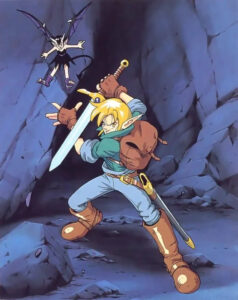
Yoshitaka Tamaki, the artist responsible for the aesthetic of the Shining series, was tasked with creating a protagonist who broke the "heroic archetype." The result was Nigel (Lyle in Japan), a forest elf and professional treasure hunter whose motivations were driven by profit and adventure rather than a traditional quest to save the world. Tamaki initially considered a "beastman wizard" design but pivoted to Nigel to better fit the adventurous tone Naito requested.

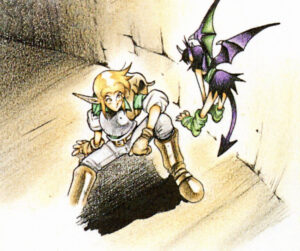
Nigel was paired with Friday, a palm-sized nymph who served as both a narrative companion and a gameplay mechanic for healing. The dynamic between the two was central to the game’s identity, though it drew early comparisons to Nintendo’s The Legend of Zelda. To differentiate the project, Tamaki emphasized Nigel’s status as a "romantic treasure hunter" and populated the world with morally ambiguous rivals like the mercenary Kayla and her bumbling companions, Wally and Ink.
The narrative development followed what chief map designer Kenji Orimo called the "flexible scenario method." Rather than following a rigid script, the story often expanded based on the maps themselves. For instance, when a designer created a tall tower for a castle map, the writers decided a princess (Lara) should be imprisoned there, leading to her inclusion in the plot.

The Auditory Landscape of Mercator
The soundtrack for Landstalker was composed by Motoaki Takenouchi, a protege of Dragon Quest composer Koichi Sugiyama. Takenouchi joined the project in February 1992, bringing a background in classical piano and synthesizer composition. He sought to create a "rhythmic orchestral" sound that would maximize the Mega Drive’s FM synthesis chip.
Takenouchi’s approach was highly atmospheric; for the character of Princess Loria (Lara), he composed a two-minute ballad that required no player input, intended for the audience to simply listen and appreciate the composition. Despite the technical limitations of managing sound noise at low volumes, Takenouchi produced 40 tracks that are now considered some of the finest in the 16-bit era. He later cited his work on Landstalker as a career highlight, though he eventually left the industry in 1996, frustrated by the corporate pressures of game development.
The "Shining Rogue" Mystery and Brand Separation
One of the most debated aspects of Landstalker’s history is its relationship to the Shining franchise. Internal documents and statements from staff, including sound programmer Yasuhiro Taguchi, confirm that the game was originally titled Shining Rogue and was intended to be a direct sequel to Shining in the Darkness. Early concept art by Tamaki even featured enemies from the previous game, such as the "Chestbeak" and "Kromeball."
However, by the June 1992 press conference, the game had been rebranded as a standalone IP. Naito officially stated that the gameplay was too distinct to be categorized as a Shining title. Yet, industry whispers and comments from Takenouchi suggested "internal frictions" within Climax. This creative divergence eventually saw Hiroyuki Takahashi take the Shining brand under the Sonic! Software Planning banner (later Camelot), while Naito focused Climax on isometric titles like Dark Savior and the Super Famicom spin-off, Ladystalker.
Market Reception and Enduring Legacy
Upon its release, Landstalker was a commercial and critical success, selling approximately 35,000 units in its first week in Japan—a strong figure for a new IP on the Mega Drive. Critics praised the DDS520 engine for its visual depth, though some players found the diagonal controls and lack of character shadows (omitted to preserve processing speed) to be a significant barrier to precision platforming.
The game’s legacy is defined by its uncompromising commitment to a specific aesthetic vision. While Climax Entertainment ceased operations in 2014, Landstalker has been preserved through numerous re-releases on the Wii Virtual Console, Steam, and the Mega Drive Mini. A planned 3D remake for the PlayStation Portable was showcased at the 2005 Tokyo Game Show but was ultimately canceled, leaving the original 16-bit masterpiece as the definitive version of Nigel’s adventure.

In retrospect, Landstalker stands as a testament to the "Golden Age" of Japanese RPG development, where small teams of programmers and artists pushed hardware to its absolute breaking point. By choosing geometry over tradition, Kan Naito and Climax Entertainment created a treasure that remains a benchmark for isometric design in the history of interactive entertainment.








