
 Farhan hamdan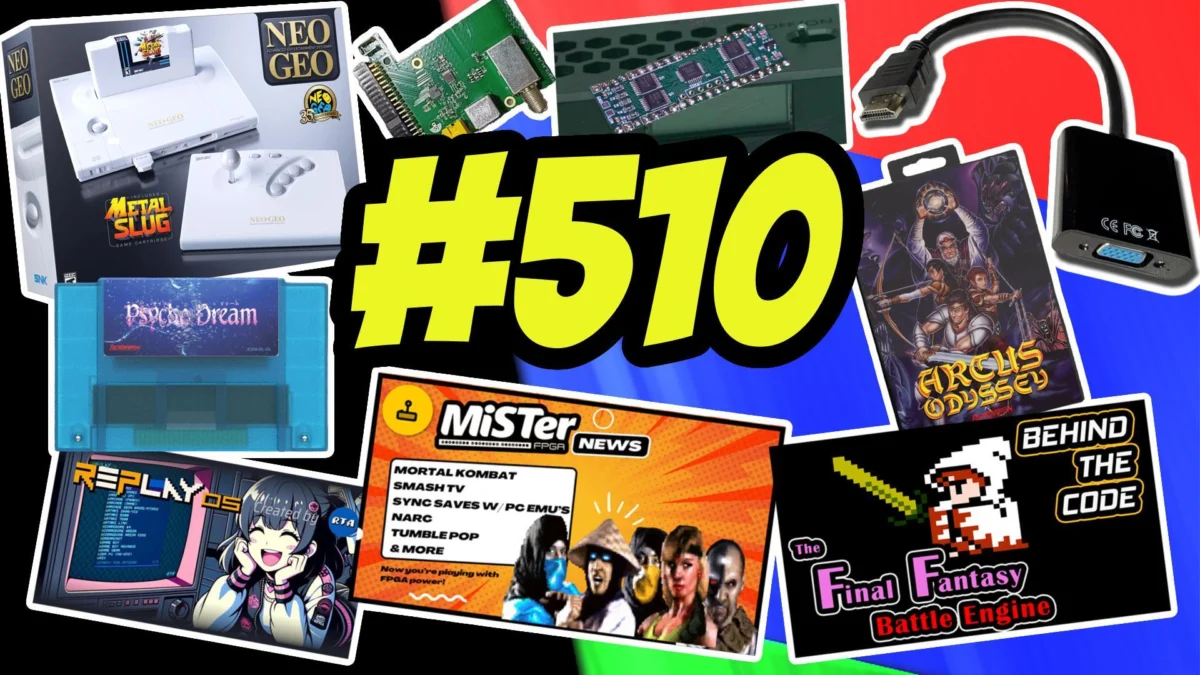
The retro gaming community continues to see a vibrant landscape of innovation, preservation efforts, and hardware revitalization, as highlighted in the latest "Weekly Roundup #510" released on April 22nd, 2026. This edition covers a spectrum of developments, from significant new hardware announcements for iconic systems like the Neo Geo AES to critical software updates for FPGA platforms, alongside detailed technical analyses and practical hardware solutions for enthusiasts. The ongoing evolution underscores a dedicated global network of developers, modders, and content creators committed to enhancing the experience of classic gaming.
Revitalizing Classic Hardware: The Neo Geo AES Re-Emergence
One of the most anticipated announcements detailed in the roundup concerns a "New Official Neo Geo AES." The SNK Neo Geo Advanced Entertainment System (AES), originally released in 1990, holds a legendary status in gaming history. Known for its arcade-perfect conversions and prohibitive price point at the time, the AES was often dubbed the "Rolls-Royce of gaming consoles." Its games, delivered on large, expensive cartridges, pushed the boundaries of 2D sprite-based graphics and sound, creating an unparalleled home arcade experience. For decades, owning an AES has been a significant investment for collectors, with original hardware often showing signs of age and requiring specialized display setups.
The prospect of a "new official" Neo Geo AES unit carries profound implications. Historically, official re-releases of classic consoles, such as Nintendo’s NES Classic Edition or Sony’s PlayStation Classic, have aimed at capturing nostalgia with scaled-down, emulation-based hardware. However, the term "official" in the context of a Neo Geo AES suggests a potentially more authentic, high-quality reproduction or even a modern reimagining endorsed by the original rights holders, SNK. Such a device would likely address common pain points of original hardware, including modern video output (HDMI), potentially improved internal components for reliability, and perhaps even built-in game libraries or cartridge compatibility. The announcement taps into a deep vein of collector desire and new player curiosity, offering a chance for a broader audience to experience the Neo Geo’s unique appeal without the prohibitive costs and maintenance associated with vintage units. The potential for a modern, officially sanctioned Neo Geo AES could redefine accessibility for this revered platform, bridging the gap between historical significance and contemporary gaming standards. Market analysts suggest that such a product, if executed with fidelity to the original experience while integrating modern conveniences, could command significant interest among both veteran collectors and new enthusiasts looking to delve into arcade history.
Enhancing Visual Fidelity: OSSC Pro and NES Lumacode Optimization
The pursuit of pristine video output for retro consoles remains a cornerstone of the modern retro gaming movement. The roundup highlights two key developments in this area: Nicole’s review of the OSSC Pro’s RF-In capabilities and a specialized guide for optimizing NES video with the original OSSC using a "Lumacode" profile.
The Open Source Scan Converter (OSSC) series, developed by Markus Hiienkari, has become an indispensable tool for retro gamers. It’s renowned for its ability to convert analog video signals from classic consoles into digital HDMI output with minimal lag, preserving the pixel-perfect aesthetic and progressive scan output crucial for modern displays. The OSSC Pro represents the next generation, building upon its predecessor’s success with advanced features. Nicole’s review of its RF-In functionality is particularly significant. Radio Frequency (RF) modulation was the most common, and often the only, connectivity option for early home consoles, delivering composite video and audio signals over a single coaxial cable. While ubiquitous, RF is inherently prone to signal degradation, noise, and blurry images, making it the least desirable video output method for discerning players. The OSSC Pro’s ability to process and potentially clean up RF signals, as highlighted in the review, marks a significant step towards preserving the original display methods of early consoles while striving for the best possible image quality under such challenging circumstances. This innovation caters to purists who wish to connect their consoles exactly as they would have been in their original era, but with the benefit of modern processing.
Complementing this, the "Original OSSC NES Lumacode Profile Setup Guide" addresses the unique video output characteristics of the Nintendo Entertainment System (NES). The NES PPU (Picture Processing Unit) generates a composite video signal that, while groundbreaking for its time, exhibits specific artifacts and color limitations. The term "Lumacode" likely refers to advanced OSSC settings that specifically target the luma (brightness) and chroma (color) components of the NES’s composite signal, aiming to correct known issues such as color bleed, rainbow banding, or desaturation. By meticulously configuring the OSSC, enthusiasts can achieve a cleaner, more vibrant, and accurate representation of NES graphics on modern displays, moving beyond the often-muddy appearance typical of standard composite connections. These guides and reviews exemplify the community’s dedication to pushing the boundaries of retro video fidelity, ensuring that classic games look their absolute best, regardless of their original output limitations. The continued refinement of such tools is vital for the long-term enjoyment and accurate presentation of gaming history.
Unpacking Gaming Mechanics: Final Fantasy’s Battle Engine Dissection
The "Final Fantasy Battle Engine BTC" (Behind The Code) analysis represents a deep dive into the technical intricacies of one of gaming’s most iconic RPG series. Such dissections are crucial for understanding the foundational design principles of classic titles, aiding in preservation, accurate emulation, and the creation of fan translations or modifications. The Final Fantasy series, particularly its early installments on the NES and SNES, established many conventions of the Japanese Role-Playing Game (JRPG) genre, including its turn-based battle systems, intricate magic mechanics, and character progression.
A detailed dissection of the battle engine, specifically focusing on "physical attacks," would uncover the algorithms governing damage calculation, critical hit rates, evasion mechanics, and how various character statistics interact. This involves analyzing assembly code, memory maps, and game logic to understand precisely how a seemingly simple sword swing translates into numerical damage and visual feedback within the game engine. Such an effort contributes significantly to the collective knowledge base of retro gaming. For emulators, this information ensures pixel-perfect and frame-accurate replication of original hardware behavior. For fan communities, it provides the foundation for balance patches, new content creation, or even reverse-engineering the engine for modern ports or reimaginings. Moreover, it offers invaluable insight for game design students and historians, revealing the ingenious methods developers employed within the stringent technical limitations of the era to create compelling gameplay experiences. These "Behind The Code" investigations are a testament to the enduring appeal and complexity of classic games, demonstrating that even decades later, there is still much to learn from their underlying architecture.
MiSTer FPGA: A Hub of Continuous Innovation
The MiSTer FPGA platform continues to be a focal point of development in the retro gaming community, as evidenced by "Lu’s MiSTer Updates." The MiSTer project leverages Field-Programmable Gate Arrays (FPGAs) to recreate classic arcade and console hardware at a transistor level, offering unparalleled accuracy and ultra-low latency compared to software emulation. This approach ensures that games behave almost identically to their original counterparts, making it a gold standard for retro gaming enthusiasts.
Lu’s updates frequently cover significant advancements across various cores (the FPGA implementations of specific hardware). The mention of "Mortal Kombat sync saves with PC emulators" is a notable development. The Mortal Kombat series, particularly its early arcade iterations, is legendary for its unique digitized graphics and brutal gameplay. An accurate MiSTer core for these games is highly valued. The ability to synchronize save states or progress between a MiSTer FPGA and PC emulators represents a significant quality-of-life improvement. This feature allows players to seamlessly transition their gaming sessions between different platforms, perhaps starting a game on their MiSTer setup and continuing it on a portable device or a different PC, enhancing flexibility and convenience. This interoperability highlights the MiSTer community’s focus on user experience alongside hardware accuracy.

Beyond specific game cores, MiSTer updates often encompass broader system enhancements, such as improved input latency, better audio processing, support for new peripherals, and general stability improvements. The open-source nature of the MiSTer project fosters a global community of developers who contribute tirelessly, refining existing cores and creating new ones for a vast array of vintage systems. This collaborative model ensures rapid progress and a continuous stream of innovations, solidifying MiSTer’s position as a leading platform for hardware-accurate retro gaming. The ongoing development efforts underscore the platform’s commitment to not just preserving, but actively enhancing, the experience of classic games for future generations.
Modernizing Retro Interfaces: RePlayOS and Cost-Effective Connectivity
Innovation in retro gaming extends beyond core hardware to user interfaces and peripheral compatibility. The roundup features "RePlayOS Touchscreen Support" and a review of a "$5 HDMI to VGA DAC," both addressing crucial aspects of usability and display connectivity.
RePlayOS is likely an operating system or frontend designed for retro gaming devices, such as single-board computers (like Raspberry Pi) or FPGA platforms. The addition of touchscreen support significantly enhances the user experience, offering a more intuitive and direct method of navigation compared to traditional controller or keyboard inputs. Touchscreens can streamline menu selections, game browsing, and configuration adjustments, making the retro gaming setup more accessible and user-friendly, especially for devices integrated into arcade cabinets or portable handhelds. This development reflects a broader trend in retro computing to marry classic content with modern interface paradigms, improving accessibility without compromising the core retro experience. Developers aim to provide flexible control options, recognizing that modern users are accustomed to diverse input methods.
Concurrently, the "$5 HDMI to VGA DAC" (Digital-to-Analog Converter) addresses a common compatibility challenge in retro setups. Many retro gaming enthusiasts utilize older CRT monitors or specialized VGA displays for an authentic visual experience due to their native support for lower resolutions and interlaced signals, which modern LCDs often struggle with. Conversely, many modern retro consoles or upscalers output via HDMI. A cost-effective HDMI to VGA DAC provides a bridge, allowing modern digital HDMI signals to be converted into analog VGA for legacy displays. While premium converters exist, a $5 solution democratizes this capability, making it accessible to a wider audience. The review would likely assess its performance, signal integrity, and potential limitations at such a low price point, providing valuable information for budget-conscious retro gamers seeking specific display solutions. These types of practical, affordable hardware solutions are vital for maintaining the diverse ecosystem of retro gaming, catering to various preferences for display technology and control methods.
Preserving and Re-Releasing Classics: Retro-Bit’s Contribution
The preservation and re-release of classic games play a pivotal role in ensuring that gaming history remains accessible. The roundup highlights "Arcus Odyssey & Psycho Dream Retro-Bit Re-releases," showcasing the continued efforts of companies like Retro-Bit in this crucial area. Retro-Bit has established itself as a key player in the retro gaming market by collaborating with original intellectual property holders to produce officially licensed cartridges and accessories for vintage consoles.
Arcus Odyssey, originally released for the Sega Genesis/Mega Drive in 1991, is a lesser-known but critically acclaimed action RPG developed by Wolf Team. It features intricate level design, challenging combat, and a compelling narrative. Psycho Dream, a Super Famicom (Japanese SNES) title from 1992, is a unique side-scrolling action game known for its surreal aesthetics and challenging difficulty. Both titles, while not mainstream blockbusters, represent important pieces of gaming history that might otherwise be difficult or expensive for modern players to experience due to their scarcity or regional exclusivity.
Retro-Bit’s re-releases often involve high-quality, newly manufactured cartridges compatible with original hardware, often including collector’s packaging, manuals, and sometimes even exclusive bonus content. This approach not only provides a legal and accessible way for fans to own and play these games on original systems but also contributes to the broader preservation movement by keeping these titles in circulation and introducing them to new generations. The process involves meticulous work with rights holders to ensure authenticity and quality, distinguishing these re-releases from unauthorized reproductions. The impact of such initiatives is significant, as it helps to cement the legacy of these games, supports their creators, and makes them available to a global audience without the complexities of emulation or the high cost of vintage collecting.
Beyond the Console: Practical Tech and Lifestyle
While the core focus of the "Weekly Roundup" is invariably on retro gaming, the inclusion of "Short Jeep/Truck Antenna Replacement," "Jeep Dash Tray," and "AutoStop Eliminator" demonstrates a broader interest in practical technology and lifestyle enhancements. These items, though seemingly disparate from gaming, cater to a segment of the audience interested in general tech solutions, vehicle modifications, or efficiency improvements.
The "Short Jeep/Truck Antenna Replacement" likely addresses aesthetic or practical concerns for vehicle owners, replacing long, cumbersome antennas with more compact versions. A "Jeep Dash Tray" offers a convenient storage solution, enhancing interior organization. The "AutoStop Eliminator" is a device designed to disable the automatic engine start/stop feature found in many modern vehicles, a common point of contention for drivers who prefer continuous engine operation. These inclusions suggest that the content creator behind the roundup caters to a diverse audience with interests extending beyond purely gaming-related topics, offering practical insights into everyday technology and automotive accessories. While not directly contributing to the retro gaming experience, they reflect a shared enthusiasm for functional and innovative products that improve daily life.
Sustaining the Retro Community: The Role of Support and Engagement
The comprehensive nature of "Weekly Roundup #510" underscores the tremendous effort involved in creating detailed reviews, technical guides, and news updates for the retro gaming community. The call for support via monthly services, tips, or affiliate links is a vital mechanism for sustaining this ecosystem. Content creators, hardware developers, and software modders often dedicate countless hours to their passion projects, relying on community backing to cover research and development costs, equipment acquisition, and time investment.
Platforms like Patreon enable direct financial contributions, fostering a symbiotic relationship between creators and their audience. Affiliate links, while offering convenience to consumers, provide a small commission to the creator at no extra cost to the buyer, representing a passive yet effective form of support. This model of community-driven funding is particularly prevalent and successful in niche markets like retro gaming, where mainstream commercial support might be limited. The ongoing engagement and financial contributions from enthusiasts directly fuel the continuous stream of innovation, preservation, and educational content that defines the modern retro gaming scene. It ensures that critical analyses, new hardware developments, and comprehensive guides continue to be produced, enriching the experience for everyone involved and safeguarding the legacy of gaming for future generations.








