Hartono Sudibyo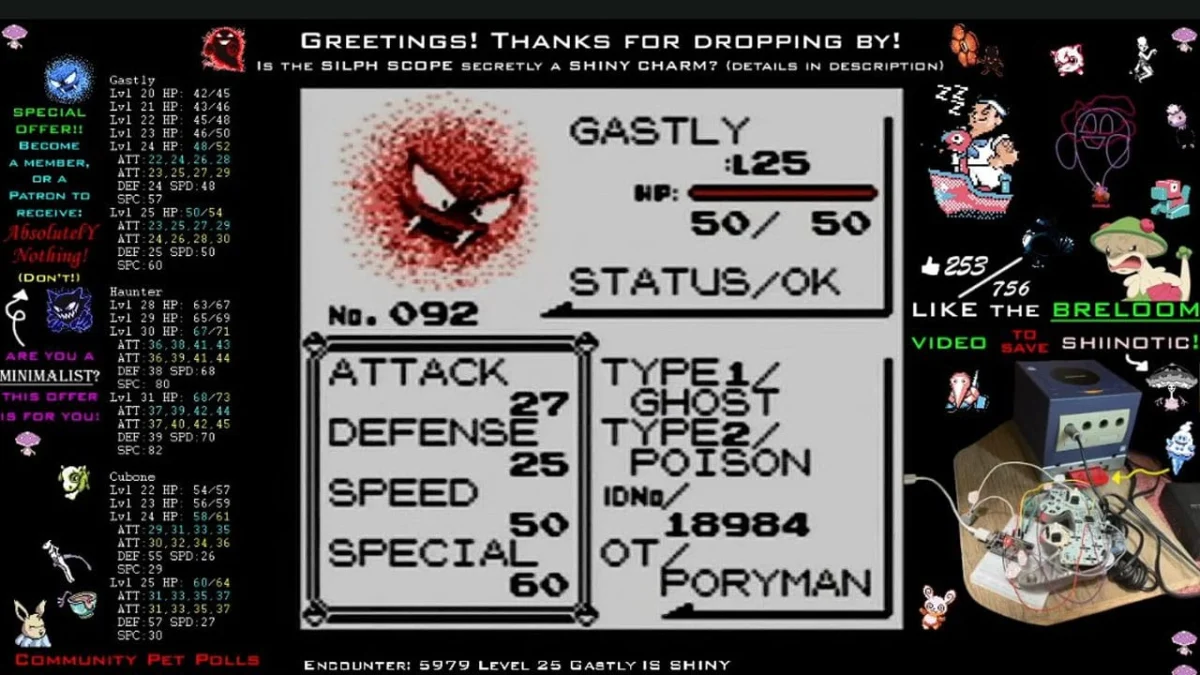
The world of Pokémon, even decades after its initial release, continues to surprise and intrigue. A recent discovery within the foundational games of the franchise, Pokémon Red and Blue, has sent ripples of excitement through the dedicated fan base. A phenomenon previously believed to be impossible – encountering a wild Shiny Pokémon in the first-generation titles – has been documented, and the location adds a layer of thematic resonance to the discovery: the notoriously eerie Pokémon Tower in Lavender Town. This breakthrough challenges long-held assumptions about the mechanics of these beloved early games and opens up new avenues for exploration and understanding of their intricate code.
The Unforeseen Shiny Encounter
For years, the consensus among Pokémon enthusiasts and data miners was that wild Pokémon encounters in Pokémon Red and Blue were inherently "shiny locked." This meant that the specific combination of values, known as Determinant Values (DVs) in the original games, required for a Pokémon to be classified as shiny, could not be generated through the game’s standard wild encounter mechanics. Shiny Pokémon, distinguishable by their alternate color palettes, were introduced in the second generation of games, Pokémon Gold and Silver, and were not intended to be found in the wild in their predecessors. Therefore, obtaining a shiny in Red or Blue typically involved complex glitches, trading with a shiny Pokémon from a later generation, or manipulating save data.
However, this established understanding has been dramatically altered by the findings of a dedicated Pokémon ROM hacker and content creator known by the handle Porygondolier. Through extensive experimentation with a modified version of Pokémon Red, Porygondolier identified a peculiar anomaly within the digital confines of Pokémon Tower. This iconic in-game location, known for its somber narrative and the spectral presence of Gastly, Haunter, and Gengar, appears to possess a unique set of encounter parameters that differ from the rest of the Kanto region.
The Role of the Silph Scope: A Catalyst for Shininess
The key to this groundbreaking discovery lies in an in-game item that players acquire during their journey through Pokémon Tower: the Silph Scope. This item is crucial for progressing through the tower, as it allows players to identify the Ghost-type Pokémon that are otherwise invisible and intangible to the player character. Porygondolier’s research suggests that the Silph Scope, when interacting with the game’s encounter engine specifically within Pokémon Tower, triggers a reassessment of the Pokémon’s DVs.
According to Porygondolier’s analysis, the act of using the Silph Scope in this specific context appears to force a "DV reroll." This reroll effectively resets the Pokémon’s DVs, granting it a chance to generate a combination that aligns with the criteria for being shiny. This is a significant deviation from the game’s standard wild encounter system, where such DV combinations are seemingly inaccessible. The consequence of this reroll is a dramatic shift in the odds: the probability of encountering a shiny Pokémon, which was previously considered to be zero in wild encounters, is now theoretically elevated to the same odds as in the second-generation games – approximately 1 in 8192.
Chronology of the Discovery
The revelation of this phenomenon has unfolded through a series of community discussions and shared findings. While the exact date of Porygondolier’s initial breakthrough is not publicly detailed, the dissemination of this information gained significant traction around April 22, 2026. A prominent tweet from user @SirToastyToes, shared on this date, brought wider attention to Porygondolier’s findings, stating: "A YouTuber named Porygondolier has found a wild shiny Gastly in Pokemon Tower. Normally overworld encounters in Red/Blue are shiny locked as no shiny DV combinations can generate. BUT the Silph Scope allegedly causes a DV reroll, returning the odds to 1/8192." This tweet was accompanied by a visual confirmation, likely a screenshot or video clip, showcasing the shiny Gastly. The credit for this visual evidence was attributed to the user Porygondolier, reinforcing the YouTuber’s role in the discovery. The event has since been documented and discussed on various retro gaming platforms and forums, solidifying its place in Pokémon history.

Background: The Lore and Mechanics of Shiny Pokémon
The concept of Shiny Pokémon, while now a staple of the franchise, was an unexpected addition to the Pokémon universe. Introduced in Pokémon Gold and Silver (released in 1999 in Japan and 2000 internationally), these rare color variants were a surprise to players who had become accustomed to the standard sprites of their favorite creatures. The implementation of shiny Pokémon was an incidental byproduct of the game’s mechanics. The DV system in Generation 1 was used for various attributes, including a Pokémon’s stat modifiers and its ability to be shiny. In Generation 2, the DV system was replaced by the Individual Values (IVs) system, and a separate set of values was dedicated to determining shininess.
The DV system in Generation 1 had 16 possible values for each of the four stats (Attack, Defense, Speed, and Special). A Pokémon was considered shiny if its Attack, Defense, and Speed DVs were all 10, and its Special DV was either 10 or 11. This specific combination was not achievable through the normal wild encounter generation process in Red and Blue. This is why, prior to Porygondolier’s discovery, wild shiny encounters in these games were considered a myth or a product of glitches unrelated to standard gameplay.
Pokémon Tower itself holds a significant place in the narrative of Pokémon Red and Blue. It is the resting place of the Pokémon that have passed away, and the player encounters the tormented spirit of Marowak, as well as Team Rocket members who are harassing the Pokémon and their ghosts. The atmosphere of the tower is one of solemnity and unease, making the discovery of a rare and visually distinct shiny Pokémon within its haunted halls particularly poignant. Gastly, the very Pokémon that inhabits the tower in abundance, being the first confirmed wild shiny, adds a layer of thematic relevance to the discovery.
Supporting Data and Technical Analysis
The technical explanation behind this phenomenon, as articulated by Porygondolier and shared within the community, centers on the interaction between the Silph Scope and the game’s internal data handling. When the player obtains the Silph Scope and enters Pokémon Tower, the game’s programming is altered to allow for the recognition of Ghost-type Pokémon. It is theorized that this alteration causes a specific subroutine related to Pokémon identification to be re-engaged or modified.
In the context of wild Pokémon encounters, the game typically generates a Pokémon based on the encounter tables for the specific route or area. The DVs for this generated Pokémon are then assigned. However, the standard process in Red and Blue does not allow for the generation of the specific DV combinations required for a shiny Pokémon. Porygondolier’s discovery suggests that the Silph Scope’s presence or activation within Pokémon Tower forces a re-evaluation of these DVs. This "reroll" means that the Pokémon is not simply assigned a predetermined DV value, but rather, its DVs are recalculated, giving it a chance to fall within the shiny parameters.
This is a crucial distinction from other forms of Pokémon manipulation. While glitches could theoretically lead to shiny Pokémon in Generation 1, this method appears to be tied to a specific in-game item and a particular in-game location, suggesting a more integrated, albeit unintended, game mechanic at play. The fact that this occurs with wild encounters, rather than through breeding or other complex manipulation, makes it a significant find.
Reactions and Implications
The discovery has been met with considerable excitement and awe within the Pokémon community. For many long-time fans, this revelation offers a new perspective on the depth and complexity of the original Pokémon games, which were developed with limitations that are now dwarfed by modern technology. The idea that such a sought-after feature as shiny Pokémon could have been subtly present, waiting to be unlocked through a specific game interaction, is a testament to the enduring mysteries of these titles.

While there have been no official statements from Nintendo or The Pokémon Company regarding this specific discovery, the implications for the retro gaming community are substantial. It encourages further exploration and analysis of the game’s code and mechanics. It also raises questions about other potential hidden mechanics or undocumented features that might still exist within these classic games.
The discovery also highlights the persistent dedication of the Pokémon fan base. Content creators like Porygondolier, through their passion and technical expertise, continue to uncover new layers of understanding in games that have been in the public consciousness for decades. This pursuit of knowledge not only enriches the collective understanding of Pokémon history but also fuels the ongoing interest and engagement with these foundational titles.
Broader Impact and Future Possibilities
The unearthing of a wild shiny encounter in Pokémon Red and Blue through this specific method has several broader implications. Firstly, it revitalizes interest in the technical aspects of game development for the Nintendo Entertainment System (NES) era. It demonstrates that even with the perceived limitations of the hardware, developers could create intricate systems that, when interacted with in unexpected ways, could yield surprising results.
Secondly, this discovery might inspire a new wave of ROM hacking and glitch hunting. Players and developers may now be motivated to investigate other locations and items within the game to see if similar "hidden" mechanics can be uncovered. The Pokémon Tower anomaly serves as a precedent, suggesting that other areas might harbor similar secrets, perhaps related to other rare Pokémon appearances or unique gameplay interactions.
Furthermore, this finding underscores the enduring appeal of Pokémon. The franchise, now over three decades old, continues to captivate new generations of players while simultaneously fostering a deep appreciation for its origins among long-time fans. Discoveries like this inject a fresh sense of wonder into the familiar, reminding everyone that there are still unexplored corners within the worlds they thought they knew so well. It’s a powerful reminder that the digital landscapes of our favorite games can hold secrets waiting for the right explorer, the right tool, and perhaps, the right spooky tower. The question now remains: what other spectral secrets does Kanto hold?