Jia Lissa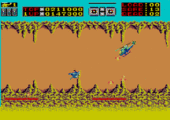
The release of Choplifter for the Sega Master System in 1986 marked a significant milestone in the evolution of the "shoot ’em up" (shmup) genre, transitioning a beloved home computer classic into a powerhouse arcade-style experience. Originally conceived by Dan Gorlin and published by Brøderbund for the Apple II in 1982, Choplifter stood out from its contemporaries by shifting the primary objective from mindless destruction to a mission of mercy. While most titles in the early 1980s focused on high scores through elimination, Gorlin’s design prioritized the preservation of life, requiring players to navigate a fragile helicopter into enemy territory to retrieve prisoners of war. When Sega Enterprises acquired the rights to adapt the property for the arcade in 1985, the project was handed to Rikiya Nakagawa, a developer who would later become a cornerstone of Sega’s arcade success with titles like Alien Syndrome and Thunder Blade. Nakagawa’s refinements transformed the minimalist Apple II original into a visually lush, mechanically complex experience that would eventually find its definitive 8-bit home on the Sega Master System.
The Evolution of Choplifter From Computer to Arcade
The journey of Choplifter from a 48K RAM computer program to a high-fidelity arcade cabinet involved a complete overhaul of the game’s aesthetic and pacing. In October 1985, Sega Enterprises USA debuted the arcade version as a conversion kit alongside the groundbreaking motorcycle racer Hang-On. This version utilized the Sega System 1 and System 2 hardware, which allowed for a significantly higher color palette and more fluid animations than the Apple II or Commodore 64 versions.
Rikiya Nakagawa recognized that arcade players required a faster pace and higher stakes. He implemented several core changes to the gameplay loop. While the original game tasked players with rescuing 16 hostages per sortie, Nakagawa reduced the capacity of the helicopter to eight, forcing players to make more frequent trips back to the home base. This increased the tension, as every return trip exposed the player to escalating enemy reinforcements. Furthermore, Sega expanded the game’s scope by adding diverse environments. The original desert setting was supplemented by a naval fleet stage and a subterranean cave level, providing a level of variety that was rare for the era. These enhancements served as the blueprint for the 1986 Master System port, which sought to replicate the arcade’s intensity within the constraints of home hardware.
Technical Specifications and the Master System Port
The Sega Master System (SMS), released in North America in 1986, was technically superior to its primary rival, the Nintendo Entertainment System (NES), in several key areas. The SMS featured a custom VDP (Video Display Processor) capable of displaying up to 32 colors simultaneously from a palette of 64, compared to the NES’s more limited color depth. Choplifter utilized this hardware to deliver some of the most impressive visuals available on the console at the time.
One of the most notable technical achievements in the SMS port of Choplifter was the implementation of parallax scrolling. By moving background elements at a slower speed than the foreground, the developers created a sense of depth that was absent in many other 8-bit titles. The desert stage featured shimmering heat effects and distant dunes, while the naval stage showcased rolling waves and a multi-layered sky. This visual fidelity was paired with a sophisticated physics engine for the helicopter itself. Unlike the rigid movement found in many side-scrolling shooters, the helicopter in Choplifter possessed inertia. Players had to account for momentum when banking, ascending, or descending, making the act of landing—especially under fire—a genuine test of skill.
Detailed Gameplay Mechanics and Mission Structure
The fundamental objective of Choplifter on the Master System remains consistent across its six stages, which are comprised of three distinct environments looped twice with increased difficulty. The player controls a rescue helicopter, moving laterally across a sprawling battlefield. The mission flow is divided into three critical phases: infiltration, retrieval, and extraction.
In the infiltration phase, players must navigate past anti-aircraft fire, jet fighters, and ground-based tanks to reach the hostage barracks. Upon arrival, the player must use their onboard machine gun to breach the buildings, releasing the hostages. The retrieval phase is the most delicate; the helicopter must be landed carefully. If the player lands directly on a hostage, that hostage is killed instantly. Once on the ground, the helicopter is a sitting duck for enemy tanks and bombers. Hostages will run toward the craft, but their progress can be halted by enemy fire.
The extraction phase requires the player to return to the "Post Office" (the designated safe zone) and land to offload the survivors. A total of 40 hostages must be rescued to progress to the subsequent environment. The game provides a slim margin for error; with only 48 hostages available in a level, losing more than eight results in an immediate "Game Over," regardless of how many lives the player has remaining. This mechanic ensures that players cannot simply "brute force" their way through levels through attrition.
Environmental Analysis and Level Design
The three primary environments in Choplifter each present unique tactical challenges that require players to adapt their flight patterns:
- The Desert (Stages 1 and 4): This environment serves as the introduction to the game’s mechanics. The terrain is relatively flat, but the sky is cluttered with "Sproing" mines and fast-moving jets. In the looped version (Stage 4), the setting shifts to a night-time aesthetic, and enemy aggression is significantly ramped up.
- The Ocean (Stages 2 and 5): This stage introduces naval warfare. Hostages are held on a series of transport ships and a massive aircraft carrier. A unique mechanic in this level involves hostages swimming from a sinking submarine to the player’s helicopter. The lack of solid ground requires the player to hover precisely or land on the small decks of moving vessels.
- The Cave (Stages 3 and 6): Widely considered the most difficult portion of the game, the cave environment features tight corridors and environmental hazards like stalactites. The vertical space is severely limited, making it difficult to dodge incoming fire. The claustrophobic design forces players to engage in close-quarters combat with ground forces while managing the helicopter’s momentum to avoid crashing into the ceiling.
Chronology of the Choplifter Franchise
To understand the impact of the Master System port, one must look at the broader timeline of the franchise’s development and its influence on the industry:
- 1982: Dan Gorlin releases the original Choplifter for the Apple II. It becomes a massive hit, later ported to the Atari 8-bit family and Commodore 64.
- 1985: Sega releases the arcade version, introducing the three-stage loop and enhanced graphics.
- 1986: Sega publishes the Master System port, which is hailed as one of the best "arcade-perfect" translations of the era.
- 1991: Choplifter II is released for the Game Boy, developed by Beam Software. It introduces more complex mission objectives and varied weaponry.
- 1994: Choplifter III arrives on the Super Nintendo and Sega Game Gear, further refining the graphics and adding boss encounters.
- 2012: Choplifter HD is released for modern platforms (PC, PS3, Xbox 360), bringing the classic gameplay into a 2.5D environment with modern physics and cinematic storytelling.
Critical Reception and Market Impact
Upon its release, Choplifter was a critical success for the Sega Master System. Reviewers praised the game for its balance of action and strategy. Unlike the NES library, which in 1986 was heavily focused on platformers like Super Mario Bros. and arcade ports like Kung Fu, Choplifter offered a more methodical experience. Contemporary gaming magazines noted that while the game was exceptionally difficult—particularly the cave stage—the "just one more try" factor was incredibly high.
The game also served as a showcase for the Master System’s hardware. The fluid animation of the hostages and the detailed sprites of the enemy tanks were often cited as evidence that Sega’s console was the more powerful machine. However, the game’s brevity was a point of contention. Experienced players could complete all three environments in under 15 minutes once they had memorized enemy patterns. To counteract this, Sega ensured the difficulty curve was steep, effectively extending the playtime through the necessity of practice and repetition.
Legacy and Modern Implications
The legacy of Choplifter extends beyond its own sequels. It helped popularize the "rescue shmup" sub-genre, influencing later titles such as Desert Strike: Return to the Gulf and its successors, which expanded on the concept of helicopter-based extraction missions with more tactical depth and open-ended maps.
Furthermore, Choplifter is remembered for its "Easter eggs." If a player manages to destroy 16 rockets in specific stages, iconic characters like Superman or E.T. the Extra-Terrestrial will appear on the screen. These inclusions were a testament to the era’s experimental development culture and Sega’s desire to pack their home cartridges with hidden secrets to reward dedicated players.
In a modern context, Choplifter for the Master System remains a definitive example of how to port an arcade title to home hardware. By focusing on the core "rescue" loop and utilizing the system’s superior color palette and scrolling capabilities, Sega created a version of the game that many enthusiasts consider superior to the arcade original. Its inclusion in various "best of" lists for the Master System library underscores its status as a foundational title in the history of home console gaming. Despite its short length and punishing difficulty, the game’s unique premise—that saving a life is just as exhilarating as taking one—continues to resonate with retro gaming audiences worldwide.