Jia Lissa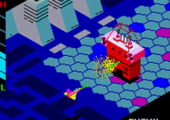
Released in 1982 by Sega Enterprises, Zaxxon represented a significant technological and stylistic departure from the prevailing trends of the early arcade era. While the "shoot-’em-up" (shmup) genre was already well-established through titles such as Space Invaders (1978) and Galaxian (1979), Zaxxon introduced a visual depth and mechanical complexity that had previously been unseen in the industry. Developed by Sega and distributed in North America by Gremlin Industries, the title became a cornerstone of arcade culture, primarily due to its pioneering use of axonometric projection—more commonly referred to as an isometric perspective. This viewpoint provided a simulated three-dimensional environment on two-dimensional hardware, effectively changing the player’s relationship with the digital space and setting a new standard for graphical sophistication.
Technical Innovation and the Isometric Perspective
The most striking feature of Zaxxon was its visual presentation. In 1982, most arcade shooters utilized either a fixed screen, a vertical scroll, or a horizontal scroll. Zaxxon broke this mold by presenting the game world at a 45-degree angle, creating a sense of depth that allowed for gameplay involving both lateral movement and vertical altitude. This was achieved through axonometric projection, a technique that maintains the scale of objects regardless of their position on the screen, thus providing a consistent 3D effect without the need for complex polygon rendering, which was beyond the capabilities of early 1980s hardware.
The hardware powering Zaxxon was the Sega G80 system, which utilized the Zilog Z80 microprocessor. This board was capable of handling the sprite-heavy environments and the unique scrolling required to simulate flight over a fortified space fortress. To assist players in navigating this new 3D space, Sega implemented a shadow mechanic. By observing the shadow of their craft on the ground below, players could gauge their actual position and altitude relative to obstacles. This was a critical innovation, as the isometric view often created optical illusions regarding the proximity of enemy fire and physical barriers.
Core Gameplay Mechanics and the Flight Simulation Influence
Zaxxon placed players in the cockpit of a fighter craft tasked with infiltrating a heavily defended space station. Unlike its contemporaries, the game utilized a flight stick controller rather than a traditional joystick, reinforcing the simulation aspect of the experience. The controls were "inverted" in accordance with standard aviation logic: pulling back on the stick caused the ship to ascend, while pushing forward caused it to descend.
The gameplay was divided into three distinct phases:
- The Space Fortress Infiltration: Players navigated through a series of walls, energy barriers, and turrets. Success required precise altitude management to fly through narrow gaps.
- The Open Space Battle: A transitionary phase where players engaged enemy fighter jets in a more traditional dogfight setting.
- The Boss Encounter: The final confrontation with the titular Zaxxon robot, a massive mechanical sentinel that required high-speed reflexes and accurate targeting to defeat.
Adding to the difficulty was a fuel consumption system. Unlike many shooters where the only threat was enemy fire, Zaxxon forced players to monitor a fuel gauge. To replenish fuel, players had to destroy fuel canisters scattered throughout the enemy base. This mechanic introduced a risk-reward element; players often had to dive into dangerous, low-altitude areas to secure fuel, risking a collision with ground-based defenses to ensure they did not crash from an empty tank.
Chronology of Development and Market Impact
The development of Zaxxon occurred during a period of rapid expansion for Sega. Having acquired the American company Gremlin Industries in the late 1970s, Sega was poised to dominate the global arcade market. Zaxxon was a centerpiece of this strategy.
- January 1982: Zaxxon is released in Japanese arcades, immediately garnering attention for its unique visuals.
- April 1982: The game is licensed to Gremlin Industries for North American distribution. It becomes a massive commercial success, eventually selling over 30,000 arcade cabinets in the United States alone by the end of the year.
- 1982–1983: Sega and Coleco enter an agreement to bring Zaxxon to home consoles. The ColecoVision port becomes one of the system’s "killer apps," praised for its proximity to the arcade experience despite hardware limitations.
- 1984: The release of Super Zaxxon, a sequel that increased the game’s speed and difficulty while introducing new enemy types. However, it failed to capture the same level of cultural zeitgeist as the original.
- 1987: Zaxxon 3-D is released for the Sega Master System, utilizing the SegaScope 3-D glasses to provide actual depth perception, a literal realization of the original game’s 3D ambitions.
- 1995: Zaxxon’s Motherbase 2000 is released for the Sega 32X, attempting to modernize the franchise with polygon graphics, though it received mixed reviews and marked the end of the series’ prominence.
Commercial Performance and Industry Reactions
Zaxxon was not merely a technical showcase; it was a financial powerhouse. Industry reports from 1982 placed Zaxxon among the top-earning arcade games, frequently appearing alongside hits like Ms. Pac-Man and Donkey Kong. Its success proved that players were willing to engage with high-difficulty games if the visual rewards and "cool factor" were sufficient.
Market analysts at the time noted that Zaxxon’s cabinet design—featuring a professional-grade flight stick and detailed side-art—made it a "destination" game in arcades. It appealed to an older demographic of gamers who were looking for more than simple reflex tests; they wanted a sense of mastery over a complex machine. Rival developers took note of the isometric trend, leading to a wave of "Zaxxon-clones" and the eventual birth of the "isometric action" sub-genre, which would later influence titles like Desert Strike and Viewpoint.
Porting Challenges and the Home Console Transition
The transition from arcade to home consoles was a significant hurdle for Zaxxon. The original arcade hardware utilized a specialized video processor to handle the isometric scrolling and large sprite counts. Most home systems of the early 1980s, such as the Atari 2600 and the Intellivision, struggled to replicate the experience.
The Atari 2600 version, for instance, had to abandon the isometric perspective entirely in favor of a more traditional 2D view, which stripped the game of its primary identity. Conversely, the ColecoVision version was hailed as a technical marvel because it managed to retain the isometric view and the altitude meter. This disparity in quality across platforms highlighted the "arcade-at-home" gap that defined the early 1980s gaming market.
In the modern era, Zaxxon has seen numerous re-releases on digital platforms, including the Nintendo Wii Virtual Console and various Sega Genesis collections. However, historians often point out that playing the game without the original flight stick alters the experience. The precision required for the game’s narrow corridors is difficult to replicate with a standard D-pad, leading to a perception among modern players that the game is unfairly difficult.
Historical Significance and Broader Implications
The legacy of Zaxxon extends beyond its 1982 release. It was the first game to be advertised on television with a cinematic commercial, a marketing move that signaled the video game industry’s move toward mainstream entertainment status. Furthermore, it was the first game to utilize "shadowing" as a functional gameplay mechanic, a concept that is now a standard feature in 3D game design to assist with spatial awareness.
From a design perspective, Zaxxon challenged the industry to think outside the two-dimensional plane. It paved the way for the exploration of 2.5D and eventually full 3D environments. While the franchise itself has remained largely dormant since the mid-1990s, the DNA of Zaxxon—the marriage of high-tech visuals, simulated physics, and punishing difficulty—continues to reside in the modern shmup and flight simulation genres.
In conclusion, Zaxxon remains a pivotal entry in the history of interactive media. It was a product of a specific moment in time when hardware limitations were being bypassed by creative engineering. Its 8 out of 10 standing in the annals of gaming history is justified not just by the fun it provided, but by the doors it opened for the future of three-dimensional digital worlds. For researchers and enthusiasts of the Golden Age of Arcades, Zaxxon stands as a testament to Sega’s early dominance and its role as a premier innovator in the global gaming landscape.