
 Jia Lissa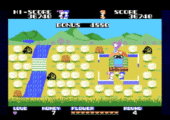
The landscape of the home console market in 1985 was characterized by intense competition and rapid technological evolution, with Sega attempting to establish a foothold against the dominant Nintendo Famicom. Among the titles released during this formative period, Girl’s Garden stands as a significant historical artifact. Developed and published by Sega Enterprises for the SG-1000, the game is widely recognized not only for its technical accomplishments on limited hardware but also as the directorial debut of Yuji Naka, the programmer who would later achieve global fame as the lead developer of Sonic the Hedgehog. Released in February 1985, Girl’s Garden represents a pioneering attempt to broaden the gaming demographic by specifically targeting female players, a strategy that was relatively uncommon during the early 1980s.
Historical Context and the SG-1000 Ecosystem
The SG-1000, Sega’s first entry into the home console market, was launched in 1983 on the same day as Nintendo’s Famicom. While the Famicom eventually dominated the Japanese market due to its superior scrolling capabilities and third-party support, the SG-1000 provided a platform for Sega to refine its development philosophies. The system utilized a Zilog Z80A CPU and a Texas Instruments TMS9918A Video Display Processor (VDP), which limited its graphical output compared to the Famicom’s custom hardware.
By 1985, Sega was under pressure to produce content that could showcase the system’s potential while appealing to diverse audiences. Hiroshi Sato, then a manager at Sega, tasked a young Yuji Naka with creating a game that would appeal to girls. Naka, who had joined the company as a trainee programmer, spent approximately five months developing the title alongside Hiroshi Kawaguchi, who would later become a legendary composer for Sega’s arcade hits. This project served as a "final exam" for Naka, proving his ability to manage a full development cycle.
Core Gameplay Mechanics and Narrative Structure
Girl’s Garden places players in the role of Papri, a young girl on a quest to win the affection of her crush, Minto. The narrative conflict arises from a rival character, Cocco, who is also vying for Minto’s attention. To secure Minto’s love, Papri must navigate a series of outdoor environments to collect a bouquet of exactly ten flowers. This premise introduces a unique blend of action-adventure and resource management that was sophisticated for its era.
The game utilizes a top-down perspective, where Papri must traverse a garden infested with hostile bears and environmental hazards. The flowers themselves follow a specific growth cycle consisting of six distinct animation frames. Players are required to time their collection precisely; flowers must be harvested only when they are in full bloom (the fourth frame). If Papri collects a wilted flower, she is penalized by losing half of her current bouquet. This mechanic demands careful observation and patience, distinguishing the game from more traditional "twitch-based" arcade titles of the time.
A critical component of the gameplay is the visual timer. Instead of a standard numerical countdown, the game features a progress bar at the bottom of the screen showing Minto walking away from Papri and toward Cocco. If the player fails to deliver the ten flowers before Minto reaches Cocco, the round is lost. This integration of narrative stakes into the UI was a forward-thinking design choice that enhanced the game’s thematic cohesion.
Technical Sophistication and Visual Innovation
Despite the hardware constraints of the SG-1000, Girl’s Garden implemented several advanced visual techniques. One of the most notable is the use of pseudo-parallax scrolling. On a system that did not natively support hardware scrolling, Naka utilized the background layer to create the illusion of depth. The clouds in the background, the mountains in the mid-ground, and the grass in the foreground move at different speeds. While this resulted in somewhat choppy movement compared to Famicom titles, it was a remarkable feat for the SG-1000 hardware.
Furthermore, the game’s color palette is remarkably vibrant. The SG-1000 was limited to one color per sprite line, often leading to monochromatic characters or heavy flickering when multiple sprites aligned horizontally. Girl’s Garden mitigated these issues through clever sprite layering and artistic design, ensuring that Papri and her environment remained visually distinct.
The game also features a "Challenging Stage" every two rounds, which showcases the SG-1000’s ability to display enlarged sprites. In these bonus rounds, Papri and the bears are rendered at four times their normal size. Players must time jumps over waves of bears to earn bonus points. This mode utilized a specific hardware register of the TMS9918A VDP that was rarely exploited by other developers, further highlighting the technical ambition of the development team.
Audio Composition and Soundtrack Significance
The auditory experience of Girl’s Garden was equally advanced for the mid-1980s. The soundtrack was composed by Tohru Nakabayashi and Katsuhiro Hayashi, with programming assistance from Hiroshi Kawaguchi. Kawaguchi would later go on to compose the iconic scores for Space Harrier, OutRun, and After Burner.
The soundtrack is characterized by its melodic variety and thematic appropriateness. It includes distinct tunes for the main exploration phases, the bonus stages, and specific jingles for victory and failure. Notably, the game features an 8-bit rendition of Felix Mendelssohn’s "Wedding March" upon the successful completion of a level. The inclusion of classical arrangements alongside original compositions provided a sense of polish and "cuteness" that aligned with the game’s target demographic.
Development Timeline and Production Data
The production of Girl’s Garden followed a tight schedule typical of early 80s development cycles:
- September 1984: Project initiation. Yuji Naka begins training at Sega and is assigned the task of creating a "girl-oriented" title.
- October – December 1984: Programming and asset creation. Naka works on the scrolling engine and sprite management.
- January 1985: Final testing and sound implementation. Sega executives review the game and decide on a commercial release rather than a limited promotional run.
- February 1985: Official release on the SG-1000.
- Post-1985: The game is later made compatible with the Sega Mark III and the Master System, though it retains the original SG-1000 resolution and color palette limitations.
While specific sales figures from 1985 are not publicly archived in Sega’s historical financial reports, the game is cited in internal company histories as a successful "entry-level" project that justified the hiring of Naka and his contemporaries.
Impact and Legacy in Video Game History
Girl’s Garden occupies a unique niche in the history of Sega. It is often cited as the starting point for the "Sega Style" of development—a focus on technical excellence, vibrant colors, and innovative gameplay mechanics. For Yuji Naka, the game was a proving ground. The lessons learned in sprite manipulation and hardware optimization on Girl’s Garden directly informed his later work on the Master System and the Mega Drive (Genesis), eventually leading to the creation of the Sonic the Hedgehog franchise.
The game is also an early example of the "kawaii" (cute) aesthetic in gaming, a genre that would eventually flourish with titles like TwinBee and various mascot-based platformers. By centering the gameplay on a non-violent objective (collecting flowers for a crush) while maintaining a high level of difficulty (the bear encounters), Sega successfully created a title that appealed to both its target female audience and the existing male-dominated player base.
Modern Accessibility and Preservation
For contemporary players and historians, Girl’s Garden has become more accessible through various retrospectives and emulated collections. It was included in the "Sega 3D Reprint Archives 3: Final Stage" for the Nintendo 3DS, released in Japan in 2016. This version allowed a new generation of players to experience the game with stereoscopic 3D effects, which further accentuated the parallax scrolling Naka had fought to implement decades prior.
The game also remains a staple of the Sega Mark III and Master System hobbyist communities. Because the Master System was backward compatible with SG-1000 cartridges, the game enjoyed a second life in European and Brazilian markets where Sega’s 8-bit hardware remained popular well into the 1990s.
In summary, Girl’s Garden is far more than a simple action game from the mid-80s. It is a testament to the ingenuity of early game developers who worked within extreme hardware constraints to deliver experiences that were both technically impressive and emotionally engaging. As the debut work of one of the industry’s most influential figures, its place in the annals of video game history is firmly secured.








