
 Jia Lissa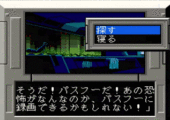
Detonator Orgun stands as a significant, if technically inconsistent, entry in the library of the Sega Mega CD, representing the early 1990s trend of adapting "Original Video Animation" (OVA) series into interactive digital experiences. Released on July 31, 1992, in Japan, the title was developed by Darts and published by Hot-B Co. Ltd. It sought to capitalize on the popularity of the three-part science fiction anime series of the same name, which had debuted just a year prior. As a graphic adventure game, it prioritized narrative depth and cinematic presentation over the high-speed action typically associated with the mecha genre, reflecting a specific era of Japanese software development where the storage capacity of the CD-ROM was first being explored to deliver voice acting and full-motion video (FMV).
Historical Context and Development Background
The early 1990s marked a pivotal transition in the video game industry, as hardware manufacturers moved from silicon-based cartridges to optical media. The Sega Mega CD, an add-on for the Mega Drive (Sega Genesis), was at the forefront of this shift in Japan. Developers were eager to utilize the 500MB+ storage capacity of a CD to incorporate elements that were previously impossible, such as orchestral soundtracks, digitized speech, and animated sequences.
Detonator Orgun arrived during a surge of cyberpunk and mecha-themed anime productions. The original OVA, directed by Masami Obari—renowned for his distinct "Obari-style" mechanical designs and kinetic animation—was a centerpiece of the 1991 anime market. Hot-B, a publisher known for eclectic titles like the steampunk shooter Steel Empire, saw the OVA as an ideal candidate for a "digital comic" or visual novel adaptation. This genre was particularly popular in the Japanese PC market (on platforms like the PC-98) and was beginning to find a stronghold on home consoles through the Mega CD and the PC Engine Super CD-ROM².
Narrative Structure and Plot Chronology
The game’s narrative serves as a faithful adaptation of the source material, specifically focusing on the first two episodes of the OVA series. The story is set in the futuristic "City No. 5" and follows Tomoru Shindo, an ordinary university student who begins experiencing haunting telepathic visions of a mechanized warrior.
The chronology of the game’s plot mirrors the anime’s "slow burn" approach:
- The Lunar Encounter: The story begins with a violent conflict on the Moon involving Orgun, a "Detonator" or mechanized knight belonging to the hostile alien race known as the Evoluders.
- Telepathic Contact: Following the battle, Orgun—having defected from his kind—establishes a psychic link with Tomoru Shindo on Earth.
- The EDF Involvement: Earth’s Defense Force (EDF) becomes aware of the looming Evoluder threat, leading to Tomoru’s eventual integration with the Orgun armor to defend the planet.
- The Evoluder Threat: The narrative culminates in a confrontation with the Evoluder forces, providing a bridge to the events that would conclude the animated trilogy.
By focusing on dialogue and character interaction, the game attempts to build the psychological tension present in the anime, though critics have often noted that this comes at the expense of the visceral action sequences fans of Masami Obari’s work might have expected.
Technical Specifications and Gameplay Mechanics
As a graphic adventure, Detonator Orgun utilizes a traditional menu-driven interface. Players interact with the environment and progress the story through four primary commands: "Look," "Think," "Talk," and "Move." This system aligns the game with other prestigious titles of the era, such as Hideo Kojima’s Snatcher or the Urusei Yatsura adaptations.
Visual Presentation
The game utilizes the Mega CD’s ability to play FMV sequences taken directly from the anime. However, the hardware’s limitations are evident. The Mega Drive’s VDP (Video Display Processor) was restricted to a 64-color palette from a total of 512 colors. When displaying digitized video, this resulted in significant dithering and pixelation. While the cutscenes were considered impressive for 1992, they lacked the clarity found in later 32-bit era systems. The static backgrounds and character portraits, however, successfully captured the cyberpunk aesthetic and detailed linework of the original production.
Audio Discrepancies
One of the most analyzed aspects of Detonator Orgun is its inconsistent use of the CD-ROM medium for audio. The game features a score by Kouji Hayama, a celebrated composer known for his work on the Cho Aniki series. While the opening sequence features high-fidelity Redbook CD audio, much of the subsequent gameplay reverts to the Mega Drive’s internal YM2612 FM synthesis chip.
Supporting data suggests that this was likely a budgetary or storage-management decision. While the intro and key scenes feature full voice acting—a luxury at the time—the frequency of these voiced segments diminishes as the game progresses. This technical "regression" from CD-quality audio to chiptunes was a common criticism among early adopters of the Mega CD, who expected a more consistent utilization of the hardware’s capabilities.
Market Reception and Regional Exclusivity
Detonator Orgun was never localized for Western markets. This was a standard outcome for many Japanese graphic adventures of the era, as the genre relied heavily on large volumes of text and cultural context that were expensive to translate. For English-speaking audiences, the game became a sought-after import title for collectors of mecha memorabilia, though the language barrier rendered it largely unplayable for those without Japanese proficiency.
Contemporary reviews of the game often highlight its "quick cash-in" nature. While it provided a faithful interactive window into the OVA series, it did not innovate within the graphic adventure genre. The lack of action-oriented gameplay was a point of contention; mecha fans expecting to pilot the Orgun armor in real-time combat were instead met with a slow-paced, decision-based narrative.
Broader Impact and Industry Implications
The release of Detonator Orgun on the Mega CD is a case study in the growing pains of optical media in the early 1990s. It illustrates the industry’s struggle to balance high-quality assets (like FMV and CD audio) with the processing and memory limitations of the base console hardware.
The Rise of Licensed Multimedia
The game was part of a broader movement where anime production committees viewed video games as essential components of a multimedia franchise. This era saw the birth of the "Media Mix" strategy in Japan, where an OVA, a manga, and a video game would be released in close proximity to maximize brand visibility. Detonator Orgun represents a pure implementation of this strategy, prioritizing brand fidelity over gameplay innovation.
Legacy of the Graphic Adventure
The game’s reliance on the "Look/Think/Talk" interface helped solidify the visual novel format that remains a staple of the Japanese gaming industry today. While Western markets gravitated toward point-and-click adventures like The Secret of Monkey Island, Japanese developers refined the menu-driven system seen in Detonator Orgun, eventually leading to the modern visual novels found on platforms like Steam and the Nintendo Switch.
Analysis of Final Reception
In retrospect, Detonator Orgun is viewed as a mediocre execution of a high-potential license. Technical analysis suggests that the title failed to fully leverage the Mega CD’s hardware, specifically regarding audio consistency. The decision to shift from CD audio to internal synth midway through the experience remains a notable flaw that detracted from the "premium" feel the CD-ROM format was intended to provide.
Furthermore, the game’s narrative pacing—mirroring the "slow burn" of the first episode of the OVA—did not always translate well to an interactive format. Without the kinetic energy of the anime’s fight choreography to break up the dialogue, the gameplay experience could feel stagnant. Consequently, the game received a score of 6 out of 10 from various retrospective critics, positioning it as a title primarily for "die-hard" fans of the source material rather than a must-play for the general Mega CD audience.
Conclusion
Detonator Orgun remains a fascinating artifact of the 16-bit CD-ROM era. It captures a moment in time when the video game industry was enamored with the "multimedia" potential of the silver disc but had not yet mastered the technical hurdles required to deliver a seamless experience. For fans of Masami Obari and 90s cyberpunk, it offers a nostalgic glimpse into a specific aesthetic, even if the gameplay and technical execution fall short of the standards set by its contemporaries like Snatcher or Lunar: The Silver Star. Its legacy is one of technical ambition tempered by the harsh realities of early 90s hardware constraints and the burgeoning nature of the anime-to-game pipeline.








