Vera Clarissa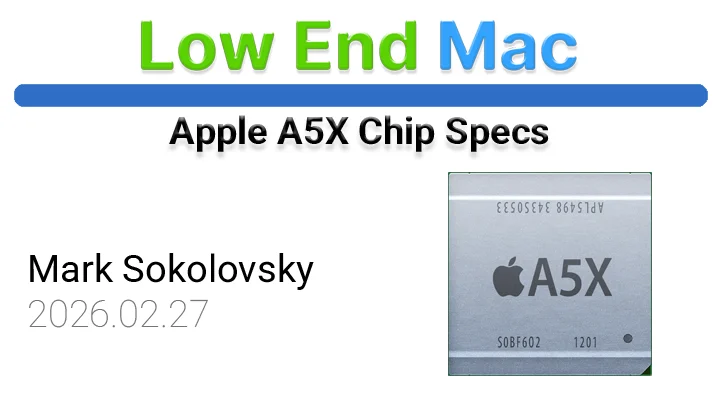
The Apple A5X System-on-Chip (SoC) represents a significant milestone in mobile processing technology, designed and manufactured by Samsung for Apple. Unveiled on March 16th, 2012, this powerhouse chip was engineered to drive Apple’s most demanding consumer electronics, specifically powering the third-generation iPad. Its architecture, details of which are meticulously documented, reveals a strategic approach to balancing performance, efficiency, and graphical prowess, setting a new benchmark for tablet computing at the time of its release.
Architectural Foundation and Core Specifications
At its heart, the Apple A5X is built upon the ARMv7 (32-Bit) instruction set architecture (ISA), a widely adopted standard for mobile processors. The chip is fabricated using a 45-nanometer process, a testament to the manufacturing capabilities of Samsung in 2012. While the exact transistor count remains undisclosed by Apple, this process node typically allowed for a dense integration of components, crucial for the sophisticated functionality expected from a leading-edge SoC.
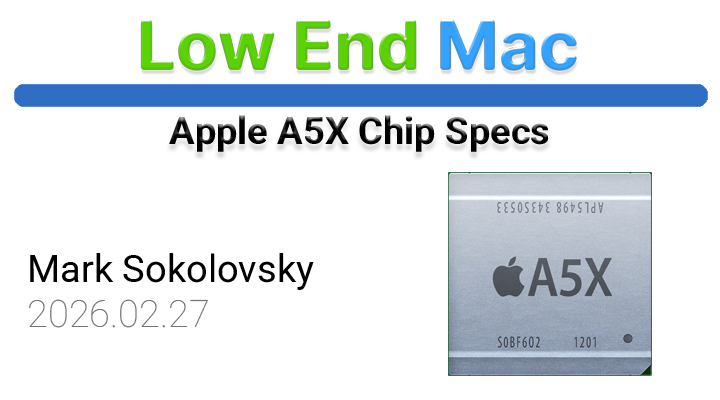
The CPU configuration of the A5X features a dual-core design, with both cores operating at a clock speed of 1 GHz. These are designated as "Performance Cores" (P-Cores), indicating their primary role in executing computationally intensive tasks. The absence of dedicated "Efficiency Cores" (E-Cores) in this particular iteration suggests a design philosophy prioritizing raw performance for the target applications, such as high-resolution display rendering and demanding applications.
Cache memory plays a vital role in processor performance by reducing latency to main memory. The A5X is equipped with L1 caches that are split into instruction (L1i) and data (L1d) caches. Each P-Core possesses a 32 KB L1i cache and a 32 KB L1d cache, totaling 64 KB of L1 cache per core. Furthermore, a unified 1 MB L2 cache is shared across both P-Cores, providing a substantial pool of fast memory for frequently accessed data and instructions, thereby enhancing overall processing speed. The lack of specified L1/L2 caches for E-Cores is consistent with the dual-core P-Core configuration. System-level cache information for the A5X is not provided, suggesting that the primary cache hierarchy is confined to the CPU cores themselves.
Memory Subsystem: Fueling Visual Fidelity
The memory subsystem of the A5X is a critical component, especially considering its deployment in a device with a high-resolution Retina display. The chip boasts a 128-bit memory bus width, a significant figure that enables high data throughput. This wide bus is divided into four independent channels, each operating at 32-bit width, allowing for parallel data transfers. The memory type utilized is LPDDR2-800, operating at a frequency of 400 MHz. This configuration yields an impressive theoretical memory bandwidth of approximately 12.8 GB/s. This substantial bandwidth is crucial for efficiently feeding data to the CPU and, perhaps more importantly, the GPU, which is responsible for rendering complex graphics. The total capacity of the integrated RAM is 512 MB, a common amount for flagship mobile devices of that era, supporting both the operating system and application demands.

Graphics Processing Unit (GPU): A Leap in Visual Performance
The graphics capabilities of the A5X were a primary differentiator, designed to power the visually rich experience of the third-generation iPad. The SoC incorporates a powerful GPU with four dedicated cores. These cores are further detailed by their specifications: 8 SIMD (Single Instruction, Multiple Data) Execution Units (EUs) and 64 FP32 (Single-Precision Floating-Point) Arithmetic Logic Units (ALUs). The GPU operates at a clock speed of 200 MHz, delivering a theoretical peak performance of 25.6 GFLOPS (Giga Floating-Point Operations Per Second). This level of graphical horsepower was substantial for its time, enabling smoother gameplay, more responsive user interfaces, and the ability to render high-definition content with greater fidelity. The absence of dedicated AI cores and AI operations figures indicates that the A5X was not architected with the explicit focus on machine learning tasks that would become prevalent in later generations of Apple Silicon.
Chronology and Context of Release
The unveiling of the A5X chip on March 16th, 2012, was directly tied to the launch of the third-generation iPad. This device was a significant upgrade from its predecessor, most notably featuring the Retina display with a resolution of 2048 x 1536 pixels. Achieving this high pixel density while maintaining smooth performance and acceptable battery life required a substantial leap in graphical processing power. The A5X was engineered precisely to meet this demand.
Prior to the A5X, Apple had utilized the A4 and A5 chips in its iOS devices. The A5, introduced in the iPad 2, was a dual-core processor that offered a considerable improvement over the A4. However, it was not sufficient to drive the demands of a Retina display at native resolution. The A5X can be seen as an evolution of the A5, with a significant enhancement in its GPU component. While the CPU cores remained largely similar in clock speed and core count to the A5, the addition of a more powerful graphics engine with dedicated memory bandwidth was the key innovation.

The choice of Samsung as the manufacturer for the A5X was a continuation of a long-standing relationship between Apple and the South Korean electronics giant. For several generations of iPhone and iPad, Samsung was a primary supplier of Apple’s A-series chips. This partnership allowed Apple to leverage Samsung’s advanced manufacturing capabilities and scale to produce millions of chips required for its rapidly growing product lines. However, this relationship would later become subject to significant legal and competitive pressures as both companies vied for market dominance.
Supporting Data and Performance Metrics
While the provided data focuses on the architectural specifications, performance benchmarks from the era offer further insight into the A5X’s capabilities. Reviewers at the time often highlighted the dramatic improvement in graphical performance compared to previous iPads. Benchmarks for gaming, photo editing, and video playback consistently showed the third-generation iPad outperforming its competitors, a direct result of the A5X’s potent GPU and ample memory bandwidth.
For instance, the memory bandwidth of 12.8 GB/s was more than double that of many contemporary mobile processors, enabling the GPU to access textures and frame buffer data much more rapidly. This was crucial for the Retina display, which required rendering four times the number of pixels compared to the iPad 2. The dual-core 1 GHz CPU, while not groundbreaking in itself, provided sufficient processing power to complement the graphics capabilities, ensuring a balanced user experience.

Official Responses and Broader Impact
Apple, in its typical fashion, did not release extensive technical details about the A5X at the time of its announcement. The focus was always on the user experience and the capabilities the chip enabled. However, the industry recognized the A5X as a significant step forward in mobile SoC design, particularly in its integration of powerful graphics. Analysts and tech journalists lauded Apple’s ability to customize and optimize its silicon for specific product needs, a strategy that would become a hallmark of its success.
The impact of the A5X was profound. It enabled the Retina display on the iPad to become a reality, setting a new standard for screen quality in tablets. This, in turn, drove app developers to create richer, more visually complex applications, pushing the boundaries of what was possible on a mobile device. The A5X solidified Apple’s reputation for delivering cutting-edge performance and user experience in its hardware.
Furthermore, the A5X’s success reinforced Apple’s strategy of vertical integration – controlling both the hardware and software. By designing its own chips, Apple could tailor them precisely to the needs of its operating system (iOS) and its applications, optimizing performance, power efficiency, and features in a way that third-party chip manufacturers might not be able to replicate. This strategy would continue to evolve with subsequent generations of Apple Silicon, leading to the company’s eventual transition to its own ARM-based processors for its Mac lineup.

Evolution and Legacy
The Apple A5X was a transitional chip, bridging the gap between earlier dual-core designs and the more sophisticated multi-core, heterogeneous architectures that would follow. While the A5X’s CPU was largely an iteration of the A5, its GPU was a substantial upgrade. This emphasis on graphical prowess for a specific, high-demand application (the Retina iPad) highlighted Apple’s ability to adapt its silicon design to the evolving needs of its product ecosystem.
The subsequent A6X, released in the fourth-generation iPad, would represent a more significant architectural leap, featuring a custom-designed CPU and an improved GPU. However, the A5X remains a critical piece of Apple’s silicon history, demonstrating the company’s commitment to pushing the boundaries of mobile computing and laying the groundwork for the powerful and efficient processors that would define its future devices. Its technical specifications, meticulously documented, offer a valuable glimpse into the engineering considerations that underpinned the success of one of the most influential consumer electronics devices of its time. The A5X was not just a chip; it was an enabler of a visual revolution in the tablet market, a testament to Apple’s relentless pursuit of performance and user experience.