
 Jia Lissa
When Sega released Shining in the Darkness for the Mega Drive in 1991, it marked a pivotal shift in the landscape of 16-bit role-playing games (RPGs). Developed by the newly formed Climax Entertainment, the title served as the cornerstone for the enduring Shining series, a franchise that would eventually span nearly two dozen entries across multiple hardware generations. While Nintendo’s Super Famicom was often viewed as the primary home for the RPG genre in the early 1990s, the arrival of Shining in the Darkness provided Sega with a sophisticated, first-person dungeon crawler that leveraged the superior processing power of the Motorola 68000 CPU to deliver a high-fidelity experience characterized by fluid movement, an intuitive user interface, and a distinct Western-influenced aesthetic.
The Foundations of Climax Entertainment and the Departure from Chunsoft
The genesis of the Shining series is inextricably linked to the professional trajectories of Hiroyuki Takahashi and Hiroshi "Kan" Naito. Before establishing Climax Entertainment, both men were instrumental in the development of the Dragon Quest series at Chunsoft, a studio closely aligned with Enix and Nintendo. Takahashi, who transitioned from a background in television production and executive planning to the gaming industry, initially joined Enix in a public relations capacity. His meticulous nature—demonstrated by his creation of a comprehensive dialogue flowchart for Dragon Quest III—quickly elevated him to the role of assistant producer.
Naito, a self-taught programmer with an obsession for 3D wireframe graphics and arcade architecture, served as the chief programmer for Dragon Quest III and IV. Despite the commercial juggernaut status of the Dragon Quest franchise, both Takahashi and Naito felt constrained by the industry’s tendency to replicate successful formulas. Takahashi, in particular, was motivated by a desire to create software that could command international respect, particularly after observing American focus groups that viewed Japanese games as mere imitations of Western computer software.

In April 1990, the duo departed Chunsoft to form Climax Entertainment. They sought a development environment that prioritized individual recognition and creative autonomy. Accompanying them were several key colleagues, including Shinya Nishigaki and Yasuhiro Taguchi, forming a small but highly experienced team capable of extracting maximum performance from 16-bit hardware.
A Strategic Shift to Sega Hardware
While the Famicom (NES) was the dominant platform of the era, Climax Entertainment made the strategic decision to bypass Nintendo’s 8-bit and early 16-bit offerings in favor of the Sega Mega Drive. The decision was rooted in technical necessity. The Famicom lacked the processing power to render the realistic 3D spatial awareness Takahashi envisioned for his "real-time haunted house" concept. Although the Super Famicom was a viable alternative, the Mega Drive had been on the market since 1988, and its development environment—while initially substandard—offered a more stable architecture for a studio looking to hit the ground running.
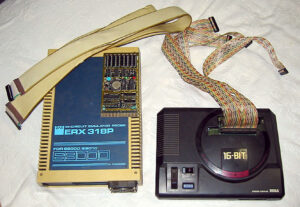
The partnership with Sega was facilitated by Sega’s then-president, Hayao Nakayama, who was aggressively recruiting third-party talent to bolster the Mega Drive’s library against Nintendo’s market dominance. To support the project, Sega R&D head Hisashi Suzuki provided Climax with high-performance Hewlett-Packard workstations. However, the team found Sega’s standard in-circuit emulators (ICE) insufficient for high-level graphics work. Consequently, the first software Climax developed for the Mega Drive was not a game, but a bespoke set of graphical tools designed to handle large-scale character sprites and complex 3D rendering.
Architectural Innovation: Panorama 3D and Icon-Based Menus
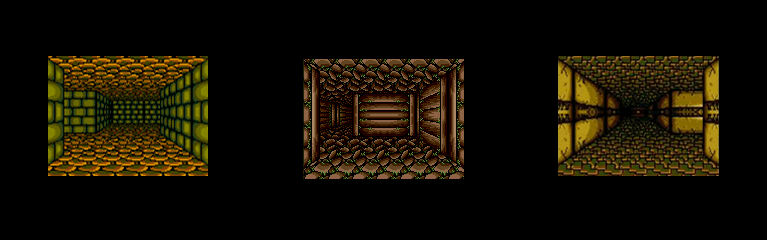
Shining in the Darkness was designed to be an "immersive RPG," a term the developers used to describe a game that prioritized a first-person perspective to create a sense of direct engagement. To achieve this, the team developed the "Panorama 3D" technique. Unlike previous dungeon crawlers that utilized static, frame-by-frame movement, Shining in the Darkness featured fluid, smooth-scrolling transitions.
This technical feat was managed by Yasuhiro Taguchi, who utilized tile-based manipulation and palette-swapping tricks to simulate depth on a console that lacked hardware-level scaling or rotation (features like Nintendo’s Mode 7). By shrinking the playable window and focusing resources on highly detailed, animated enemy sprites, Climax created an environment that felt alive. The dungeon walls were meticulously crafted pixel-by-pixel by artists Yoshitaka Tamaki and Hidehiro Yoshida to ensure that the perspective remained consistent even as the player turned corners.
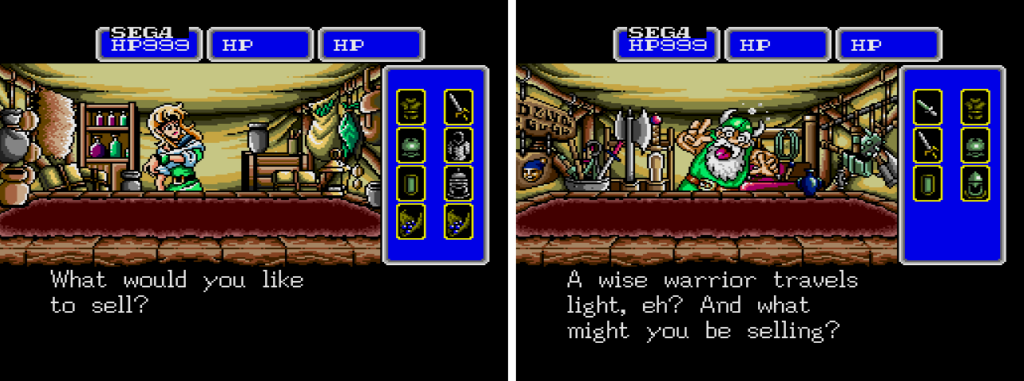
Complementing the visual immersion was a revolutionary icon-based menu system. Recognizing that traditional text-heavy menus often alienated players and bogged down the pacing of random encounters, Naito implemented a four-directional icon layout that corresponded directly to the d-pad. This allowed for near-instantaneous command execution. While some contemporary critics compared the system to Phantasy Star III, the Climax iteration was significantly more detailed, featuring animated icons that represented actions such as "Magic," "Item," and "Attack," a design philosophy that would become a staple of the Shining series and influence future RPGs like Secret of Mana.
The Aesthetic and Narrative Framework
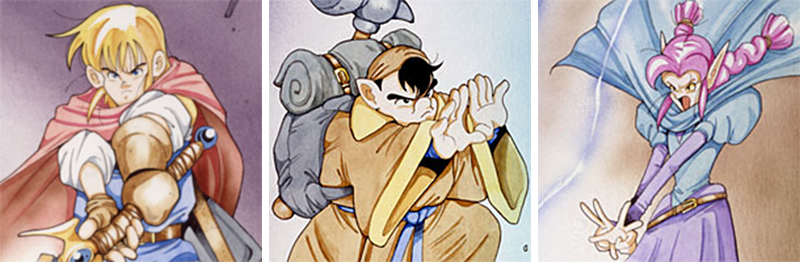
The visual identity of Shining in the Darkness was a deliberate departure from the manga-inspired art styles prevalent in Japanese RPGs of the early 1990s. Takahashi and Naito were heavily influenced by classic Disney animation, specifically the "caricature" style found in features like Sleeping Beauty and The Sword in the Stone. Freelance artist Yoshitaka Tamaki was tasked with bringing this vision to life. The resulting character designs for the protagonist Max, the priest Milo, and the mage Pyra featured exaggerated proportions and expressive facial animations that resonated with both Eastern and Western audiences.
The narrative, set in the Kingdom of Thornwood, followed a traditional but tightly executed "save the princess" arc. However, the depth of the world was found in its NPCs and environmental storytelling. Takahashi utilized his background in theater to treat each location—the tavern, the castle, and the shrine—as a stage. The game utilized an "auto-check" system where NPC dialogue would dynamically shift based on the party’s status, such as whether a character was poisoned or deceased, further enhancing the sense of a reactive, living world.
Market Performance and Regional Reception
Shining in the Darkness was released in Japan on March 29, 1991, and became an immediate commercial success. It sold approximately 300,000 units, a significant figure considering the Mega Drive’s Japanese install base was roughly 1.9 million at the time. This represented a 16% attach rate, signaling a strong demand for high-quality RPGs on Sega hardware.
In North America, the game faced a different set of challenges. Sega of America (SOA) marketing head Al Nilsen recalled that while the game was a success for the genre, it did not receive the massive television advertising budgets reserved for flagship titles like Sonic the Hedgehog. Despite limited print advertising, the game found a dedicated audience among fans of Western computer RPGs like Wizardry. Takahashi later expressed shock at the game’s popularity abroad, noting that Western fans praised the game for its polish and mechanical depth, with many refusing to believe it had been developed by a Japanese team.
| Metric | Data Point |
|---|---|
| Initial Release Date | March 29, 1991 (Japan) |
| Platform | Sega Mega Drive / Genesis |
| Cartridge Size | 8-Megabit (with Battery Backup) |
| Japanese Sales | ~300,000 units |
| Development Time | Approximately 6-9 months |
| Key Innovation | Icon-based UI; Panorama 3D scrolling |
Broader Impact and the Evolution of the Franchise
The legacy of Shining in the Darkness extends far beyond its initial sales figures. It established the "Shining" brand as a versatile entity. Although the first game was a dungeon crawler, the studio immediately pivoted for its successor, Shining Force (1992), which introduced tactical strategy elements while retaining the icon-based menus and character archetypes established in the original.
The refusal to include an auto-mapping system in Shining in the Darkness remains one of its most discussed design choices. Takahashi and Naito argued that forcing players to navigate via landmarks and memory enhanced the "realism" of the experience. While this increased the difficulty, it also fostered a sense of accomplishment that defined the early 16-bit RPG era.
The game also served as a proving ground for musical talent. Composer Masahiko Yoshimura’s orchestral-style score became the auditory benchmark for the series. His collaboration with Tamaki ensured that the audio and visual elements were perfectly synchronized, a standard that helped the Shining series survive the transition from the 2D era to the 3D landscapes of the Sega Saturn and beyond.
Ultimately, Shining in the Darkness proved that the Sega Mega Drive was a capable platform for deep, narrative-driven experiences. By prioritizing user accessibility through its UI and pushing the limits of software-based 3D rendering, Climax Entertainment created a landmark title that bridged the gap between Western computer RPGs and Japanese console sensibilities, ensuring the franchise’s place in gaming history for decades to come.








