
 Jia Lissa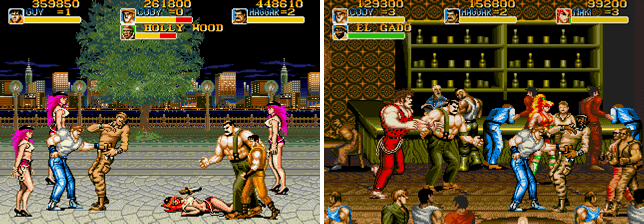
The landscape of 16-bit retrogaming has witnessed a significant resurgence in recent years, driven by a dedicated community of independent developers pushing aging hardware beyond its original design specifications. One of the most ambitious projects currently in development is Final Fight MD, a ground-up recreation of Capcom’s seminal 1989 arcade brawler for the Sega Genesis (Mega Drive). Developed by the Brazilian studio MXRetroDev, led by Mauro Xavier, the project aims to deliver the most comprehensive home console version of the title ever produced, surpassing the technical and content limitations that defined previous ports on the Super Nintendo Entertainment System (SNES) and the Sega CD.
Historical Context and the Quest for the Perfect Port
To understand the significance of Final Fight MD, one must look back at the history of the game’s home releases. When Final Fight debuted in arcades on Capcom’s CPS-1 hardware, it set a new standard for the beat-em-up genre with its large sprites, detailed urban environments, and fluid combat. However, early 1990s home consoles struggled to replicate this experience. The 1990 SNES port was famously compromised, lacking the character Guy, omitting the "Industrial Area" stage, and supporting only single-player gameplay.
The 1993 Sega CD version, developed by Sega’s internal teams, was a massive improvement. It restored the missing characters and stages, added two-player cooperative play, and featured a high-quality Redbook CD audio soundtrack. For decades, the Sega CD version was considered the gold standard for 16-bit fans, despite some graphical compromises such as a reduced color palette and occasional sprite flickering. Final Fight MD seeks to challenge this legacy by utilizing modern coding techniques to bring an even more faithful arcade experience to the base Genesis hardware, which lacks the additional CPU and memory of the Sega CD attachment.
Technical Innovations and Gameplay Enhancements
MXRetroDev has built Final Fight MD from the ground up, rather than attempting to modify existing code from previous ports. This approach has allowed the team to implement features previously thought impossible on the stock Genesis hardware. One of the most notable technical achievements is the "1 Player+" mode. By accessing this mode through a specific input on the main menu, the game reallocates system memory to prioritize performance. According to the developer, this allows the engine to render up to seven enemies on screen simultaneously with minimal slowdown—a feat that exceeds the capabilities of both the original SNES and Sega CD versions, which typically capped at three or four enemies.
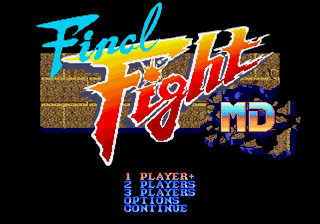
Furthermore, the game offers a choice between 30 and 60 frames-per-second (FPS) modes. While 60 FPS provides the fluid motion associated with the arcade original, it demands more from the hardware. MXRetroDev suggests that the 60 FPS setting is ideal for users playing on overclocked Genesis consoles or high-end emulators, though the 30 FPS mode remains highly optimized for standard hardware.
Feature Parity and New Content
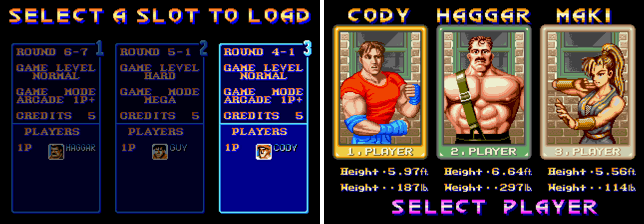
Final Fight MD distinguishes itself by including every feature found in the arcade original while introducing several modern quality-of-life improvements. The core roster of Mike Haggar, Cody Travers, and Guy is fully intact, but the developer has expanded the selection to include Maki, a fan-favorite character from the SNES-exclusive Final Fight 2. The project also introduces three-player cooperative gameplay, a feature never before seen in a home version of the first Final Fight. To facilitate this, the game is compatible with peripheral hardware such as the Sega Team Player and EA’s 4-Way Play adapter.
Beyond the expanded roster, the game includes:
- All Arcade Stages: Including the often-omitted Industrial Area and the transit transition scenes.
- Same-Character Selection: Allowing multiple players to choose the same fighter, a feature typically absent in early ports.
- Save System: Three dedicated save slots that automatically record progress at the conclusion of each stage.
- Mega Mode: A specialized menu for cosmetic and gameplay customization, allowing players to adjust character palettes and toggle various modifiers.
The Achievement System and Replayability
A central pillar of the Final Fight MD experience is its robust achievement system. The game features 60 unlockable milestones tied to the "Mega Mode." These are not merely cosmetic badges; they serve as the gateway to a wide array of gameplay modifiers and secret content. Early unlocks include the ability to use boss themes from Final Fight 2 and 3, enable air combos, or activate "instant knockout" punches.
As players progress past the 30-achievement mark, the rewards become increasingly transformative. High-level unlocks include:
- Nightmare Difficulty: A mode designed for veteran players that significantly increases enemy aggression and damage.
- Vampire Mode: A mechanic where player health constantly depletes but is replenished by dealing damage to enemies.
- Lunar Gravity and One Punch Man Modes: Physics-defying modifiers that alter the fundamental feel of combat.
- Boss Rush and Bonus Stage Challenges: Dedicated modes for players looking to hone their skills against the game’s toughest encounters.
To maintain the integrity of the challenges, the developer has implemented a restriction where activating these special modifiers halts further progress toward new achievements until the game is returned to its standard settings.
Development Timeline and Community Feedback
The development of Final Fight MD has been a transparent, community-driven process. Mauro Xavier has frequently released updates via his Patreon and Itch.io pages, incorporating user feedback into the game’s design. A significant portion of the development time has been dedicated to refining hitboxes and enemy AI algorithms to ensure that the "game feel" mirrors the arcade original as closely as possible.
Despite the technical success of the project, the development has faced hurdles regarding its official status. Xavier has expressed frustration with the complexities of the licensing world. In communications on his Patreon page, he noted that several potential publishers and distributors had approached him with the promise of securing an official license from Capcom, only to see those deals fall through. This has mirrored the path of other high-profile homebrew projects, such as the 2021 physical release of Mega Man: The Wily Wars by Retro-Bit, which successfully navigated the licensing landscape. For now, Final Fight MD remains an unlicensed fan project, and Xavier has stated he will continue development at his own pace to ensure the final product meets his personal standards of quality.
Broader Implications for the Retro Scene
The emergence of Final Fight MD is a testament to the enduring power of the 16-bit era and the technical ingenuity of the modern homebrew scene. By bringing a near-perfect arcade experience to a console that is over 35 years old, MXRetroDev is contributing to a broader movement that includes other "impossible" ports, such as the recent efforts to bring Street Fighter Alpha 2 to the SNES with improved performance or the ongoing work on Castlevania: Symphony of the Night for the Genesis.
These projects do more than just provide fans with new ways to play old games; they serve as a form of digital archeology and hardware exploration. They prove that the limitations of the 1990s were often a result of strict development deadlines and high cartridge manufacturing costs rather than the actual ceilings of the hardware itself.

Current Availability and Future Prospects
As of late 2024, Final Fight MD is available in a playable "demo" state, with regular updates provided to supporters of the developer’s Patreon. A free version is also hosted on Itch.io, allowing the general public to experience the technical milestones the team has reached. While a physical cartridge release remains unlikely without the explicit cooperation of Capcom, the digital ROM has already become a staple for enthusiasts using flash cartridges like the EverDrive.
The developer is currently focused on polishing the audio and finalizing the "Mega Mode" content. While the current soundscape is highly praised for its accuracy to the Genesis’s YM2612 FM synthesis chip, there are ongoing discussions regarding a patch that would allow the game to utilize the Sega CD’s high-fidelity soundtrack if played on hardware with the CD attachment or through specific emulators.
Final Fight MD stands as a definitive love letter to the beat-em-up genre. It represents a rare intersection of technical mastery, historical preservation, and modern game design, ensuring that the Mad Gear gang will be terrorizing the streets of Metro City—and Genesis owners will be stopping them—for years to come.








