Jia Lissa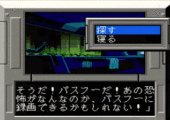
Historical Context and the Rise of the Media Mix Strategy
The release of Detonator Orgun occurred during a transformative period for the Japanese entertainment industry, characterized by the "media mix" strategy. This approach involved the simultaneous or sequential release of a story across multiple platforms, including manga, anime, and video games, to maximize brand visibility and consumer engagement. The original Detonator Orgun OVA was directed by Masami Ōbari, a figure synonymous with the stylized, high-detail mecha designs of the late 80s and early 90s. Ōbari’s work on titles such as Bubblegum Crisis and Iczer-1 had established a specific aesthetic of "cyberpunk mecha" that the Mega CD game attempted to replicate.
The OVA told the story of Tomoru Shindo, a college student living in the futuristic City No. 5 in the year 2292. Tomoru finds himself telepathically linked to Orgun, a "Detonator" or mechanized knight who has defected from the hostile alien race known as the Evoluders. The game follows this narrative closely, focusing on the first two episodes of the series. By the time of the game’s release, the Mega CD was still in its infancy, and developers were experimenting with how to utilize the 640MB of storage provided by the CD-ROM format—a staggering leap from the 1MB to 2MB typically found on standard Mega Drive cartridges.
Narrative Structure and Interactive Mechanics
Unlike many contemporary mecha titles that opted for side-scrolling action or tactical simulation, Detonator Orgun was designed as a "command-style" graphic adventure, often referred to as a visual novel in modern terminology. The gameplay is entirely devoid of traditional action sequences, relying instead on a static point-and-click interface. Players navigate the world of City No. 5 through a series of context-sensitive menus: "Look," "Think," "Talk," and "Move."
This methodical approach to gameplay mirrors the pacing of the OVA, which was frequently criticized by contemporary viewers for its "slow burn" narrative. The game prioritizes world-building and character interaction over visceral combat. For instance, the early stages of the game involve Tomoru’s mundane life and his growing confusion regarding the psychic visions he receives from the Moon. The interaction with the Earth Defense Force (EDF) and the eventual emergence of the Evoluder threat are handled through dialogue trees and investigative segments.
The reliance on Japanese text presented a significant barrier to entry for international audiences. During the early 1990s, the import market was a niche but growing sector of the gaming community. For Western players who acquired the Japanese disc, the lack of an English localization meant that the game’s primary draw—its story—was largely inaccessible, leaving only the visual presentation to sustain interest.
Technical Specifications and Audiovisual Performance
The Sega Mega CD was theoretically capable of displaying Full Motion Video (FMV) and high-fidelity CD audio, but the hardware’s limitations often forced developers into difficult compromises. Detonator Orgun utilizes actual footage from the OVA for its cinematic sequences, yet the execution highlights the constraints of the system’s 64-color palette and limited video bandwidth.
Visual Presentation
The FMV sequences in Detonator Orgun are heavily compressed, resulting in a graininess that was common for the era. The video is presented in a letterboxed format to reduce the number of pixels the processor had to update simultaneously. Despite these technical hurdles, the game successfully captures the "Ōbari style"—sharp angles, dramatic lighting, and intricate mechanical designs. The static background art used during the adventure segments is notably cleaner than the video clips, providing a faithful recreation of the anime’s cyberpunk environments.
Audio Disparity
One of the most curious technical aspects of Detonator Orgun is its inconsistent audio quality. The game begins with high-quality Red Book CD audio for the opening cinematic and initial dialogue, featuring the original voice cast from the anime. However, as the player progresses, the reliance on CD-quality audio diminishes. Large portions of the game transition to the Mega Drive’s internal YM2612 FM synthesis chip for music and sound effects.
This shift from orchestral, synth-heavy CD tracks to 16-bit chiptunes is jarring for a product marketed on its "CD-ROM" capabilities. Industry analysts suggest this was likely a result of storage management or budget constraints during development. While the score by Kouji Hayama—renowned for his work on the Cho Aniki series—is compositionally strong, the technical delivery remains a point of contention for hardware enthusiasts.
Chronology of In-Game Events
The game’s timeline is structured to mirror the episodic nature of the source material. The narrative is divided into chapters that correspond to key milestones in the OVA:
- The Lunar Contact: The game opens with the battle on the Moon and Orgun’s initial telepathic reach toward Earth.
- City No. 5 Investigation: Players control Tomoru as he navigates his daily life while being pursued by EDF agents who suspect his connection to the alien entity.
- The First Integration: A pivotal moment where Tomoru first merges with the Orgun armor to defend the city against an Evoluder scout.
- The Evoluder Siege: The latter half of the game focuses on the escalating conflict as the Evoluder fleet, led by the ruthless Zoa, approaches Earth.
- The Preview: The game concludes with a narrative bridge leading into the events of the third OVA episode, effectively acting as a promotional tool for the home video release.
Market Reception and Industry Implications
Upon its release, Detonator Orgun received a lukewarm reception from the Japanese gaming press. While it was praised for its faithfulness to the OVA, critics noted that the lack of gameplay variety made it more of an "interactive pamphlet" than a standalone gaming experience. In the context of 1992, the title was competing with high-profile Mega CD releases like Lunar: The Silver Star and the Japanese port of Prince of Persia, both of which offered more substantial gameplay loops.
The game’s failure to include action elements was a missed opportunity in the eyes of many fans. The Detonator Orgun IP featured spectacular mecha combat that seemed tailor-made for the Mega CD’s hardware scaling and rotation effects (functions of the system’s "ASIC" chip). By choosing a static adventure format, Hot-B effectively limited the game’s appeal to hardcore fans of the anime’s lore rather than the broader gaming public.
Furthermore, the game highlights the "quick-turnaround" nature of anime licensed products in the early 90s. The rush to release games while an OVA was still relevant often resulted in titles that felt unpolished or technically compromised. Detonator Orgun’s fluctuating audio quality is a primary indicator of a development cycle that may have prioritized meeting a release window over technical excellence.
Legacy and Modern Perspective
Today, Detonator Orgun is viewed as a collector’s item and a historical curiosity. It represents a specific moment in time when the industry believed that simply putting anime on a disc was enough to satisfy consumers. The title serves as a precursor to the modern visual novel genre, which would eventually find a massive audience on platforms like the PlayStation and PC.
For historians of the Sega Mega CD, the game is a reminder of the platform’s identity crisis. Was it a machine for "better" versions of cartridge games, or a new medium for interactive cinema? Detonator Orgun leaned heavily into the latter, but without the budget or technical finesse to fully realize that vision.
In the broader scope of mecha media, Detonator Orgun remains a cult classic. The character of Orgun would later appear in the popular Super Robot Wars franchise (specifically Super Robot Wars W for the Nintendo DS), which introduced the story to a new generation of fans. However, the 1992 Mega CD game remains the most direct interactive adaptation of Tomoru Shindo’s journey. While it may not have revolutionized the adventure genre, it stands as a testament to the ambitious, if often flawed, experimental spirit of the 16-bit CD-ROM era.