Jia Lissa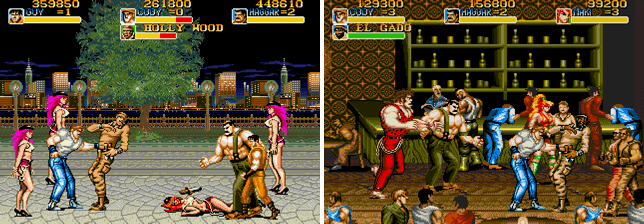
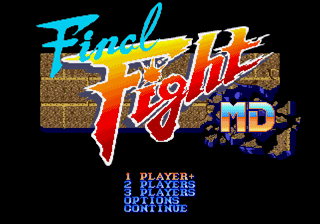
The landscape of retro gaming preservation and homebrew development has reached a significant milestone with the emergence of Final Fight MD, an ambitious reimagining of Capcom’s seminal 1989 arcade brawler. Developed by the Brazilian studio MXRetroDev, led by programmer Mauro Xavier, this project represents more than a mere port; it is a technical overhaul designed to push the Motorola 68000 processor of the Sega Genesis (Mega Drive) to its absolute limits. While the Sega CD version of Final Fight was long considered the definitive 16-bit console experience due to its orchestrated soundtrack and inclusion of all arcade stages, Final Fight MD seeks to surpass that legacy by introducing features never before seen in any home version of the title.
Historical Context and the Evolution of Final Fight Ports
To understand the significance of Final Fight MD, one must look at the fractured history of the game’s transition from arcades to living rooms. When Final Fight first arrived on the Super Nintendo Entertainment System (SNES) in 1990, it was met with mixed reviews due to significant hardware-imposed limitations. The SNES version famously omitted the playable character Guy, removed the entire Industrial Area stage, and lacked a two-player cooperative mode. Subsequent releases, such as Final Fight Guy, attempted to rectify these omissions but still failed to provide a complete experience on a single cartridge.
The 1993 release of Final Fight CD for the Sega Mega-CD peripheral was a revelation for fans. It utilized the CD-ROM format to include all three original characters—Cody, Guy, and Mike Haggar—alongside the full stage progression and a redbook audio soundtrack. However, even the Sega CD version faced constraints, particularly regarding the console’s limited color palette and the number of active sprites allowed on screen before performance degradation occurred.
In the decades following, various "pixel-perfect" ports appeared on the Game Boy Advance and modern digital storefronts, but the Sega Genesis community remained without a native, high-quality cartridge version that could rival the CD-ROM counterpart. Final Fight MD fills this thirty-year void, leveraging modern coding techniques and a deep understanding of the Genesis hardware architecture to deliver a version that rivals the arcade original in ways previously thought impossible.
Technical Innovations and the 1 Player+ Mode
The core appeal of Final Fight MD lies in its technical sophistication. MXRetroDev has rebuilt the game engine from the ground up, moving away from the limitations of early 90s development kits. One of the most touted features is the "1 Player+" mode. By accessing a hidden toggle on the main menu, players can enable a high-performance state that reallocates system memory to prioritize gameplay fluidity and sprite density.
In standard 16-bit beat ’em ups, the number of enemies on screen is usually capped at three or four to prevent "sprite flickering" and CPU slowdown. Final Fight MD shatters this convention, capable of rendering up to seven active enemies simultaneously. This feat is achieved through optimized assembly code and efficient VRAM management, ensuring that the chaotic, crowded feel of the arcade original is preserved. Furthermore, the game offers a toggle between 30 and 60 frames per second (FPS). While the 60 FPS mode is recommended for users utilizing overclocked original hardware or high-end emulators, the 30 FPS mode provides a stable, consistent experience for those using stock hardware.
Expanding the Roster and Gameplay Mechanics
Beyond technical prowess, Final Fight MD introduces significant content expansions. For the first time in the franchise’s 16-bit history, the game supports three-player simultaneous cooperative play. This feature is compatible with the Sega Team Player and EA 4-Way Play adapters, transforming the traditional duo-brawler into a chaotic group experience.
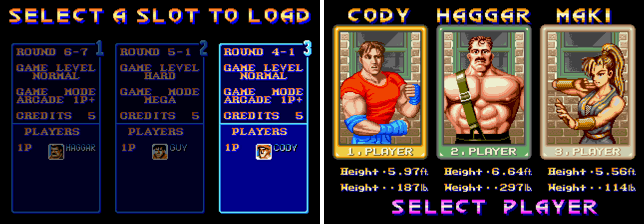
The roster has also been expanded to include Maki, the fan-favorite ninja who debuted in the SNES-exclusive Final Fight 2. Her inclusion represents a crossover of sub-series lore, providing Genesis players with a high-speed alternative to the power-based playstyles of Haggar and Cody. MXRetroDev has also addressed long-standing complaints regarding "hitbox" accuracy. By meticulously refining the collision detection algorithms, the developer has ensured that the "reach" and "priority" of attacks mirror the arcade’s logic, providing a level of competitive fairness that was often missing in earlier console ports.
The Mega Mode and Achievement System
To increase longevity, MXRetroDev has integrated a comprehensive "Mega Mode," which features 60 unlockable achievements. These are not merely cosmetic badges; they serve as the gateway to a deep customization system. As players complete specific challenges—such as clearing stages without using continues or defeating bosses within time limits—they unlock gameplay modifiers and new modes.
The rewards within Mega Mode are divided into tiers:
- Gameplay Modifiers: These include the ability to perform "air combos," a mechanic typically reserved for later entries in the genre like Streets of Rage 4. Other modifiers include "Instant Knockout" punches and adjustable food drop rates.
- Cosmetic Customization: Players can unlock alternative color palettes for all four characters and even swap boss themes with music from Final Fight 2 and Final Fight 3.
- End-Game Challenges: Upon reaching the 30-achievement milestone, players gain access to "Nightmare" difficulty, a "Boss Rush" mode, and "Vampire Mode," where the player’s health constantly depletes unless they land successful attacks on enemies.
To maintain the integrity of the challenge, the game disables further achievement progress once "cheat-like" modifiers—such as "God Mode" or "One Punch Man" mode—are activated.
Development Timeline and Licensing Hurdles
The journey of Final Fight MD has been marked by both community support and industrial frustration. Mauro Xavier has maintained a transparent development cycle through his Patreon page, frequently releasing "work-in-progress" builds to gather user feedback. This iterative process led to the total reworking of the game’s sound engine and enemy AI routines.
However, the path to a formal release has been obstructed by the complexities of intellectual property law. Xavier has publicly expressed frustration regarding failed negotiations with various third-party publishers. In several statements, he noted that development was frequently paused or delayed under the premise that an official license from Capcom could be secured for a physical cartridge release.
"I have held back the development of the game countless times at the request of supposed publishers and distributors," Xavier stated on his Patreon. "I can no longer stand being stuck and unable to move forward… because of this pending promise to deliver a game that I promised."
As of late 2024, the project remains an unofficial fan effort. While companies like Retro-Bit have successfully licensed Capcom properties for physical re-releases—most notably Mega Man: The Wily Wars in 2021—the specific hurdles for Final Fight MD appear tied to the fact that it is a transformative work rather than a direct ROM reproduction. Consequently, Xavier has shifted his focus to completing the game to his own satisfaction and releasing it for free to the community, while continuing to seek official recognition.
Sound Design and Future Compatibility
While the Sega CD version is lauded for its high-fidelity audio, Final Fight MD faces the challenge of the Genesis console’s Yamaha YM2612 FM synthesis chip. While FM synthesis cannot replicate the orchestral quality of a CD, MXRetroDev has utilized advanced sound drivers to produce a soundtrack that captures the "gritty" urban atmosphere of Metro City.
The developer has also hinted at future compatibility with the Sega CD hardware. If a player runs the Genesis cartridge while a Sega CD unit is attached, the game may eventually be able to "pull" the high-quality audio tracks from a CD, effectively creating a hybrid experience that utilizes the superior visuals and features of the MD port with the superior audio of the CD version.

Implications for the Retro Gaming Industry
The emergence of Final Fight MD highlights a growing trend in the "Neo-Retro" scene: the use of modern development tools to "fix" the history of the 16-bit era. As hardware limitations of the past are overcome by the ingenuity of today’s programmers, the line between official historical releases and fan-made "definitive editions" continues to blur.
For Capcom, the project presents a unique dilemma. While fan projects are often met with "cease and desist" orders, the high quality and community reverence for Final Fight MD offer a potential roadmap for how legacy publishers could engage with their most dedicated fans. The project serves as a technical proof-of-concept, demonstrating that there is still a massive, untapped market for high-quality, physical releases on legacy hardware.
Final Availability and Community Impact
Currently, Final Fight MD is available as a free digital download on itch.io, with Xavier providing regular updates to his Patreon supporters. The community response has been overwhelmingly positive, with many citing the game as the "missing link" in the Genesis library. By including features like save slots—a luxury unheard of in the original arcade or early console releases—MXRetroDev has modernized the brawler for a contemporary audience while retaining the aesthetic and mechanical purity of the 1980s.
As the project nears its final "polished" state, it stands as a testament to the enduring legacy of the Sega Genesis and the passion of the Brazilian development scene. Whether it ever receives an official Capcom seal of approval or remains a legendary "underground" masterpiece, Final Fight MD has already secured its place as one of the most significant technical achievements in the history of homebrew software. For fans of Metro City, the Mad Gear gang, and the golden age of the beat ’em up, the definitive fight has finally arrived on the hardware it was always meant to conquer.