Jia Lissa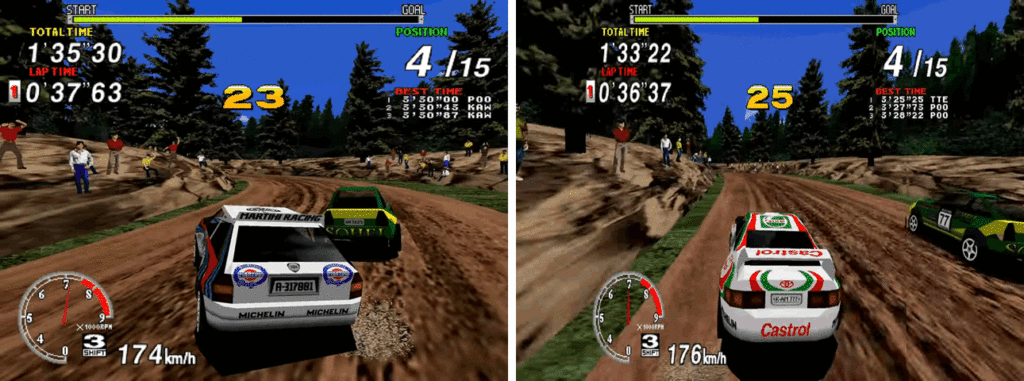
The landscape of the coin-operated amusement industry underwent a seismic transformation during the mid-1990s, driven by a fierce technological arms race between Sega and its primary rival, Namco. While the broader public narrative of the era focused on the "console wars" between Sega and Nintendo, the arcade sector was defined by a quest for three-dimensional graphical supremacy. This competition reached its zenith with the development and release of Sega Rally Championship in 1995. Developed by Sega’s AM3 division, the title represented a departure from the polished, track-based racing of its contemporaries, introducing off-road mechanics, licensed vehicles, and a sophisticated approach to environmental rendering that would redefine the racing genre for decades to come.
The Technological Frontier: From Model 1 to Model 2
The early 1990s marked the transition from two-dimensional sprite-scaling to true 3D polygonal graphics. Sega’s Model 1 hardware, which powered hits like Virtua Racing (1992) and Virtua Fighter (1993), had established a baseline for 3D performance, capable of pushing 180,000 flat-shaded polygons per second. However, the 1994 debut of the Model 2 hardware—a collaborative effort between Sega and GE Aerospace—offered a massive leap in capability.
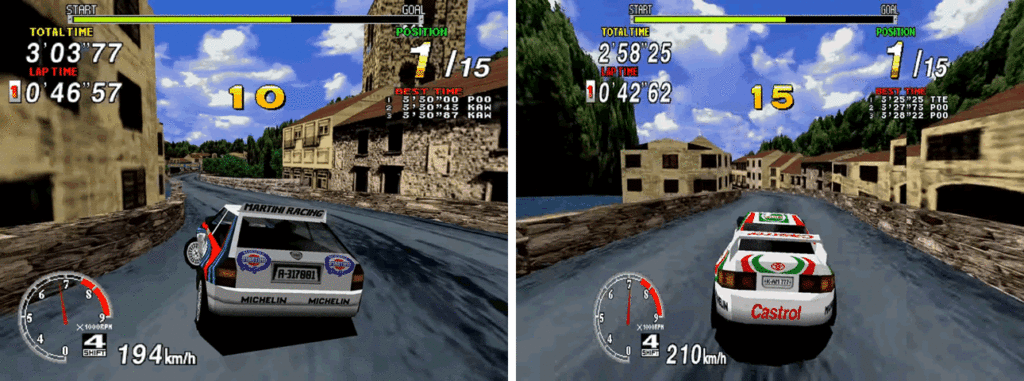
The Model 2 was a technological marvel of its time, capable of rendering up to 500,000 polygons per second. More importantly, it introduced advanced features such as texture mapping, texture filtering, and trilinear filtering. These advancements allowed developers to move away from the "flat" look of early 3D games, enabling the application of realistic surfaces like dirt, gravel, and asphalt. While Daytona USA had utilized the Model 2 to massive success in 1994, industry analysts noted that it utilized only a fraction of the board’s potential. Sega Rally Championship was conceived as the project that would push this architecture to its limit, focusing on the complex physics of loose-surface driving.
Leadership and the Formation of AM3’s Emotion Design Lab
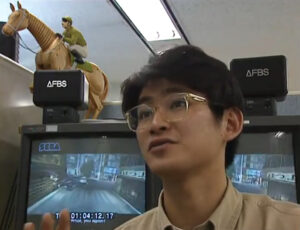
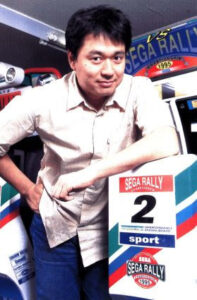
The project was spearheaded by Tetsuya Mizuguchi, a visionary producer who joined Sega in 1989 with a background not in traditional game design, but in virtual reality and high-end simulators. Mizuguchi’s entry into the company was unorthodox; he famously presented a 40-page proposal on the future of entertainment and VR to R&D head Hisashi Suzuki. Mizuguchi’s early work on the AS-1 motion simulator provided the foundation for his interest in immersive, "body sensation" (taikan) gaming.
To realize his vision for a rally-themed title, Mizuguchi assembled a specialized team within the AM3 department, which he dubbed the "Emotion Design Lab." Key to the team’s success was the recruitment of Kenji Sasaki, a former Namco developer who had served as the lead designer for Ridge Racer. Sasaki’s experience at a rival firm provided a fresh perspective on 3D game construction. Rounding out the leadership was Sohei Yamamoto, a veteran programmer known for his work on mechanical motion cabinets. This trio—Mizuguchi as producer, Sasaki as director, and Yamamoto as lead programmer—faced the challenge of creating a racing game that could stand out in a market already dominated by track-based titles.
Chronology of Development: From "Rally California" to "Sega Rally"
The development of Sega Rally Championship followed a complex timeline characterized by radical pivots in design. Initially, the team planned a cross-country racing game titled "Rally California," inspired by the 1981 film The Cannonball Run. The concept involved a single, continuous drive from the West Coast to the East Coast of the United States.
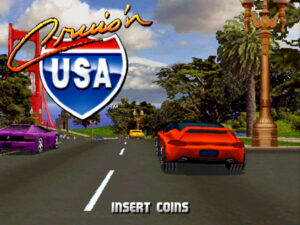
However, the 1994 announcement of Midway’s Cruis’n USA forced a strategic retreat. Midway’s title utilized a nearly identical premise, prompting AM3 to abandon the cross-country concept to avoid direct competition. This setback proved beneficial, as the team realized that rendering thousands of miles of unique scenery was technically unfeasible given the memory limitations of the era. The focus shifted toward World Rally Championship (WRC) style racing, which was immensely popular in Europe but relatively niche in Japan and North America.
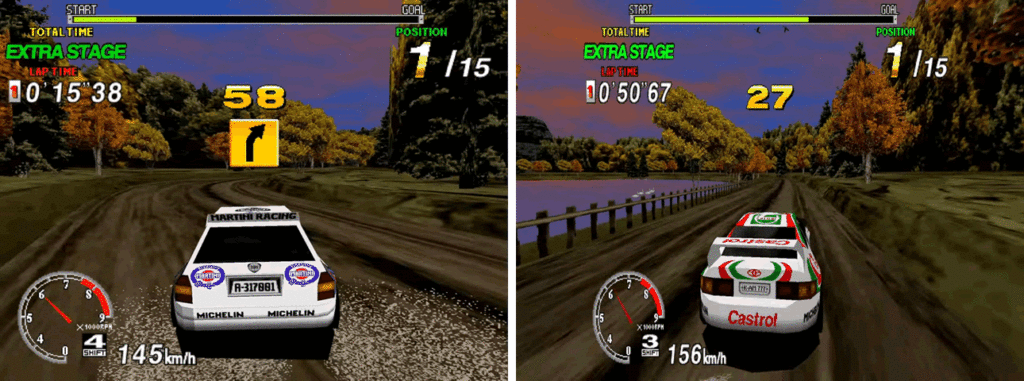
To ensure authenticity, the team embarked on a 1,200-mile research expedition across the United States, traveling from Mexico City to Yosemite National Park. During this two-week trip, the developers captured over 4,000 photographs and hours of video footage. These materials were used to create the game’s textures, ensuring that the environments felt grounded in reality rather than digital abstraction.
Engineering Authenticity: Licensing and Sound Design
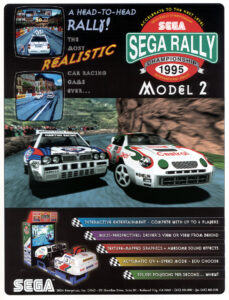
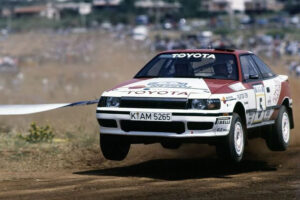
One of the most significant hurdles in development was the acquisition of vehicle licenses. In the mid-1990s, licensing real-world cars for video games was not yet standard practice. Mizuguchi was determined to feature the Toyota Celica GT-Four and the Lancia Delta HF Integrale, two iconic rally vehicles.
Initial reactions from Toyota were skeptical; executives argued that video games were not a viable marketing tool for the automotive industry. However, upon seeing the high-fidelity 3D models and textures the team had produced, Toyota management relented. Mizuguchi then used Toyota’s tentative agreement to leverage a deal with Fiat (Lancia’s parent company) in Turin, Italy. Remarkably, these licenses were secured without the exorbitant fees common in the modern era, as both manufacturers viewed the project as a experimental publicity venture.
The commitment to realism extended to the audio. AM3 composer Tomoyuki Kawamura recorded engine sounds from actual rally-spec vehicles at the Maruwa Autoland Nasu dirt track. The team recorded idling, high-RPM revs, and the specific sound of gravel hitting the undercarriage. These sounds were integrated into the "Active Shock Generator" (ASG) system, a proprietary vibration technology that moved the arcade seat in sync with the audio frequencies, providing players with tactile feedback of the road surface.
Gameplay Innovations and the "Game Over Yeah!" Legacy
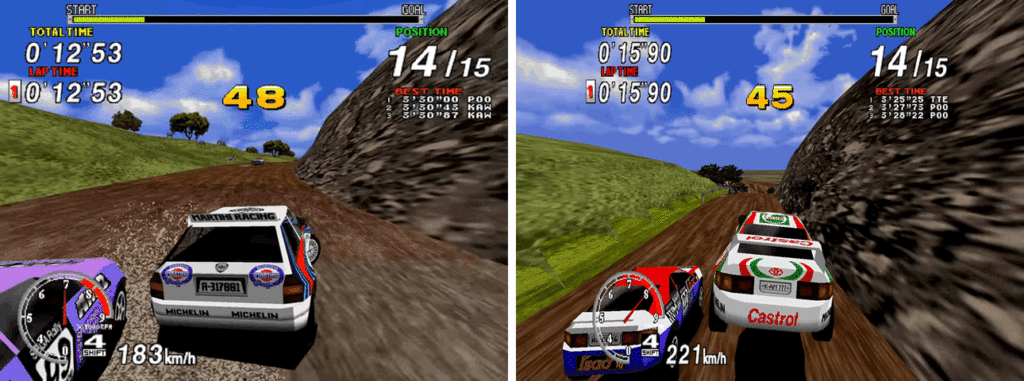
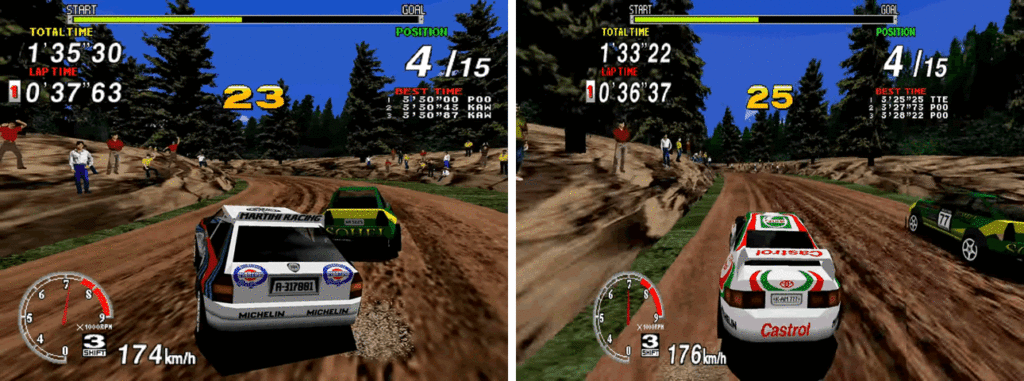
Sega Rally Championship introduced several mechanics that differed from the arcade standard. Unlike Daytona USA, which featured a mini-map, Sega Rally relied on a "co-driver" system. Players received audio cues—such as "Easy right" or "Over jump"—mimicking the real-world communication between a rally driver and navigator.
The game’s physics engine was specifically tuned to simulate the difference between driving on tarmac, dirt, and mud. This was a significant achievement for 1995, as most racing games treated all surfaces with a uniform friction coefficient. The "gear drifting" technique, while present in earlier Sega titles, was refined here, allowing skilled players to navigate tight corners by rapidly downshifting to initiate a slide.
The soundtrack, composed by Sega legend Takenobu Mitsuyoshi, became an iconic part of the experience. Mitsuyoshi, who had previously achieved fame for his vocal work on Daytona USA, provided the game’s celebratory "Game Over, YEAH!" jingle. This sound bite was sampled as a single phrase rather than fragmented segments, a technical luxury afforded by the Model 2’s improved sound hardware.
Market Impact and Arcade Variants
Upon its February 1995 release, Sega Rally Championship was a commercial success, eventually selling approximately 12,000 arcade units globally. While this figure was lower than the massive numbers seen by 2D predecessors like OutRunners, it was considered a triumph for a new sub-genre.
Sega produced three primary cabinet configurations:
- The Standard Upright: A space-saving model for smaller venues.
- The Twin Unit: The most popular version, allowing for two-player linked competition.
- The Deluxe Cabinet: A high-end version featuring a mini-Celica replica with pitch and roll motion.
A fourth, exceedingly rare version known as the "Special Stage" was installed at Sega’s Shinjuku Joypolis. This was a massive motion simulator featuring full-sized Toyota Celica shells mounted on a six-axis hydraulic platform. It represented the ultimate realization of Mizuguchi’s taikan philosophy, though the high maintenance costs and the eventual closure of the venue in 2000 meant that no units are believed to have survived in working order.
Broader Industry Implications
The success of Sega Rally Championship had a profound impact on both Sega’s internal structure and the wider industry. The game proved that there was a global market for rally racing, leading to the development of the Sega Rally 2 (1998) on the Model 3 hardware and eventually the Dreamcast.
In 1996, a port was released for the Sega Saturn. Despite the hardware’s difficulty with 3D transparency and its lower polygon throughput compared to the Model 2, the port was hailed as a masterpiece of optimization. It served as a vital "killer app" for the console during its competition with the Sony PlayStation.

Furthermore, the game’s influence extended to western developers. Guy Wilday, the producer of the original Colin McRae Rally (1998) at Codemasters, cited Sega Rally’s handling and surface physics as the primary inspiration for their series. The game essentially established the template for the modern rally sim-arcade hybrid.
For Tetsuya Mizuguchi, the project served as the springboard for his transition into more experimental territory. Following the success of the rally series, he formed "AM Annex" (later United Game Artists), where he would create avant-garde titles like Rez and Space Channel 5. Sega Rally Championship remains a landmark achievement, representing a moment in history when technical innovation, field research, and a daring approach to licensing converged to create a timeless piece of interactive entertainment. To this day, the game is remembered not just for its graphics, but for the visceral, physical joy of a perfectly executed drift on a digital dirt track.