Jia Lissa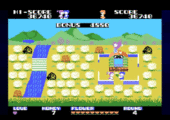
Girl’s Garden, released in February 1985 for the Sega SG-1000, represents a pivotal moment in the early history of Sega Enterprises, serving as the professional debut of Yuji Naka, who would later achieve international fame as the lead programmer of Sonic the Hedgehog. Developed during a period of intense competition between Sega’s first home console and Nintendo’s Family Computer (Famicom), Girl’s Garden was a strategic attempt to diversify the gaming market by targeting a female demographic, a rarity in the mid-1980s. The game is an action-oriented title that combines resource gathering with survival mechanics, set against a backdrop of technical innovation that pushed the limited hardware of the SG-1000 to its absolute boundaries.
Historical Context and Development Origins
The development of Girl’s Garden began in late 1984 under the direction of Hiroshi Kawaguchi and Yuji Naka. At the time, Sega was seeking to expand its software library beyond arcade ports to include original titles that could appeal to a broader audience. According to historical records and retrospective interviews with Yuji Naka, the project was born from a corporate directive to create a game that would appeal specifically to young girls. This was a significant departure from the male-centric action and sports titles that dominated the SG-1000’s early catalog.
Yuji Naka, then a young programmer who had recently joined Sega, was tasked with the design and coding of the project. Working alongside him was Hiroshi Kawaguchi, who would later become one of Sega’s most celebrated composers, though his role on Girl’s Garden was primarily focused on programming. The development cycle lasted approximately five months, a standard timeframe for the era, but the resulting product showcased a level of polish and technical sophistication that was uncommon for the SG-1000 hardware.
Narrative Framework and Core Gameplay Mechanics
The game follows the story of Papri, a young girl with pink hair who is attempting to win the affection of a boy named Minto. The central conflict involves a rival character, Cocco, who also seeks Minto’s attention. The gameplay is structured around a central hub—Minto’s house—and the surrounding wilderness where Papri must gather flowers to create a bouquet.
The mechanics are governed by a unique visual timer system. Unlike the standard numerical countdowns or "energy meters" found in contemporary titles like Smurf: Rescue in Gargamel’s Castle, Girl’s Garden uses a character-based indicator. At the bottom of the screen, players can see Minto walking toward Cocco. If the player fails to deliver a bouquet of ten flowers before Minto reaches Cocco, the round is lost. This narrative-driven timer reinforces the game’s theme of romantic rivalry and provides a clear, visual sense of urgency.
To succeed, the player must navigate a series of increasingly complex screens to collect flowers. However, the flowers follow a specific growth cycle consisting of six animation frames. Flowers can only be safely harvested during the fourth frame, when they are in full bloom. If Papri collects a wilted flower, she is penalized by losing half of her current bouquet. This adds a layer of timing and pattern recognition to the standard "collect-em-up" formula.
Technical Innovations on the SG-1000 Hardware
The SG-1000 was built around the Texas Instruments TMS9918A Video Display Processor (VDP), a chip also found in the ColecoVision and MSX computers. This hardware was notoriously limited, particularly regarding its ability to display multiple colors per sprite and its lack of hardware-level scrolling support. Despite these constraints, Girl’s Garden introduced several technical feats that were considered revolutionary for the platform.
Parallax Scrolling
One of the most impressive features of Girl’s Garden is the inclusion of parallax scrolling. By manipulating the background tiles and updating them at different rates, Naka was able to create the illusion of depth. The clouds in the sky move at a different speed than the distant mountains and the foreground grass. While the scrolling is somewhat choppy due to the CPU overhead required to update the background layer frame-by-frame, it represented a level of visual fidelity that few other SG-1000 games attempted.
Sprite Manipulation and Scaling
The game utilizes a "Challenging Stage" every two rounds, which switches the perspective and scale of the characters. In these stages, the SG-1000 is forced to use a specific hardware mode that displays sprites at four times their standard size. Papri and the enemy bears appear as large-scale figures, requiring the player to time jumps over incoming waves of enemies. This mode was rarely used in other titles because it often led to significant sprite flickering and collision detection issues, yet Naka implemented it as a core gameplay feature to provide variety.
Color and Detail
The TMS9918A VDP limited sprites to a single color per 8×8 or 16×16 area. To overcome this, the developers of Girl’s Garden employed sprite layering—placing multiple sprites of different colors on top of one another to create more detailed characters. This is evident in Papri’s design, which features different colors for her hair and dress. While this increased the risk of hitting the system’s horizontal sprite limit (which causes flickering), the game manages these resources effectively to maintain a vibrant, high-quality aesthetic.
Environmental Hazards and AI Behavior
The primary antagonists in Girl’s Garden are bears that roam the flower fields. These enemies exhibit basic but aggressive AI patterns, chasing Papri if she enters their line of sight. To counter this, the player can collect honey pots, which can be dropped to distract the bears. When a honey pot is placed, the bears will prioritize the honey over the player, allowing Papri a window of safety to collect flowers.
As the player progresses, the environment becomes more hazardous. Later stages introduce water features and rocky terrain that restrict movement. These obstacles apply to both the player and the bears; however, the bears are unable to cross certain background tiles like rocks or unbloomed flowers. This environmental interaction requires the player to plan their routes carefully, turning the game into a hybrid of an action title and a pathfinding puzzle.
Audio Composition and Aesthetic Direction
While Hiroshi Kawaguchi is now synonymous with the high-energy "Sega Sound" of the late 80s, the music in Girl’s Garden was composed by Tohru Nakabayashi and Katsuhiro Hayashi. The soundtrack is notable for its variety and the use of classical arrangements to signify progression.
Upon successfully delivering a bouquet, the game plays a rendition of Felix Mendelssohn’s "Wedding March," a thematic choice that aligns with the game’s romantic goals. The audio design also includes distinct jingles for item collection (such as the skulls dropped by bees) and a frantic theme for the Challenging Stages. The use of multiple distinct tracks was a luxury for early SG-1000 cartridges, which were often limited in memory capacity.
Historical Chronology and Release Data
Girl’s Garden was officially released in Japan in February 1985. It was never officially localized for Western markets during its original run, largely because the SG-1000 was not a primary focus for Sega in North America or Europe, where they were preparing to launch the Master System (Mark III in Japan).
- 1985: Original release on the SG-1000.
- 1986: Compatibility confirmed for the Sega Mark III and the Sega Master System (via the backwards compatibility of the Japanese hardware). However, when played on these newer systems, the color palette is slightly altered due to differences in the VDP implementation.
- 2016: The game received its first official modern re-release as part of the Sega 3D Reprint Archives 3: Final Stage for the Nintendo 3DS. This version included an "Easy Mode" and technical adjustments to reduce flickering.
- 2020: The game was included as a built-in title on the Sega Game Gear Micro (Smoke version), bringing it to a handheld format for the first time.
Analysis of Implications and Legacy
The release of Girl’s Garden had several long-term implications for Sega and the broader video game industry. First, it established Yuji Naka as a rising star within the company. His ability to extract high performance from limited hardware would later lead to the development of the "Sonic" engine, which was famous for its speed on the Sega Genesis.
Second, the game is an early example of "genre-blending." While many games in 1985 were strictly defined as shooters or platformers, Girl’s Garden incorporated elements of stealth (avoiding bears), resource management (the bouquet), and timing-based action.
Finally, the game’s focus on a female protagonist and a non-violent, romantic objective was a precursor to the "social simulation" and "otome" genres that would eventually find a massive market in Japan. While Sega did not immediately follow up with a series of similar titles, Girl’s Garden remains a unique artifact of a time when the industry was still experimenting with what a video game could be and who it could be for.
In modern retrospective analysis, Girl’s Garden is frequently cited by game historians as one of the "must-play" titles for the SG-1000. It stands as a testament to the idea that technical limitations can foster creativity. The game’s charm, coupled with its historical significance as the starting point for some of the most influential figures in gaming history, ensures its place in the annals of interactive entertainment. For collectors and historians, it remains a primary example of Sega’s early innovation and a rare look at the formative years of the developers who would go on to define the 16-bit era.