Indra Gunadi
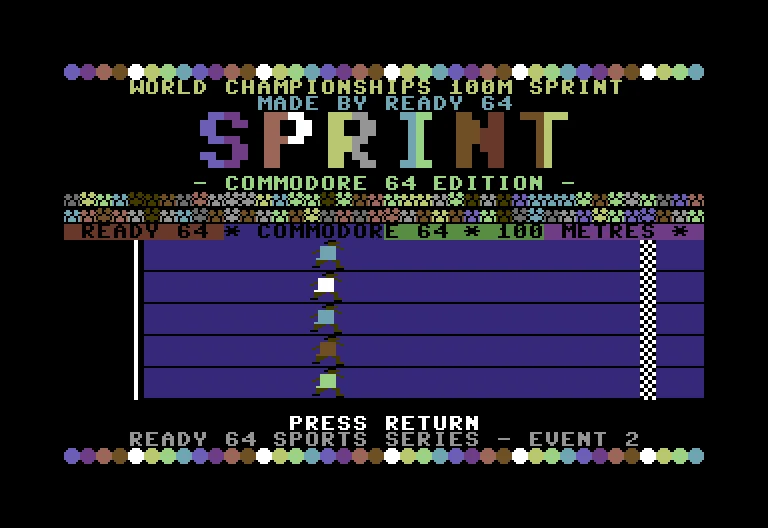
The Commodore 64, a machine that dominated the home computing market in the 1980s, has received a new software entry with the release of World Championships 100-Meter Sprint. Developed by the collective known as ready64, this title arrives in October 2026, serving as a testament to the enduring viability of the 8-bit platform more than four decades after its commercial debut. While modern gaming is characterized by hyper-realistic graphical fidelity and massive online multiplayer environments, this new release focuses on the mechanical simplicity and high-tension gameplay that defined the early era of sports simulation.
The Context of Retro-Computing Development
The development of software for legacy hardware has evolved from a niche hobbyist pursuit into a formalized scene with high production standards. The "breadbox," a colloquial term for the original Commodore 64 design, remains the most popular retro platform due to its accessible architecture and a massive library of existing documentation. Ready64, an established name in the C64 preservation and development community, has aimed to bridge the gap between historical nostalgia and modern software quality assurance.
World Championships 100-Meter Sprint is not merely a graphical update to existing track-and-field titles; it represents an attempt to optimize the machine’s MOS Technology 6510 microprocessor to handle the specific input latency required for a competitive sprinting simulation. In the 1980s, titles like Epyx’s Summer Games set the gold standard for button-mashing gameplay. The new release by ready64 adopts these mechanics, requiring players to achieve rhythmic consistency to maintain top speed, a task that remains as physically demanding for the player today as it was in 1984.
Chronology of the Commodore 64 Scene
To understand the significance of this release, one must look at the timeline of the Commodore 64’s lifecycle. Launched in 1982, the C64 became the best-selling single computer model of all time, with estimates ranging from 12.5 to 17 million units sold. By the mid-1990s, the official commercial software market had largely vanished. However, the "demoscene"—a subculture focused on pushing the graphical and audio limits of hardware—ensured that the machine never truly died.
- 1982: Commodore Business Machines releases the C64 to the mass market.
- 1985–1990: The "Golden Age" of C64 gaming, defined by titles like Impossible Mission and The Last Ninja.
- 1994: Commodore International files for bankruptcy, marking the end of official support.
- 2000s: The rise of cross-development tools allows programmers to write code on modern PCs and transfer it to the C64, leading to a renaissance in homebrew software.
- 2026: The release of World Championships 100-Meter Sprint signals the continued maturity of modern retro-development, where community-driven projects now mirror the polish of professional retail releases from the 1980s.
Technical Analysis and Performance Metrics
The gameplay loop of World Championships 100-Meter Sprint centers on the physics of the sprint. On the C64, where the frame rate is locked to the PAL/NTSC refresh rate (50Hz or 60Hz), managing input polling is critical. Ready64 has implemented a control scheme that emphasizes precision over chaotic button pressing.
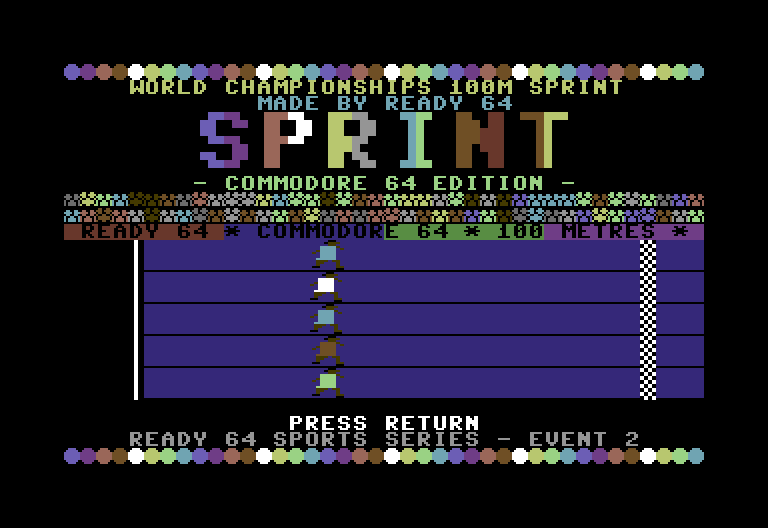
From a technical standpoint, the game utilizes the VIC-II (Video Interface Chip) to manage sprite multiplexing. Because the C64 can only natively display eight hardware sprites at once, displaying a fluid runner requires complex programming to recycle sprite registers mid-frame. Ready64’s implementation allows for smooth animation cycles that avoid the "flicker" often associated with poorly optimized 8-bit software. The sound design utilizes the SID (Sound Interface Device) chip, a programmable sound generator that remains highly regarded in audio engineering circles for its unique analog-style synthesis. The game’s audio cues provide the player with rhythmic feedback, an essential component for timing the acceleration phase of the sprint.
The Sociology of Retro Sports Gaming
The appeal of a 100-meter sprint simulator on 40-year-old hardware is rooted in the "mechanical tactile" experience. Modern sports games, such as the EA Sports FC or NBA 2K series, rely on complex animation trees and motion-captured movement. In contrast, World Championships 100-Meter Sprint strips the experience down to the raw interaction between the user’s input and the machine’s logic gates.
Industry analysts suggest that the resurgence of such titles is a reaction to the bloat found in contemporary gaming. By removing the need for server connectivity, patch downloads, or subscription models, a game like World Championships 100-Meter Sprint offers a "complete" experience upon execution. This resonates with a demographic of aging gamers who value the permanence of physical media and the simplicity of offline play.
Implications for the Retro-Development Ecosystem
The release of this title by ready64 has implications for the broader retro-development ecosystem. First, it highlights the importance of open-source development tools. Projects like the CC65 C compiler have enabled a new generation of developers to contribute to the C64 library without needing to master 6502 assembly language. This has lowered the barrier to entry, resulting in a higher volume of releases.
Second, the commercialization—or at least the professional distribution—of these titles is changing. While World Championships 100-Meter Sprint is categorized as a community release, many similar projects are now being packaged with high-quality physical manuals, cassettes, and even custom-molded cartridges. This shift turns software releases into collector’s items, providing a sustainable model for developers to fund future projects.
Challenges in Legacy Hardware Optimization
Developers working on the Commodore 64 in 2026 face unique constraints that modern software engineers rarely encounter. Memory management is the most significant hurdle; the C64 is limited to 64 kilobytes of RAM. Every byte must be accounted for. Ready64’s approach to memory management in this sprint title involves dynamic loading segments, where non-essential assets are purged from memory as the race progresses from the starting block to the finish line.
Furthermore, the challenge of display output remains relevant. While most users run these games on emulators (such as VICE or TheC64 Mini), a significant portion of the user base still operates on original cathode-ray tube (CRT) monitors. Designing a game that looks correct on both high-definition digital displays and analog phosphorescent screens requires careful attention to color palettes and scanline behavior. Ready64 has reportedly tuned the game’s color contrast to ensure readability across all display types, a level of polish that distinguishes top-tier homebrew projects from amateur attempts.
Future Outlook and Community Response
Initial reactions from the Commodore 64 community, primarily disseminated through forums such as Lemon64 and various social media hubs, have been positive. The consensus reflects an appreciation for the game’s "pick-up-and-play" nature. In an era where game tutorials can last for hours, the simplicity of a 100-meter dash is seen as a refreshing return to the roots of the medium.
Looking forward, the release of World Championships 100-Meter Sprint sets a high bar for upcoming sports simulations on the platform. As the hardware continues to be pushed by creative developers, the line between "retro" and "modern" continues to blur. While the Commodore 64 will never replace the processing power of modern PCs, it remains a robust sandbox for developers who wish to explore the fundamental mechanics of game design.
The legacy of the 100-meter dash in digital gaming is long, spanning from the early mainframe experiments to the high-fidelity experiences of today. That a developer in 2026 would choose to revisit this genre on a machine released in 1982 is a powerful statement about the nature of play. It suggests that the value of a game is not found in its polygon count or its resolution, but in the immediacy of the challenge and the satisfaction of mastering a limited, yet perfectly formed, digital environment. As the Commodore 64 enters its fifth decade of existence, it is clear that the platform remains a living, evolving ecosystem, sustained by a community that refuses to let its history become static.