Jia Lissa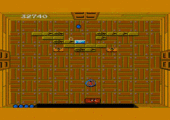
The evolution of the arcade-to-home console transition in the late 1980s was defined by a quest for technical parity, particularly in the genre of "block breakers." While the genre traces its origins to the 1976 Atari arcade title Breakout, the mid-1980s saw a paradigm shift with Taito’s Arkanoid. As Sega sought to solidify its presence in the Japanese market with the Mark III (the precursor to the Master System), it introduced a proprietary peripheral: the paddle controller. This device, bundled with the 1987 title Woody Pop: Shinjinrui no Block Kuzugi, remains a case study in the challenges of porting arcade-specific input methods to home hardware.
The Technical Necessity of Paddle Controllers
The paddle controller represents a distinct departure from the digital D-pad input that became the industry standard for home consoles. Unlike a digital controller, which provides binary "on/off" signals, a paddle controller utilizes a potentiometer—a three-terminal resistor that creates a variable voltage. This allows the console to register the precise speed and position of the player’s movement, providing a fluid range of motion essential for games like Super Breakout or Arkanoid.
During the Atari 2600 era, the paddle controller was a staple, supporting over 30 titles. However, as the industry transitioned toward the Nintendo Famicom and the Sega Mark III, manufacturers faced a hardware dilemma. Nintendo’s decision to exclude paddle controllers from the standard Famicom packaging meant that third-party developers, most notably Taito, were forced to bundle their own hardware with software to ensure a playable experience. This created a fragmented ecosystem where peripheral support was tied directly to specific software SKUs, effectively limiting the reach of games requiring high-precision analog input.
Chronology of the Sega Mark III Paddle Initiative
In 1987, Sega launched an ambitious, albeit limited, hardware initiative for the Mark III. The company released two distinct paddle controller bundles to bridge the gap between their arcade library and their home console.
- Early 1987: Sega releases the paddle controller bundled with Alex Kidd BMX Trial, a title requiring precise control for navigating obstacles.
- Late 1987: The company releases Woody Pop, a block breaker title, also bundled with the paddle controller.
- Hardware Lifecycle: Over the course of the Mark III’s lifespan, only seven games were developed to utilize the paddle peripheral. Four of these, including the arcade port of Megumi Rescue, were exclusive to the device, marking the controller’s total lifecycle contribution to the platform.
Despite the technical potential, Sega’s investment in the paddle controller remains an outlier in the company’s history. Sega’s primary arcade success was built on joysticks and steering wheels; the paddle controller served no role in their most popular arcade cabinets. This disconnect suggests that the peripheral was developed less as a core strategic pillar and more as a reactive measure to the success of competitors like Arkanoid.
Analysis of Woody Pop: Design and Gameplay Mechanics
Woody Pop: Shinjinrui no Block Kuzugi serves as a direct, if somewhat derivative, evolution of the block-breaking genre. The player assumes the role of "Woody," a spirit navigating the "Bizarre Mansion" to rescue a character named Gumball. From a mechanical standpoint, the game attempts to refine the formula established by Taito.
Innovations and Enhancements
Woody Pop introduced several features that were absent in contemporary titles. Most notable is the visual feedback system: bricks that require multiple hits to destroy show clear signs of structural failure, such as visible cracks. Furthermore, the game introduced branching paths, allowing players to select different rooms upon clearing a level. This added a layer of replayability, as players could choose between doors that ostensibly represented different levels of difficulty or reward, although the practical distinction between these paths remains minimal.
Power-up Dynamics
The game employs a system of bubbles released from destroyed crystal blocks, which grant Woody various abilities. These items—including a "glue" power-up for catching the ball, a "flame" power-up for burning through obstacles, and a "diamond" ball for piercing—can be combined. This layering of mechanics was a significant departure from the more rigid power-up systems seen in other titles of the era.
Challenges in Hardware Implementation and Localization
Despite these design nuances, Woody Pop faced significant hurdles due to the technical limitations of the Mark III and the fundamental design choices of the development team. The primary issue stems from the aspect ratio. While Arkanoid was designed for the vertical orientation of an arcade monitor, the Mark III output was strictly 4:3. This horizontal expansion forced the player to cover more ground with the paddle, which, when combined with an aggressive increase in projectile speed, often made the game feel punishing rather than challenging.
Furthermore, the game’s aesthetic presentation—heavy on browns and oranges—was intended to reflect the "wood paneling" theme of the 1980s mansion setting. However, the limited color palette of the Mark III resulted in poor contrast, making it difficult for players to distinguish between moving elements and the background. This, paired with a sound design that relied heavily on percussion and feedback loops rather than melodic composition, led to an experience that felt disjointed.
Broader Implications for the Console Market
The failure of the Mark III paddle controller to achieve widespread adoption highlights the risks of hardware-specific peripherals. In the late 1980s, the "bundled controller" model was an expensive barrier to entry. For the consumer, the value proposition of a controller that only functioned with a handful of games was difficult to justify.
From an industry perspective, the inclusion of warp holes and "toy box" enemies—which constantly replenished threats on the screen—indicated an attempt by developers to compensate for a lack of depth with artificial difficulty. These mechanics, while technically functional, often resulted in extended periods of inactivity where the ball would bounce harmlessly in inaccessible areas of the screen.
While the game is sometimes cited as a "missing link" between early arcade block breakers and more modern titles like Wizorb, the reality is that Woody Pop was largely a vehicle for the hardware itself. The title was a strategic loss-leader, intended to move inventory rather than define the platform’s library. The total lack of Western localization for the paddle controller reinforces the notion that Sega viewed this segment of the market as niche, prioritizing the development of more versatile input methods for their subsequent consoles, such as the Sega Genesis.
Final Assessment
Woody Pop stands as a relic of a period when console manufacturers were still experimenting with how to translate the intensity of the arcade into the living room. While it offered incremental improvements over its peers, the game lacked the polish and intuitive design required to maintain long-term relevance.
The legacy of the project is not found in the gameplay itself, but in the failure of the accompanying hardware to scale. By the time the industry shifted toward more standardized controller inputs, the lessons learned from the Mark III paddle controller were clear: for a peripheral to succeed, it requires not just a single compelling title, but a robust ecosystem of software that justifies the user’s investment. With only seven supported titles, the Mark III paddle controller remains a historical footnote, an ambitious but ultimately ephemeral attempt to innovate within the confines of 1980s gaming technology.