 Jia Lissa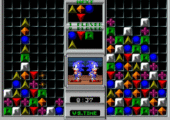
Sonic Eraser represents a significant, albeit obscure, milestone in the history of interactive entertainment, serving as one of the earliest examples of a major video game franchise branching into experimental digital distribution. Released in 1991 for the Japanese Mega Drive, the title predates the modern era of downloadable content, cloud gaming, and online storefronts. While the Sonic the Hedgehog franchise has since become a global juggernaut encompassing films, educational software, and a diverse library of spin-offs, Sonic Eraser remains a relic of an era when Sega was testing the limits of its hardware through the Game Toshokan service.
The Genesis of Digital Distribution
In the early 1990s, the concept of an online video game ecosystem was in its infancy. Sega’s initiative, the Game Toshokan (Game Library) service, was an ambitious project designed to operate over the Mega Modem, a peripheral that allowed Japanese Mega Drive users to connect to a central server via telephone lines. This allowed for the streaming of small-sized games directly to the console’s volatile memory.
The service, while revolutionary, was hampered by the technological limitations of the time, specifically the slow baud rates of early modems and a limited user base willing to invest in such experimental infrastructure. Sonic Eraser was designed with a minimal footprint to accommodate the technical constraints of the Game Toshokan, leading to a stripped-back presentation that favored functional gameplay over the high-fidelity aesthetics associated with the flagship Sonic titles. Alongside other titles like the text-heavy segments of Phantasy Star II and the dungeon-crawler Fatal Labyrinth, Sonic Eraser was meant to provide subscribers with a rotating library of exclusive, bite-sized experiences.
Chronology of a Lost Title
The life cycle of Sonic Eraser is defined by its isolation. Following the commercial discontinuation of the Game Toshokan service in 1992, the title effectively vanished from the public eye. For over a decade, it existed only in the memories of a small segment of the Japanese gaming public and as a piece of data on obsolete hardware.
- 1991: Sonic Eraser is released on the Japanese Mega Drive Game Toshokan streaming service.
- 1992: Sega terminates the Game Toshokan service, rendering the game inaccessible.
- 2004: Sega of Japan briefly revives the title via the "B-Club" download service, allowing users to purchase it digitally.
- Post-2004: Plans to include the title in the Sonic Gems Collection are shelved due to unspecified logistical concerns.
- Present: The game remains unreleased in any official Western capacity, surviving only through archival efforts and fan-translated ROMs.
The failure of the game to appear in the Sonic Gems Collection marked a turning point for its legacy. At the time, Sega was actively consolidating its back catalog for modern consoles; the omission of Sonic Eraser suggested that the publisher viewed the title as a minor historical footnote rather than a significant piece of intellectual property worth formal preservation.
Core Gameplay Mechanics and Design Philosophy
From a mechanical perspective, Sonic Eraser functions as a competitive puzzle game that prioritizes speed and tactical obstruction. Players manipulate clusters of four blocks—which share visual similarities with the iconic shapes found in Tetris—to clear lines and accumulate points. The design features a lower threshold for success than its contemporary, Columns, requiring only two matching blocks to trigger a clear.
The game’s depth is derived from its four distinct modes:
- Round Mode: A 40-stage endurance test that increases in velocity, requiring players to clear specific spiral rings to advance.
- Normal Mode: A focus on sustained, high-score progression with an adaptive difficulty curve.
- Doubt Mode: A randomized mechanic where pieces convert into neutral white squares upon impact, forcing constant adaptation.
- Block Mode: A high-risk, high-reward system centered on building vertical stacks for chain reactions, with significant penalties for structural instability.
The competitive component of the game is perhaps its most innovative feature. By utilizing the Sonic avatar to represent the player, the game introduced a rudimentary form of "attack" mechanics. Successful clears result in the player’s avatar performing animations that translate into status effects for the opponent, such as temporary paralysis. This mechanic creates a frantic, back-and-forth flow that foreshadowed the "battle puzzle" genre that would later be popularized by titles like Puyo Puyo.
Technical Analysis and Production Constraints
The minimalist design of Sonic Eraser can be attributed to the ROM size requirements imposed by the Game Toshokan distribution model. The game utilizes a sparse graphical palette, relying heavily on existing assets from the early 16-bit Sonic era. The background music is notably singular, lacking the thematic variety and melodic complexity of the mainline series.
Industry analysts have pointed to these limitations as evidence of the game’s primary purpose: to serve as a value-add for the Game Toshokan subscription model rather than a standalone commercial product. Because the software was intended to be streamed rather than purchased as a physical cartridge, there was little incentive for Sega to invest in high-end sound design or complex graphical assets that would increase file size and transmission time.
The Implications of Obscurity
The enduring mystery of Sonic Eraser lies in its status as a "lost" entry in a franchise that is otherwise meticulously preserved. The lack of an official localization is a point of contention for game historians. In the broader context of the industry, Sonic Eraser illustrates the fragility of early digital distribution. Without physical media, software becomes entirely dependent on the continuity of the platform holder’s servers. When those servers go offline, the software effectively ceases to exist for the consumer.
The fact that the only accessible versions of the game today are fan-translated ROMs raises significant questions about the responsibility of major publishers regarding digital preservation. While companies like Sega have made strides in recent years to re-release classic titles through initiatives like Sega Ages or Sonic Origins, the "historical footnote" status of Sonic Eraser has relegated it to the fringes of the company’s archives.
Conclusion: Evaluating the Legacy
When viewed through the lens of modern gaming standards, Sonic Eraser is a functional but rudimentary puzzle game. It lacks the polish of Dr. Robotnik’s Mean Bean Machine and the legacy of Columns. However, its historical significance cannot be ignored. It represents a primitive, pre-internet effort by a major developer to embrace digital distribution, a strategy that would eventually become the industry standard.
The game is ultimately a cautionary tale regarding the ephemeral nature of software. It serves as a reminder that even iconic characters like Sonic the Hedgehog have had their early contributions to gaming history obscured by technical limitations and shifting corporate priorities. While it may not be a "must-play" title for the casual fan, Sonic Eraser remains a critical subject of study for those interested in the evolution of digital gaming, the origins of online competitive play, and the history of Sega’s experimental era. As the industry continues to move toward a digital-only future, the trajectory of Sonic Eraser stands as a poignant reminder of the importance of ensuring that our digital heritage is not lost to the march of technological progress.