 Jia Lissa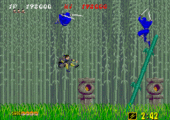
In the landscape of 1980s pop culture, few archetypes dominated the zeitgeist as thoroughly as the ninja. Capitalizing on a decade-long fascination with covert martial arts, Sega Enterprises released Shinobi in 1987, a title that would redefine the side-scrolling action genre. Developed by Sega R&D 1 under the guidance of producer Yutaka Sugano, the game arrived during a pivotal shift in arcade hardware capability. Running on the Sega System 16A board—a platform that allowed for more sophisticated sprite work and atmospheric depth compared to the company’s previous efforts like Fantasy Zone—Shinobi stood as a somber, high-stakes departure from the bright, whimsical aesthetics that defined much of the era’s coin-op catalog.
Technical Genesis and Arcade Evolution
The development of Shinobi followed Sugano’s work on Alex Kidd: The Lost Stars. While the latter embraced a colorful, platforming-focused design, Shinobi opted for a gritty, urban-inspired military aesthetic. The game’s design philosophy centered on the concept of the "one-man army." Players assumed the role of Joe Musashi, a modern-day ninja tasked with infiltrating the terrorist syndicate known as Zeed to rescue kidnapped children.
Technically, the game utilized the Motorola 68000 CPU, which enabled the System 16A to handle more complex character sprites and intricate collision detection. This hardware allowed for the game’s signature "multi-plane" movement, where players could jump between foreground and background elevations. While the backgrounds remained static, lacking the parallax scrolling that would eventually become an industry standard, the level design was built around verticality and environmental hazards. This forced players to master movement patterns rather than relying on brute force.
The Conversion Kit Business Model
A critical factor in Shinobi’s widespread success was its distribution strategy. Sega Enterprises USA utilized the conversion kit model, which allowed arcade operators to retrofit existing cabinet hardware with new game boards and artwork. This was significantly more cost-effective than purchasing dedicated, proprietary cabinets.
According to internal sales records from the late 1980s, Shinobi became one of the most successful conversion kits in the company’s history. Analysts at the time compared its market penetration to Universal’s 1982 success, Mr. Do!. By lowering the barrier to entry for arcade owners, Sega ensured that Shinobi was not restricted to high-end gaming parlors but was instead ubiquitous in pizza parlors, convenience stores, and bowling alleys across North America. This ubiquity solidified its status as a cultural touchstone for a generation of players.
Core Gameplay Mechanics and Difficulty Curve
Shinobi was characterized by an uncompromising difficulty level, a trait that arguably contributed to its status as a "quarter-muncher." The game functioned on a single-hit kill mechanic for the protagonist, forcing players to commit the enemy spawn locations and boss patterns to muscle memory.
To balance this extreme difficulty, developers implemented a variety of tactical assets:
- Shuriken Arsenal: Players began with an unlimited, albeit short-range, supply of throwing stars.
- The POW Icon: A signature power-up of the 1980s, the POW icon upgraded the player’s projectile weapon to a firearm and replaced martial arts strikes with a high-damage katana.
- Ninjutsu Magic: The inclusion of a dedicated third button for magic—specifically doppelganger clones, lightning strikes, and tornadoes—provided a "panic button" for screen-clearing utility. These spells were restricted to once per stage, forcing players to decide between strategic use during boss fights or emergency survival.
The game also featured first-person bonus stages between levels, which functioned as a reflex-testing mini-game. Successful completion of these rounds rewarded the player with an extra life, providing a vital lifeline in a game otherwise designed to exhaust the player’s resources.
Porting and Platform Expansion: The Master System Adaptation
The transition of Shinobi from the arcade to the Sega Master System in 1988 marked a significant moment in the evolution of home console gaming. Directed by Katsuhiro Hasegawa, the home port required extensive optimization to accommodate the limited memory and processing power of the 8-bit console.
To compensate for the difficulty, the console version introduced a health meter, a departure from the arcade’s "one-hit-and-you’re-out" policy. This design change, while controversial among purists at the time, made the game more accessible to a home audience. It served as a bridge between the punishing nature of arcade gaming and the narrative-focused progression models that would define the 16-bit era. This version is widely considered the precursor to the structural design of the 1989 sequel, The Revenge of Shinobi, which featured more expansive, health-based gameplay.
Historical Context and Cultural Reception
In 1987, the gaming industry was still recovering from the market crash of 1983. Shinobi emerged during a period of stabilization where arcade games were expected to be visceral, immediate, and challenging to justify the cost per play. The game’s soundtrack, characterized by mystical, synth-heavy Eastern motifs, helped distinguish it from the upbeat, pop-influenced scores of its contemporaries.
Critics at the time lauded the game for its tight controls and the sheer satisfaction of the "hack-and-slash" mechanics. However, it was also noted for its lack of genuine stealth. Despite the title, Shinobi was fundamentally a game of aggression. Players were not encouraged to hide or bypass enemies; the design mandated the systematic elimination of every adversary on screen. This blunt, direct approach to the "ninja" concept became the standard for the genre for the remainder of the decade.
Long-term Implications for the Action Genre
The legacy of the original Shinobi extends far beyond its initial release. It established Joe Musashi as one of Sega’s most enduring mascots, rivaling the popularity of characters like Alex Kidd. The franchise would eventually expand across the Sega Genesis, Saturn, and PlayStation eras, constantly iterating on the formula of high-speed platforming and challenging combat.
From an industry perspective, Shinobi serves as a prime example of successful iterative design. By listening to player feedback regarding the arcade’s difficulty and incorporating those lessons into the home port, Sega demonstrated a level of market awareness that allowed them to maintain relevance as the industry moved from arcades to the living room.
Conclusion: A Lasting Legacy
Today, Shinobi is recognized as a hallmark of 1980s game design. It successfully synthesized the era’s fascination with martial arts cinema and the economic realities of the arcade conversion market. While modern gaming has moved toward cinematic storytelling and open-world exploration, the fundamental appeal of the original Shinobi—the rhythmic, intense, and demanding nature of its combat—remains a core component of the action genre.
The game’s ability to maintain a 9 out of 10 standing in contemporary retrospective reviews is a testament to the strength of its core mechanics. It remains a foundational piece of gaming history, reminding players of a time when victory was not guaranteed, but earned through repetition, skill, and the mastery of a few well-placed shurikens. As the industry continues to evolve, the blueprint laid out by Yutaka Sugano and his team in 1987 continues to influence how developers approach the concept of the action hero in a 2D space.