 Jia Lissa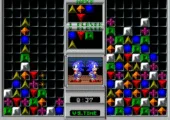
Before the Sonic the Hedgehog franchise became a global juggernaut synonymous with high-speed platforming, crossover fighting games, and educational software, Sega experimented with a niche puzzle title that would eventually become one of the most obscure entries in the company’s history. Released in 1991, Sonic Eraser was a block-matching puzzle game developed by Sega CS1. Unlike the mainstream hits that would define the Blue Blur’s legacy, Sonic Eraser was restricted to a digital-only distribution model in Japan, effectively rendering it invisible to the global market for over a decade. The game represents a critical, if often overlooked, moment in the evolution of Sega’s early 1990s digital strategy.
The Technological Context: The Game Toshokan Experiment
In the early 1990s, Sega was ahead of its time in attempting to implement digital distribution for home consoles. The company introduced the Game Toshokan (Game Library) service, which functioned via the Mega Modem peripheral for the Mega Drive. This service allowed Japanese subscribers to stream and download titles directly to their consoles. This was an ambitious, albeit technically constrained, precursor to modern digital storefronts like Xbox Live or the PlayStation Network.
Sonic Eraser was released onto this platform alongside other titles such as Fatal Labyrinth and various text-based adventures derived from the Phantasy Star series. At the time, the infrastructure for online gaming was in its infancy. The Mega Modem was expensive, the connection speeds were agonizingly slow, and the total user base was limited to a small, tech-savvy segment of the Japanese gaming population. Consequently, when the Game Toshokan service was shuttered in 1992, the software hosted on it—including Sonic Eraser—ceased to be accessible through official channels, pushing the title into a state of long-term commercial limbo.
Gameplay Mechanics and Design Philosophy
At its core, Sonic Eraser is a tile-matching puzzle game that draws mechanical inspiration from contemporaries like Tetris and Columns. Players are tasked with clearing descending blocks from the screen to prevent the stack from reaching the top. The game utilizes a four-block cluster system, though it differentiates itself by allowing players to clear groups of two or more identical blocks, rather than the three-block minimum standard in other titles of the era.
The game featured four distinct play modes, each designed to test different cognitive and reaction-based skills:
- Round Mode: A 40-stage progression system focused on speed and high scores. Players must clear specific "spiral ring" items to successfully complete stages.
- Normal Mode: A focus on score accumulation where the difficulty increases incrementally based on performance.
- Doubt Mode: An adaptive challenge where certain blocks transform into white squares upon contact with the stack, forcing players to recalculate their strategy in real-time.
- Block Mode: A high-risk, high-reward mode that emphasizes chain reactions and structural stability, often punishing the player severely for minor placement errors.
The competitive component of the game introduced a unique "Sonic avatar" mechanic. When playing against the computer or a second player, users could trigger offensive moves—such as spin dashes or defensive shields—to paralyze their opponent. This stun mechanic effectively halted the opponent’s ability to manipulate pieces, allowing for rapid score advantages. While innovative for 1991, critics noted that the stun duration could often lead to "snowball" scenarios where a player, once disadvantaged, found it nearly impossible to regain momentum.
Chronology of a Lost Title
The timeline of Sonic Eraser’s availability serves as a case study in the volatility of early digital media:
- 1991: Sonic Eraser is released on the Japanese Game Toshokan service for the Mega Drive.
- 1992: Sega discontinues the Game Toshokan service, rendering the game largely unavailable.
- 2004: Sega of Japan briefly revives the title via the B-Club download service, a web-based repository for legacy Mega Drive titles.
- Mid-2000s: A planned inclusion in the Sonic Gems Collection for consoles is scrapped, leaving the game absent from major international compilations.
- Post-2005: The fan community produces an unofficial English-language patch for the ROM, which serves as the primary method for non-Japanese speakers to experience the game.
The Strategic Failure of the Sonic Brand Integration
Industry analysts have often pointed to the lack of "brand synergy" as a primary reason for the game’s limited longevity. While Sonic the Hedgehog was the face of the franchise, the game itself bore little aesthetic or thematic resemblance to the high-energy platforming of the flagship series. The graphical assets were recycled or simplified, the audio design consisted of a single, repetitive track, and the core puzzle mechanics were largely agnostic to the Sonic intellectual property.
By grafting the Sonic license onto a generic puzzle engine, Sega appeared to be using the mascot as a marketing incentive to drive subscriptions for the struggling Game Toshokan service. There was no cohesive narrative or artistic direction linking the title to the broader Sonic universe. This lack of integration contributed to the perception that Sonic Eraser was a "disposable" title, rather than a significant expansion of the franchise’s portfolio.
Broader Implications for Digital Archiving
The history of Sonic Eraser highlights the precarious nature of early digital software. Unlike physical cartridges, which could be traded, stored, and resold, software tied to a defunct proprietary streaming service effectively vanished from existence. The reliance on the B-Club service in 2004 provided only a temporary reprieve, and the subsequent failure to include the game in global compilations like Sonic Gems Collection further entrenched its status as a "lost" game.
The effort by the fan community to translate and preserve the ROM represents a common trend in video game preservation: when official channels fail to provide access to historical software, the burden of archiving shifts to enthusiasts. However, this raises questions regarding intellectual property and the legal status of abandonware. To date, Sega has provided no official comment on a potential modern re-release of the title, suggesting that the company views Sonic Eraser as a relic of a failed experiment rather than a valuable component of the Sonic legacy.
Technical Limitations and Critical Reception
The technical constraints of 1991 are evident in every facet of the game. The ROM size was intentionally kept small to facilitate efficient streaming over the limited bandwidth of the Mega Modem, resulting in lean graphics and minimal soundscapes. While these limitations were understandable in the context of the hardware, they left the game struggling to compete with retail-level puzzle games like Puyo Puyo or Dr. Robotnik’s Mean Bean Machine.
When compared to its contemporaries, Sonic Eraser lacked the polish and "personality" required to sustain a dedicated following. The controls, while functional, were hampered by a lack of visual feedback, and the gameplay loops were deemed by many to be overly punitive. The decision to prioritize competitive disruption (the stun mechanic) over strategic depth meant that the game was often more frustrating than engaging for casual players.
Conclusion: A Historical Footnote
Sonic Eraser remains a curious, if ultimately minor, footnote in the history of the Sega Mega Drive. It represents the intersection of two distinct eras: the early, experimental phase of digital distribution and the rapid, often uncoordinated, expansion of the Sonic the Hedgehog brand. As a piece of software, it is a serviceable, albeit unremarkable, puzzle game. As a historical artifact, it is a reminder of the fragility of digital content and the lengths to which fans will go to ensure that even the most obscure titles are not erased by time.
For those interested in the evolution of the puzzle genre, the title serves as a reminder that not every iteration of a beloved character is designed for greatness. While the competitive mode offers a glimpse of what could have been a more robust multiplayer experience, the lack of polish, poor integration with the source material, and the disastrous initial distribution strategy ultimately confined Sonic Eraser to the annals of gaming history as an oddity rather than a classic. For modern players, it remains a curiosity—a relic of a bygone era of digital experimentation that never quite found its footing.