Indra Gunadi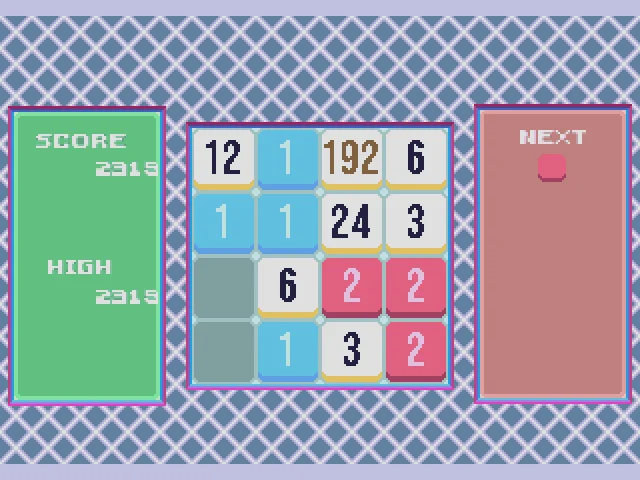
Technical Foundations and Gameplay Mechanics
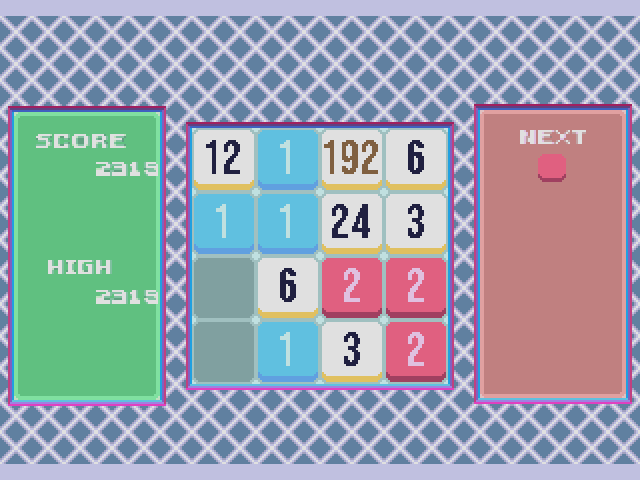
At its core, Genthrees adheres to the established logic of its predecessor, challenging players to merge specific numerical values to achieve higher sums. In this iteration, the user must combine blue “1” tiles and red “2” tiles to form white “3” tiles. Once the “3” threshold is met, the gameplay transitions into a geometric progression, requiring players to pair tiles to reach values of 6, 12, 24, and beyond.
The primary differentiator between this title and other popular iterations of the sliding-tile genre—most notably 2048—lies in the movement architecture. While 2048 typically involves moving all tiles across the grid simultaneously until they hit a wall, Genthrees employs the original Threes-style movement system. Tiles creep precisely one cell per move, necessitating a higher degree of spatial planning and foresight. The control scheme has been mapped to the Sega Megadrive’s directional pad, with the START button dedicated to resetting the board, ensuring the interface remains intuitive for users accustomed to the original console architecture.
The Evolution of the Demake Scene
The release of Genthrees is not an isolated event but rather a symptom of the burgeoning “homebrew” scene that has proliferated since the early 2010s. Developers such as abadede919302 often utilize assembly language or modern cross-compilers like SGDK (Sega Genesis Development Kit) to bring contemporary concepts to hardware that has been officially unsupported by Sega for over two decades.
This phenomenon is driven by a convergence of technological accessibility and historical nostalgia. With the documentation of the Motorola 68000 processor—the engine powering the Megadrive—now widely available, independent developers have achieved a level of proficiency that often matches or exceeds the internal development teams of the early 1990s. The release of a 2026 title confirms that the Megadrive’s hardware, specifically its ability to handle sprite-based manipulation and limited color palettes, remains a viable medium for minimalist, logic-based puzzle games.
Chronology of Retro-Platform Development
The trajectory of the retro-hardware development scene can be mapped through several distinct phases:
- The Preservation Phase (1995–2005): Following the discontinuation of consoles like the Megadrive and the Super Nintendo, initial efforts were focused on emulation. Developers sought to archive game code to prevent the loss of titles as physical media degraded.
- The Modification Phase (2006–2015): As emulation became stable, enthusiasts moved toward “ROM hacking,” where existing games were modified to include new levels or graphics.
- The Homebrew Renaissance (2016–Present): With the refinement of toolchains like SGDK, developers began creating original software from scratch. This period saw the release of high-quality titles that utilize custom sound engines and expanded ROM capacities, effectively pushing the 16-bit hardware to its theoretical limits.
Genthrees stands as a representative work of this third phase, demonstrating how a simple mobile-first design can be adapted to a fixed-function hardware environment without losing the core appeal of the original experience.
Supporting Data: Hardware Constraints and Optimization
To successfully port a modern game like Threes to the Sega Megadrive, developers must navigate severe hardware limitations. The console possesses a video display processor capable of displaying 80 colors simultaneously from a total palette of 512. The resolution is typically 320×224 pixels. For a tile-based puzzle game, this is advantageous, as the grid layout requires minimal sprite overhead.
However, the primary challenge remains the memory architecture. The Sega Megadrive uses a ROM-based system where data must be efficiently packed to fit within the memory addressing space. By simplifying the visual assets to basic numerical tiles and a static background, the developer of Genthrees ensures the game runs at a consistent frame rate without the need for extensive hardware expansion or overclocking. This optimization is a hallmark of professional-grade homebrew development, where the objective is to ensure the game functions seamlessly on original, un-modified consoles.
Broader Implications for Digital Preservation
The creation of Genthrees serves as a practical demonstration of hardware longevity. By continuing to develop for the Megadrive, programmers are effectively keeping the knowledge of 16-bit architecture alive. This has significant implications for digital preservation. When developers write new code for legacy hardware, they produce extensive documentation and open-source tools that assist others in understanding how the machine operates.
Furthermore, the release of this title highlights the shift in how games are perceived as artistic media. Rather than being tied strictly to their era of release, games are now viewed as “portable” experiences that can be re-imagined across different temporal and technological contexts. The “demake” genre, in particular, acts as a bridge between the high-fidelity experiences of the 2020s and the hardware-limited ingenuity of the 1990s.
Industry Reaction and Future Prospects
While official entities like Sega have largely transitioned to modern software distribution and licensing, the hobbyist community has maintained a symbiotic relationship with the brand’s history. Experts in game history note that the continued existence of homebrew titles keeps the secondary market for physical hardware active. The demand for “Flash Carts”—devices that allow users to play custom ROMs on original consoles—has surged, creating a micro-economy that supports the development of new games like Genthrees.
In a broader sense, the release of Genthrees serves as a benchmark for the longevity of minimalist design. The original Threes was praised for its simplicity and “easy to learn, hard to master” gameplay loop. By proving that this loop can be successfully transplanted onto a 16-bit system, the developer has underscored the universality of the game’s logic.
As we look toward the future, it is probable that more developers will explore the intersection of modern indie game design and legacy hardware. The ease of access to hardware-specific development tools suggests that the output of these “neo-retro” titles will only increase in volume and complexity. For the Sega Megadrive, a console that has already seen a multi-decade life cycle, Genthrees acts as a testament to the fact that, in the world of software engineering, hardware is rarely the limiting factor—imagination and technical proficiency are the primary drivers of innovation.
Concluding Analysis
Genthrees is more than just a functional demake; it is a successful exercise in technical adaptation. By respecting the constraints of the Sega Megadrive and honoring the mechanical integrity of the original Threes, the developer has created a project that resonates with both retro-gaming purists and fans of contemporary puzzle games.
The successful implementation of this game highlights three critical realities in the current gaming landscape:
- Cross-Generational Design: Great gameplay mechanics are platform-agnostic and can thrive on hardware spanning several decades.
- Toolchain Efficiency: The democratization of game development tools has allowed individual creators to achieve results that were previously reserved for professional studios.
- Community-Driven Archiving: The development of homebrew titles is the most effective form of hardware preservation, as it ensures that the technical skills required to maintain and interact with legacy systems are passed on to a new generation of programmers.
As Genthrees enters the canon of Sega Megadrive homebrew titles, it serves as a reminder that the history of gaming is not a static timeline but a dynamic field of study and creation. Developers will continue to look backward to move forward, utilizing the limitations of the past to define the boundaries of the future. The project stands as a clear indicator that the 16-bit era, while long past its commercial peak, remains a vital and vibrant space for creative expression.