Vera Clarissa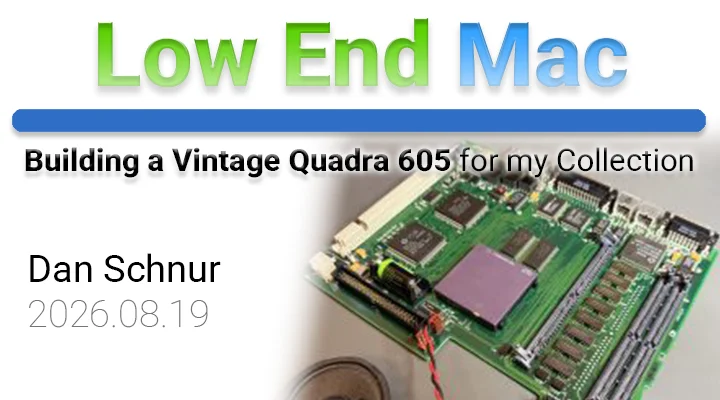
The restoration of vintage computing hardware, particularly systems manufactured during the early 1990s, presents unique engineering and material science challenges. Among the most precarious subjects for preservationists is the Macintosh Quadra 605, a machine that has become notorious for its structural instability due to the degradation of its ABS (acrylonitrile butadiene styrene) plastic chassis. Recent attempts to aggregate functional units from multiple incomplete or damaged machines highlight the growing difficulty of maintaining 30-year-old hardware in an era where original components are increasingly scarce.
Historical Context of the Quadra 605
Released in October 1993, the Macintosh Quadra 605—also marketed as the Performa 475 and LC 475—represented a transitional period for Apple Computer. Positioned as an entry-level professional workstation, it featured the Motorola 68LC040 processor. Despite its modest aesthetic, the machine was highly regarded for its price-to-performance ratio, making it a staple of educational and small-business environments of the mid-90s.

Over three decades later, these units suffer from "plastic fatigue." The brominated flame retardants used in the plastic casings of the era have caused the material to yellow and, more critically, to lose its structural integrity. As collectors and hobbyists attempt to power on these systems, they often find that the very act of opening the case results in the catastrophic failure of internal mounting tabs, power supply brackets, and logic board supports.
Chronology of a Restoration Project
The effort to return a Quadra 605 to service typically involves a multi-stage process of acquisition, component testing, and chemical restoration. In a recent case study, a restoration project required two donor machines to construct a single, reliable unit.
The process began with the acquisition of a "Logic Board and Case" unit via an online secondary market. Upon arrival, the unit was found to be in a state of severe degradation. The chassis was brittle, the power supply was missing, and the logic board exhibited significant electrolytic capacitor leakage—a common occurrence in vintage Apple hardware, where the electrolyte can corrode the copper traces on the printed circuit board (PCB).

Following the initial failure of the first unit to provide a complete set of functioning parts, a second machine was acquired. This secondary unit, while ostensibly more complete, suffered from similar material degradation. The restoration sequence followed a rigorous technical path:
- Decontamination: Removal of leaking capacitors and neutralizing the resulting acidic residue on the logic board.
- Diagnostic Analysis: Utilization of logic analyzers to monitor the Motorola 68040 processor status pins (PTS3-PTS0). During testing, a "double bus fault" was identified, indicating a processor-level failure despite the unit successfully executing the initial boot "chime."
- Component Substitution: The replacement of the faulty CPU and the integration of a rebuilt power supply.
- Structural Reconstruction: Addressing the mechanical failures of the ABS plastic. This required the application of high-strength industrial epoxies and, in some instances, mechanical reinforcement to replace snapped mounting tabs.
Technical Challenges: Power and Logic
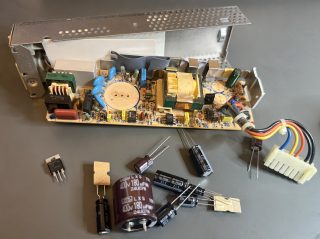
The Quadra 605 power supply presents a specific hurdle for modern restorers. Unlike modern ATX power supplies, the 605 requires a specific voltage output, including a -5V rail, which is rarely found in modern off-the-shelf power supply units. Rebuilding the original power supply—a process involving the replacement of aging electrolytic capacitors—is often the only viable path to restoration.
The failure of the Motorola 68040 processor in the initial donor unit provides a cautionary tale for collectors. Because these chips are no longer in production, the failure of a processor requires the cannibalization of other units, further thinning the global supply of functional Quadra 605 hardware. The "Double Bus Fault" encountered during the diagnostic phase is a standard indicator that the CPU is failing to handshake with the onboard ROM or RAM, a problem that underscores the sensitivity of 30-year-old logic gates to environmental stress and age.
Material Science and Preservation Implications
The degradation of the Quadra 605 chassis is not merely a cosmetic issue; it is a structural crisis for the vintage computing community. ABS plastic undergoes a process called dehydrobromination when exposed to UV light and heat, which accelerates the brittleness of the polymer chains.
Experts in computer preservation suggest that the lifespan of these machines is limited by the chemical half-life of their plastics. While chemical treatments like Retrobrite (hydrogen peroxide-based whitening) can restore the color of the yellowed plastic, they do not reverse the structural brittleness. Restorationists have increasingly turned to additive manufacturing, such as 3D printing replacement tabs or brackets, to circumvent the total loss of original plastic components. However, for purists, the use of adhesives like JB Weld remains the standard, albeit temporary, solution for structural repair.
Broader Impact on the Vintage Market
The scarcity of functional Quadra 605 hardware has created a secondary market where the value of a machine is determined less by its original retail price and more by the integrity of its plastic housing. As functional units become fewer in number, the cost of "parts machines" has risen, creating a barrier to entry for those interested in historical computing.

Furthermore, the reliance on third-party modern solutions—such as the BlueSCSI, which emulates hard drive storage using SD cards—has become necessary to ensure these machines remain functional in a modern digital environment. These emulators replace mechanical hard drives that are prone to catastrophic head crashes, thereby preserving the logic board from the physical trauma of a failing spinning platter drive.
Conclusion: The Future of Legacy Hardware
The successful assembly of a functioning Quadra 605 is an exercise in both patience and technical proficiency. It requires a synthesis of electrical engineering, chemical cleaning, and mechanical fabrication. As these machines pass the 30-year mark, they serve as a reminder of the planned obsolescence inherent in 1990s manufacturing.
For the collector, the "chime" of a successfully booted Quadra 605 is more than just a sound; it is the culmination of months of effort to reverse the decay of a piece of computing history. Whether the fragile, reconstructed chassis can support the weight of an original Apple 12-inch monitor indefinitely remains a subject of debate among enthusiasts. The consensus, however, is that as long as individual components can be salvaged and re-engineered, these machines will continue to function as viable, albeit temperamental, relics of the early desktop computing era. The ongoing challenge remains the preservation of the material integrity of the chassis, a race against time that will continue to test the limits of modern restoration techniques.