Jia Lissa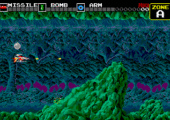
The release of Darius Extra Version for the Sega Mega Drive represents a significant milestone in the preservation and optimization of arcade classics. Developed by M2—a studio renowned for its meticulous reverse-engineering of retro hardware—this cartridge serves as a corrective evolution of the 2019 Mega Drive Mini port. By addressing longstanding balance issues, technical limitations, and historical inaccuracies inherent in the original 1986 arcade hardware, M2 has provided a definitive version of the foundational horizontal scrolling shooter.
The Historical Evolution of Darius
The original Darius, released by Taito in 1986, was a groundbreaking title for its time, notable for its unique three-screen wide cabinet configuration and branching stage structure. The transition of this game to home consoles had historically been problematic due to the limitations of 8-bit and 16-bit hardware. The 2019 Mega Drive Mini release was widely viewed as a "timeline correction," providing a native port for Sega’s hardware. However, it lacked the granular tuning and performance parity of the original arcade cabinet.
The 2021 release of Darius Extra Version, published by Taito and distributed via Columbus Circle and Strictly Limited Games, functions as a high-fidelity refinement of that effort. It covers three distinct arcade revisions of the game: OLD, NEW, and EXTRA. Each revision has been expertly ported to accommodate single-screen displays without sacrificing the aggressive difficulty and mechanical complexity that defined the arcade experience.
Technical Refinements and M2’s Methodology
M2’s approach to this release involved a comprehensive overhaul of the underlying engine. Working in collaboration with professional arcade "superplayer" KZS—a figure well-known for his mastery of the Darius series at the Takadanobaba Mikado Arcade Center in Tokyo—the developers fine-tuned durability, rank scaling, collision detection, and weapon behavior.
One of the most significant improvements concerns the EXTRA revision. In its original arcade incarnation, the EXTRA mode was controversial due to its aggressive difficulty spikes and perceived "credit-munching" design, which limited screen-clearing capsules and introduced punishing enemy tracking. M2 has rebalanced these encounters. For instance, the previously notorious Zone M, characterized by overwhelming asteroid debris and airborne threats, has been adjusted to ensure that player deaths are the result of skill-based challenges rather than unavoidable environmental hazards. Furthermore, the studio successfully addressed graphical glitches and edge-case bugs that plagued earlier iterations, ensuring that the game maintains a stable frame rate even during intense sequences with multiple high-density sprites.
Audio and Performance Enhancements
The auditory experience of the 2021 cartridge represents a marked improvement over the 2019 Mini release. Sound artist WING—known for their work on the Space Harrier renditions for the Mega Drive Mini 2—was commissioned to rebuild the FM synthesis mix. This effort restored the low-end frequency response and increased stereo separation, bringing the soundscape closer to the original arcade specifications.
Beyond simple composition, the cartridge features higher-fidelity recreation of sound effects. The "WARNING" cues and the signature "BOOM" sequences associated with boss explosions have been reconstructed using the Mega Drive’s YM2612 and DCSG chips. This attention to detail restores the sonic impact that was previously lost to low-quality PCM sampling, providing an immersive experience that adheres to the technical capabilities of the 16-bit hardware.
Expanded Gameplay and Customization
Darius Extra Version introduces a high degree of player agency. The game features six distinct setup modes across the three arcade revisions, including both standard play and Boss Rush variants. A critical addition is the inclusion of "26 Bosses" mode, which provides each route with a unique boss encounter. This addresses a common criticism of the original arcade ROM, which, due to storage constraints, relied on a recurring pool of 11 bosses across all paths.
The inclusion of an "Arcade Mode" further solidifies the title’s status as a serious preservation project. Activated via a specific input sequence at the title screen, this mode enforces strict, original arcade-style rules. It disables pausing, restricts rapid-fire to the original 10 Hz threshold, and limits the selection to the PROCO revision and the original 11-boss structure. This inclusion offers a purist experience for players looking to test their skills against the authentic, unadjusted mechanics of the 1986 release.
Broader Implications for Retro Gaming
The success of Darius Extra Version highlights a shift in the retro gaming market toward "preservation-plus" models. Rather than simple emulation, developers are increasingly focusing on "re-tuning" software to fit the constraints of home hardware while maintaining the spirit of the original arcade experience.
By providing customizable auto-fire settings (up to 30 Hz), soft-reset functionality, and comprehensive high-score tracking for every arcade revision, M2 has demonstrated that older software can be made more accessible without compromising the integrity of the original design. The removal of input lag, a common hurdle in modern emulation, positions this physical cartridge as a superior alternative for competitive players and hardware enthusiasts.
Chronology of Key Releases
- 1986: Original Darius arcade cabinet debuts, featuring a three-screen, side-by-side display.
- 2019: Sega releases the Mega Drive Mini, including a native port of Darius, marking the first time the game appeared on official Sega hardware.
- 2021: M2 releases the expanded Darius Extra Version cartridge for the Mega Drive, featuring refined versions of the OLD, NEW, and EXTRA arcade revisions.
- Post-2021: The release receives critical acclaim for its technical fidelity and the inclusion of extensive options for high-score hunters and arcade purists.
Strategic Impact on the Market
The market for physical retro releases has seen an increase in demand for high-quality, developer-led optimizations. The collaboration between Taito and M2 serves as a case study in how intellectual property holders can leverage third-party expertise to revitalize legacy titles. The decision to include features like the music test—now updated with a continuous repeat function—and the ability to toggle boss types shows a commitment to the "power user" demographic.
The impact of this release extends to the preservation community. By fixing issues such as power-up orbs becoming trapped in stage geometry and normalizing the projectile curves of bosses, M2 has created a template for how classic shooters should be handled when brought to new platforms. The project illustrates that when technical constraints are addressed through rigorous, evidence-based development, the gap between arcade and home-console performance can be effectively eliminated.
Conclusion
Darius Extra Version stands as a definitive document in the history of the Sega Mega Drive. It is not merely a collection of data, but a carefully curated experience that respects the historical context of the Taito arcade classic while modernizing its execution. With its high-fidelity audio, refined collision physics, and extensive customization options, the release provides a compelling argument for the continued relevance of physical media in the preservation of digital entertainment. For collectors and fans of the genre, the cartridge serves as both a functional game and an essential piece of video game history, setting a high standard for future retro-gaming initiatives.