Hartono Sudibyo
In a remarkable feat of retro-computing and dedicated fan effort, the groundbreaking Super Mario 64 decompilation project has become the bedrock for ambitious homebrew endeavors, bringing the iconic Nintendo 64 title to previously unimaginable platforms. While the Sega Dreamcast and Nintendo 64 themselves frequently feature in discussions of game preservation and fan-made ports, the Panasonic 3DO, a console often overlooked in the modern retro gaming landscape, is now experiencing a surprising resurgence thanks to these dedicated efforts. Eyepatch Entertainment, a prominent figure in the homebrew community, is at the forefront of this movement, actively working to bring Super Mario 64 to the 3DO, a testament to the enduring appeal of both the game and the spirit of technological innovation.
The Genesis of a Legacy: The Super Mario 64 Decompilation
The journey of Super Mario 64 to systems like the 3DO is intrinsically linked to the remarkable success of the Super Mario 64 decompilation project. Initiated by dedicated individuals within the retro gaming and reverse-engineering communities, this project sought to meticulously reverse-engineer the original game’s source code. This was not an act of piracy but rather a scholarly endeavor to understand the inner workings of one of the most influential video games ever created. By recreating the source code from the compiled executable, the decompilation project provided developers with a functional blueprint, akin to having the original development tools and assets.
This monumental undertaking, which began gaining significant traction in the late 2010s, unlocked unprecedented possibilities for game preservation and modification. It allowed developers to explore the game’s architecture, understand its rendering techniques, and, crucially, port the game to platforms for which it was never officially intended. The availability of this clean, understandable code dramatically lowered the barrier to entry for aspiring game developers interested in working with Super Mario 64, fostering a wave of creativity and innovation.
Reimagining a Classic: Super Mario 64 on the Panasonic 3DO
Eyepatch Entertainment’s work on the 3DO port of Super Mario 64 is a prime example of this post-decompilation creative explosion. The project leverages assets meticulously extracted and rendered from the decompiled source code. The chosen rendering engine for the 3DO version is the system’s native "cel engine," a unique graphics technology that, while capable of producing distinctive visual styles, presented significant challenges.
The Panasonic 3DO, released in 1993, was an early pioneer in the 3D gaming arena. However, its hardware capabilities, particularly its polygon rendering and fill rate, were notably less advanced than those of its later competitors, such as the Sony PlayStation and the Nintendo 64. While the 3DO did host a number of 3D titles, including ports of games like Tomb Raider, its architecture was not optimized for the complex polygonal environments that defined Super Mario 64.
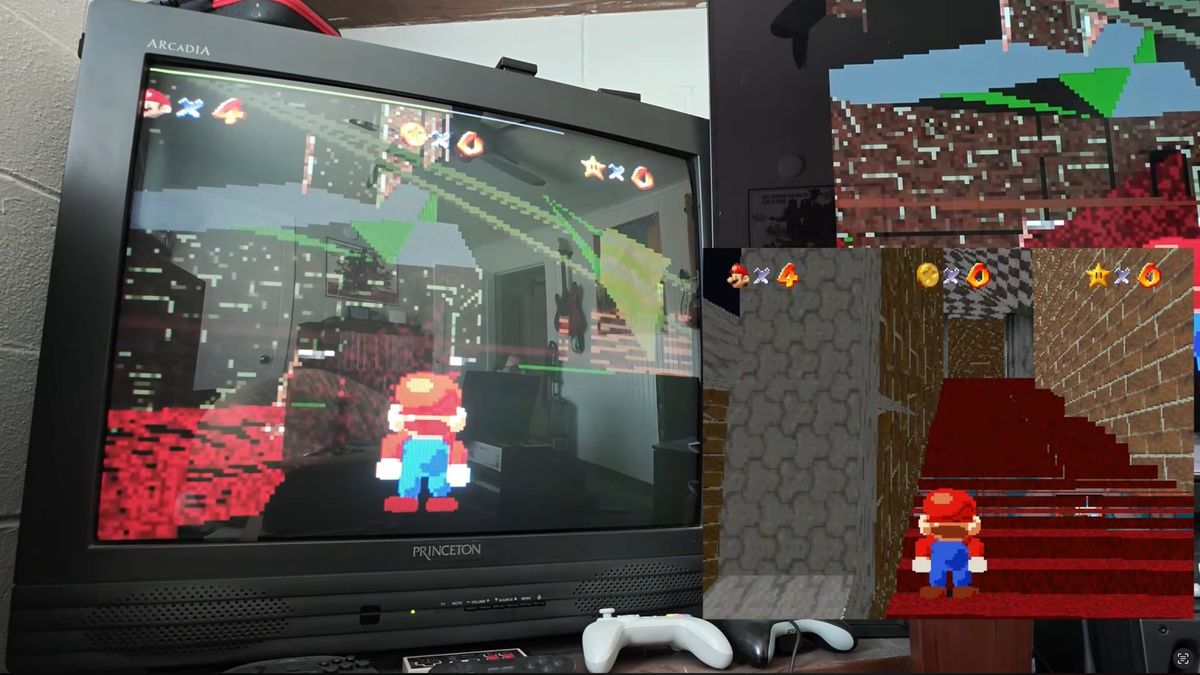
Consequently, the 3DO port of Super Mario 64 adopts a unique visual approach. Instead of a direct 3D polygonal rendering akin to the original, the game presents a 2D interpretation that creates the illusion of three-dimensional space. This artistic choice, necessitated by the hardware’s limitations, results in a visual aesthetic that has been humorously compared to a fusion of Duke Nukem and Mario. The character models and environments are simplified, with textures and sprites carefully arranged to convey depth and perspective. This approach prioritizes playability and visual coherence within the 3DO’s constraints, rather than attempting a photorealistic recreation.
Early Demonstrations and Technical Hurdles
Initial demonstrations of the 3DO port, showcased on platforms like ReCollect64, reveal the project’s current stage of development. Key areas such as Peach’s Castle and Bob-omb Battlefield are reportedly functional within the 3DO emulator, Opera, and potentially on real hardware. However, the project is still in its nascent stages, with significant hurdles yet to overcome. Notably, the absence of sound in the current builds highlights the complexity of porting not just graphical elements but also the game’s iconic audio.
The development process has been fraught with technical challenges, particularly concerning the 3DO’s fill rate. As explained in the project’s documentation, the cel engine operates on a per-pixel basis, meaning that rendering large, close-up surfaces is computationally intensive. Achieving a stable framerate on real 3DO hardware has required "a lot of very specific tricks and a lot of builds," indicating a deeply involved and iterative development cycle. This underscores the immense dedication and technical prowess required to push the boundaries of such legacy hardware.
A Parallel Endeavor: The PlayStation 1 Port
In parallel to the 3DO project, Eyepatch Entertainment is also actively developing a port of Super Mario 64 for the Sony PlayStation 1. This endeavor offers a contrasting perspective on the challenges and possibilities of porting the game to different hardware. The PlayStation 1, while also a 32-bit console, possessed a different architectural design and graphical capabilities compared to the 3DO.
The PS1 port, while still in its early, "glitchy" stages, appears to more closely resemble the visual fidelity of the original game. Reports indicate that this version includes music and cutscenes, elements that are still absent from the 3DO build. The visual style of the PS1 port has been likened to a "fever dream" in its current state, a common characteristic of ambitious homebrew projects on the platform, reminiscent of the unofficial Ocarina of Time PS1 port. However, the fact that it maintains recognizable visual elements and incorporates audio suggests a different set of technical considerations and potential for a more direct translation of the game’s original aesthetic.
The Broader Context: Game Preservation and the Homebrew Renaissance
These ambitious homebrew projects extend beyond mere nostalgia; they represent a crucial aspect of game preservation and a testament to the enduring power of community-driven innovation. In an era where digital storefronts can be ephemeral and physical media degrades, fan-made ports and emulations play a vital role in ensuring that classic games remain accessible and playable for future generations.

The Super Mario 64 decompilation project, in particular, has been a catalyst for a new wave of creativity within the retro gaming community. It has democratized access to the game’s underlying code, empowering developers to experiment and push the boundaries of what is possible on older hardware. This phenomenon is not unique to Super Mario 64; similar decompilation efforts for other classic titles are also fostering vibrant homebrew scenes.
The implications of these projects are multifaceted:
- Preservation: They provide playable versions of games on contemporary hardware, circumventing the need for original, often scarce and expensive, consoles and cartridges.
- Education: They serve as invaluable learning tools for aspiring game developers, offering insights into game design, programming, and hardware limitations of past eras.
- Innovation: They demonstrate creative problem-solving and technical ingenuity, pushing the boundaries of what was thought possible on legacy systems.
- Community Building: They foster strong online communities where developers collaborate, share knowledge, and celebrate their achievements.
The Future of Legacy Hardware and Fan Efforts
The ongoing development of Super Mario 64 ports for the 3DO and PlayStation 1 highlights a burgeoning renaissance for legacy gaming hardware. While official support for these consoles has long ceased, dedicated fan communities are breathing new life into them through ambitious homebrew projects. The work of Eyepatch Entertainment serves as a compelling example of this trend, showcasing the passion and technical skill that continues to drive the retro gaming world forward.
As these projects evolve, they not only offer new ways to experience beloved classics but also serve as a vital historical record of gaming’s evolution. The challenges overcome and the innovative solutions devised by developers like Eyepatch Entertainment offer invaluable insights into the ingenuity that defined the early days of 3D gaming. Fans eager to follow the progress of these remarkable undertakings are encouraged to keep a close watch on the Eyepatch Entertainment YouTube channel, where updates on their ongoing work are regularly shared. The continued success of these endeavors will undoubtedly inspire further explorations into the vast and often uncharted territories of retro gaming.