Jia Lissa
The history of home console gaming is often defined by the evolution of input methods, a trajectory that saw the industry shift from the precision of analog paddle controllers toward the ubiquitous digital directional pad. Among the most curious footnotes in this transition is the 1987 release of Woody Pop: Shinjinrui no Block Kuzushi for the Sega Mark III. Serving as the final "My Card" software release for the system, the title was bundled with a specialized paddle controller, an attempt by Sega to capture the success of the block-breaking genre that had been popularized by Atari’s 2600 and Taito’s arcade sensation, Arkanoid.
The Technological Context of Analog Input
Paddle controllers, which utilize potentiometers to regulate voltage for granular input, provided a level of precision that digital buttons could not replicate. During the late 1970s and early 1980s, the Atari 2600 established the viability of this control scheme through iconic titles such as Super Breakout, Kaboom!, and Warlords. These games relied on the fluid movement of a paddle to intercept projectiles, creating an intuitive link between the user’s hand and the on-screen action.
However, as the industry moved into the mid-1980s, the standard hardware configurations for major consoles began to shift. Nintendo, for instance, famously omitted paddle controllers from its Famicom system. This forced developers like Taito to bundle their own proprietary hardware with home ports of Arkanoid to maintain the integrity of the gameplay experience. This decision created a fragmented market where the analog controller, once a staple of console design, was relegated to a niche accessory supported by only a handful of titles.
The Mark III Strategy and Sega’s Hardware Push
In 1987, Sega attempted to leverage its arcade-focused brand identity to penetrate the Japanese home market. The introduction of the paddle controller for the Mark III was an unusual move given that none of Sega’s major arcade hits at the time utilized such a peripheral. Despite this, the company released seven distinct games for the Mark III that utilized the controller, four of which were exclusive to the device.
The hardware was sold in two distinct packages: one featuring the card-based Woody Pop and another featuring Alex Kidd BMX Trial on a 1Mb Gold Cartridge. While the peripheral never saw a commercial release in Western territories, it remains a significant example of Sega’s early efforts to diversify the utility of its home console hardware through specialized peripherals, similar to their later experiments with the Sega Light Phaser or the Sega Control Stick.
Mechanical Analysis: Woody Pop vs. The Industry Standard
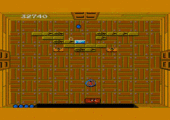
Woody Pop was explicitly designed as a response to the success of Taito’s Arkanoid. While Arkanoid was praised for its sleek, vertical-oriented gameplay and minimalist aesthetic, Woody Pop attempted to expand the genre’s scope. The game featured several mechanical innovations, such as bricks that required multiple strikes to destroy—indicated by visual cracking—and a branching level path system that allowed players to choose their progression after completing a stage.
However, the transition from an arcade-oriented design to a 4:3 television aspect ratio introduced significant challenges. The wider playfield necessitated a greater range of motion for the paddle, and the developers increased the ball speed to compensate. This created a difficulty curve that often felt disjointed, particularly when combined with obstacles like moving trains and invincible blocks that could redirect the ball into the pit before the player had sufficient time to react.
Furthermore, the game included a "warp" mechanic where the ball could be transported to isolated areas of the screen. While intended to add complexity, it frequently resulted in periods of inactivity where the player was forced to wait for the ball to re-enter the main playfield, often at an increased velocity that rendered the gameplay erratic.
Audio-Visual Limitations and Design Choices
The aesthetic presentation of Woody Pop was heavily influenced by the interior design trends of the 1980s, characterized by a pervasive use of brown and orange tones. The protagonist, a "Wood Spirit" named Woody, was tasked with navigating a mansion to rescue his friend, Gumball. Due to the technical constraints of the hardware, the character sprites lacked the necessary resolution to convey detail, leading to a visual experience that many critics at the time found muddy and indistinct.
The audio profile of the game was equally unconventional. Rather than a traditional melodic score, the soundtrack consisted primarily of percussive sound effects tied to in-game actions. While some retro-gaming historians have noted the abstract nature of this audio design—comparing it to the avant-garde soundscapes of later titles like Streets of Rage 3—it was largely received by contemporary audiences as a functional, if uninspired, accompaniment to the gameplay.
Market Performance and Historical Legacy
The commercial reception of Woody Pop was muted. With a Japanese title translated as "New Generation Block Breaker," the game struggled to distinguish itself in a market already saturated with block-breaking clones. Analysts have suggested that the game’s primary function was not to be a standalone blockbuster, but rather to act as a value-add for the paddle controller peripheral. By bundling the game with the hardware, Sega ensured a baseline install base for its accessory.
The legacy of Woody Pop is largely defined by its position as a "missing link" in the evolution of the genre. While it attempted to introduce depth through branching paths and combinable power-ups—such as the "glue" item allowing the paddle to hold the ball and the "flame" item for destruction—these additions failed to coalesce into a cohesive experience.
Technical Data and Comparative Summary
When compared to the broader landscape of the 8-bit era, the following factors contributed to the game’s overall performance:
- Platform Compatibility: Exclusive to the Sega Mark III, requiring a proprietary paddle controller.
- Genre Evolution: Introduced multi-hit brick mechanics and branching levels, features that would later become standard in the block-breaker genre.
- Hardware Constraints: The shift from a vertical arcade screen to a horizontal console screen necessitated a re-engineering of ball trajectory physics, which resulted in the noted issues with speed and pacing.
- Peripheral Support: The paddle controller was utilized by only seven games on the Mark III, four of which were exclusive to the platform, highlighting the limited lifecycle of the device.
In retrospect, the 4 out of 10 score assigned to the title by modern retrospective critics reflects its status as a playable but ultimately forgettable entry in the Sega library. The game remains a footnote for collectors and those interested in the history of peripheral-driven gaming. While it showcased a desire to innovate within a stagnant sub-genre, the execution failed to overcome the inherent limitations of the hardware, cementing its place as a niche, if historically relevant, curiosity in the history of the Sega Mark III.