Vera Clarissa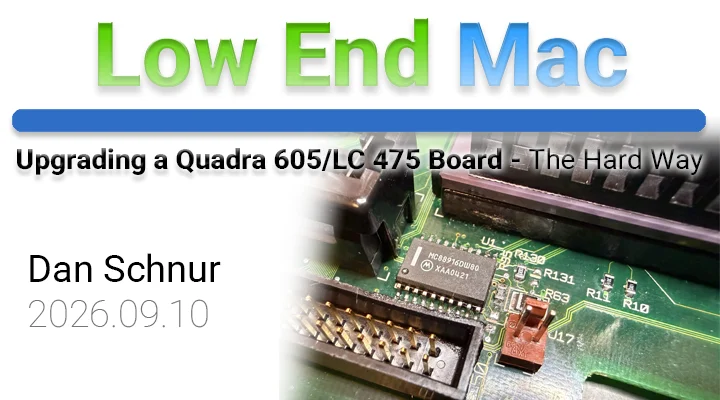
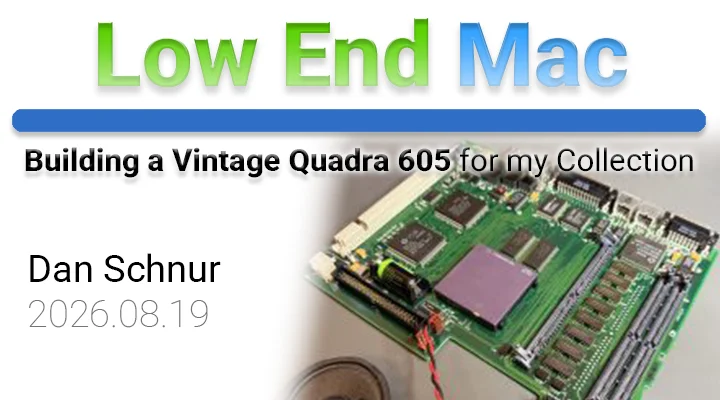
The restoration and modification of vintage computing hardware require a precise intersection of archival research, electrical engineering, and diagnostic patience. A recent project involving a Macintosh Quadra 605 logic board highlights the viability of hardware-level upgrades that bypass modern emulation in favor of period-correct performance enhancements. By systematically reconfiguring the board’s clock circuitry and replacing the central processing unit (CPU), a 25 MHz entry-level logic board was successfully transitioned to a 33 MHz configuration, complete with a functional Floating-Point Unit (FPU).
Historical Context of the Quadra 605
Released in 1993, the Macintosh Quadra 605 (also known as the LC 475) was positioned as a budget-conscious workstation. It utilized the Motorola 68LC040 processor, a "low-cost" variant of the 68040 architecture that omitted the integrated FPU to reduce manufacturing costs. While the Quadra 605 was lauded for its compact form factor and competitive price, the absence of an FPU significantly hindered its utility in high-end graphical processing, scientific calculation, and complex software applications common to the era.

The decision to restore this specific logic board was predicated on the failure of its original 68LC040 processor. Rather than sourcing a direct replacement, the project aimed to align the board with the performance profile of the higher-tier Quadra 605 configurations, which were factory-equipped with the full 68040 chip.
Technical Methodology and Chronology
The modification process was guided by original Apple Computer engineering schematics, which documented the specific configuration requirements for various clock frequencies. The board’s logic is determined by a series of passive surface-mount components, specifically resistors, which dictate the timing signals provided to the system bus.
The chronology of the upgrade proceeded as follows:

- Phase I: Resistor Reconfiguration (Clock Speed): The schematic indicated that the 25 MHz and 33 MHz configurations utilize distinct resistor arrays. The transition from 25 MHz to 33 MHz required the relocation of existing resistors from positions R21/R25 to R24/R22. This physical reconfiguration recalibrated the system’s primary clock frequency.
- Phase II: Precision Impedance Adjustments: A critical step involved the R13 resistor, which serves as a voltage regulator for the CPU clock circuit. The target value for a 33 MHz clock is 140 Ohms. Due to the scarcity of this specific value in standard surface-mount packages, a composite approach was employed, utilizing a series connection of 120-Ohm and 20-Ohm resistors to meet the exact 140-Ohm specification.
- Phase III: Logic Signal Routing: The R95 and R96 positions manage the board’s timing logic. The existing resistor at R95 was relocated to R96, effectively signaling the board’s firmware to initialize the system at the 33 MHz threshold.
- Phase IV: Clock Generator Replacement: The most significant challenge involved the U1 component, an MC88920 clock driver. To support the 33 MHz frequency, this was replaced with an MC88916, a component that has been out of production for several decades. The removal and installation process required controlled thermal application via a hot-air rework station, ensuring the surrounding surface-mount components remained undisturbed.
Data Analysis and Hardware Compatibility
The Motorola 68040 architecture was a milestone in desktop computing, introducing an integrated memory management unit (MMU) and an FPU on a single die. By replacing the 68LC040 with a full-featured 33 MHz MC68040RC33, the system not only achieved a 32% increase in base clock speed but also gained native hardware floating-point support.
From an engineering perspective, the Quadra 605 logic board was modular by design. Apple’s utilization of a unified PCB design for multiple speed grades suggests that the 33 MHz and 40 MHz variants were likely differentiated during the assembly line stage through the selection of resistors and clock driver chips. This "design-for-versatility" approach remains a subject of study among vintage hardware enthusiasts, as it allows for the reversal of product tiering decades after the product’s official end-of-life.
Broader Implications for Vintage Preservation
The successful completion of this upgrade provides a blueprint for the preservation of aging hardware. As original components—such as the MC88916 clock driver—become increasingly rare, the community of vintage computing hobbyists is forced to rely on salvaged parts or the development of modern "bridge" solutions.

The reliance on schematics rather than software-based overclocking utilities underscores a preference for permanent, hardware-level modification. While software solutions like the "Soft 475" utility can manipulate registers to alter system behavior, they often lack the stability of a hardware-defined configuration. The physical migration of components ensures that the logic board operates within the parameters intended by the original hardware engineers, thereby reducing the risk of instability or memory bus timing errors.
Industry and Community Reception
Although Apple Computer does not provide support for legacy hardware, the broader computing community—represented by organizations such as the Vintage Computer Federation and various online archival projects—views these modifications as essential to longevity. By upgrading to an FPU-enabled processor, users are able to run software that was previously incompatible with the LC-series processors, effectively extending the functional lifespan of the hardware by nearly 35 years.
Technicians involved in similar restorations emphasize that while the performance difference may be imperceptible in basic tasks, the value lies in the restoration of the machine’s full intended capability. The successful boot of the upgraded Quadra 605, confirmed by the distinctive "chime" of the Macintosh startup sequence, serves as a validation of the integrity of the board’s modified signal paths.

Conclusion
The transformation of the Quadra 605 logic board demonstrates that historical computing equipment is not necessarily static. Through the application of engineering data and careful component-level repair, it is possible to not only restore, but also enhance, systems that were once limited by artificial hardware tiering. As the supply of original parts dwindles, the methodologies used in this project—specifically the creative use of resistor series-parallel configurations and the sourcing of obsolete integrated circuits—will likely become the standard for maintaining the integrity of the vintage computing ecosystem.