Farhan hamdan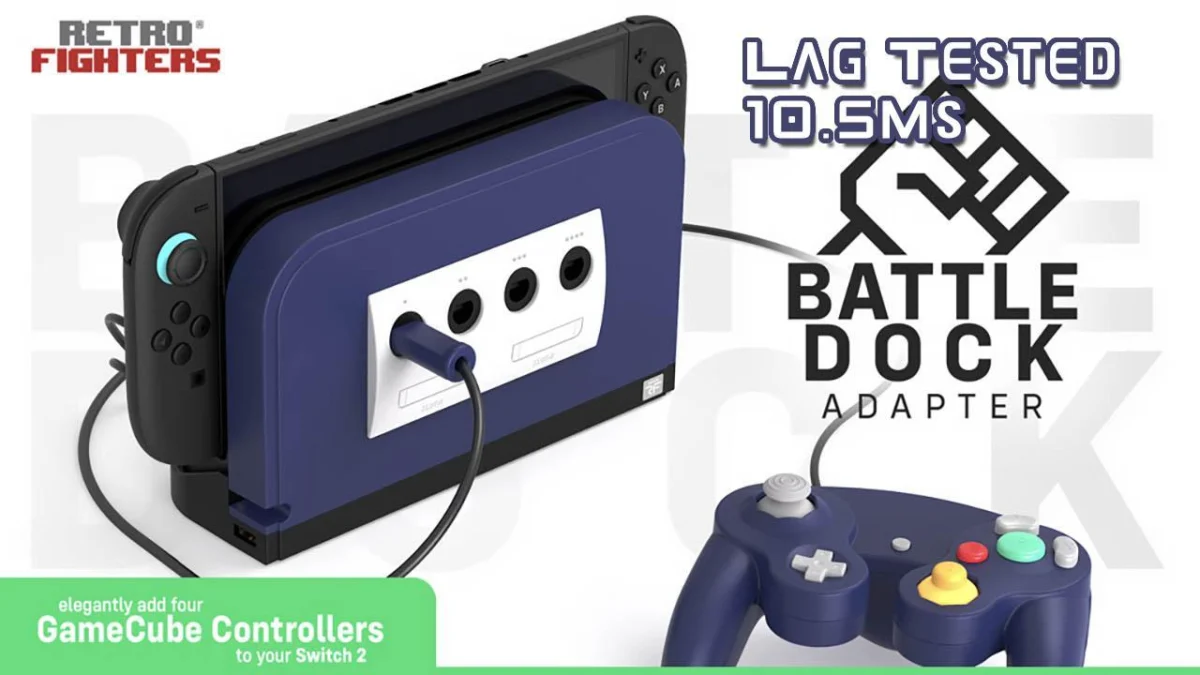
Retro Fighters, a company renowned for its innovative approach to modernizing classic gaming peripherals, has officially launched its highly anticipated "Battle Dock," a unique accessory designed to integrate the beloved Nintendo GameCube controller seamlessly with the Nintendo Switch ecosystem. Priced at $45 and immediately available for purchase via Amazon, the Battle Dock presents a novel solution for gamers seeking to leverage the iconic GameCube controller for their contemporary gaming sessions, particularly those involving titles like Super Smash Bros. Ultimate. This device distinguishes itself through a "dock for a dock" design, where an existing Nintendo Switch or Switch OLED console dock is housed within the Battle Dock, establishing a direct connection through an included USB cable. Initial performance assessments indicate a latency range of approximately 2 to 20 milliseconds (ms), a figure comparable to the official Switch Pro Controller, positioning the Battle Dock as a robust option for the vast majority of gamers.
The Enduring Appeal of the GameCube Controller
The Nintendo GameCube controller, first introduced in 2001 alongside the GameCube console, has achieved an almost legendary status within the gaming community, particularly among fans of the Super Smash Bros. series. Its distinctive ergonomic design, featuring a large A button, smaller B, X, and Y buttons, prominent C-stick, and responsive shoulder triggers, has cultivated a dedicated following. Many players consider it the optimal input device for competitive fighting games, attributing its precise control and tactile feedback to superior gameplay experiences. This enduring preference is not merely nostalgic; for a segment of the competitive gaming scene, especially in Super Smash Bros. Melee and Super Smash Bros. Ultimate, the GameCube controller is seen as an extension of the player, offering muscle memory and control precision that newer controllers, while excellent in their own right, cannot fully replicate.
Nintendo itself acknowledged this enduring appeal by releasing official GameCube controller adapters for the Wii U and later for the Nintendo Switch. However, these official adapters have occasionally faced supply challenges, price fluctuations, or design limitations, leaving a void in the market that third-party manufacturers like Retro Fighters have sought to fill. Retro Fighters, with a track record of producing high-quality, modernized versions of classic controllers for systems like the Nintendo 64, Dreamcast, and Sega Saturn, is uniquely positioned to understand and cater to this specific niche within the gaming community. Their expertise lies in respecting the original design while incorporating modern manufacturing techniques and connectivity standards, a philosophy clearly evident in the Battle Dock.
A Detailed Look at the Battle Dock’s Design and Functionality
The Battle Dock’s core innovation lies in its "dock for a dock" architecture. Unlike traditional console docks that provide HDMI output, power, and USB expansion, the Battle Dock functions as an external peripheral enhancer for the existing Nintendo Switch dock. Users simply slide their official Nintendo Switch or Switch OLED dock into the Battle Dock’s designated slot. The connection to the console’s dock is then established via a specialized USB cable, transforming the setup into a comprehensive GameCube controller hub. While primarily designed to accommodate the slightly larger dimensions of the rumored "Switch 2" dock (or perhaps future iterations), testing confirms full compatibility with the current Switch 1 dock, albeit with a less perfectly flush fit.
Aesthetically, the Battle Dock incorporates design elements reminiscent of the GameCube console itself. It features four prominent GameCube controller ports on its front face, mirroring the original console’s layout. Interestingly, the area traditionally housing memory card slots on the GameCube is purely decorative on the Battle Dock, serving as a nostalgic visual cue rather than offering functional storage. This design choice underscores the product’s focus on controller input rather than comprehensive system expansion.
Beyond its primary function, the Battle Dock offers versatile multi-platform compatibility. While optimized for the Nintendo Switch, it also functions seamlessly with PCs, Raspberry Pi devices, and MiSTer FPGA systems. When connected to these platforms, the Battle Dock is recognized as a generic "Xbox 360 Controller," a common and widely supported input standard, ensuring broad compatibility across various operating systems and emulation software. This feature significantly broadens the Battle Dock’s appeal, making it a valuable asset for retro gaming enthusiasts who utilize these platforms for their extensive game libraries.
Power and Connectivity: Engineered for Performance
One of the critical aspects of supporting multiple high-performance controllers is ensuring adequate power delivery and data throughput. The Battle Dock addresses this with an intelligently designed USB-C to A cable. This cable features two USB-A "outputs" at one end. One of these outputs is dedicated to data transmission, while the other serves as an auxiliary power input. This dual-cable approach is presumed to provide extra amperage, especially when all four GameCube controller ports are simultaneously in use. While initial tests with one or two controllers on PC and MiSTer systems showed stable performance with only the data cable connected, the additional power cable is a crucial safeguard against potential power fluctuations or performance degradation when all four ports are active and drawing power. This robust power solution aims to prevent latency spikes or disconnections that can plague lesser quality adapters under heavy load.
Furthermore, the Battle Dock thoughtfully includes two integrated USB-A ports on its side. This means that connecting the Battle Dock does not consume all available USB ports on the standard Switch dock. Instead, users gain additional USB connectivity, allowing them to plug in other peripherals such as charging cables, external storage, or other input devices without sacrificing essential ports on their console dock. This attention to practical user needs enhances the Battle Dock’s utility and convenience, solidifying its position as a well-considered accessory.
Analyzing Latency: A Critical Performance Metric
In the realm of gaming, particularly competitive play, input latency is a paramount concern. Latency refers to the delay between a player’s input (e.g., pressing a button) and the corresponding action appearing on screen. Even milliseconds of delay can significantly impact a player’s reaction time and overall performance. The Battle Dock’s reported latency range of approximately 2 to 20 milliseconds is a key performance indicator.
To put this into context, the official Nintendo Switch Pro Controller, widely regarded as a high-quality peripheral, typically exhibits latency between 5 and 36ms in its lowest latency mode, with an average around 14ms. When comparing these figures, the Battle Dock’s performance is highly competitive, often matching or even surpassing the Pro Controller’s responsiveness. For a game running at 60 frames per second (fps), each frame represents approximately 16.67ms. Therefore, a latency of 20ms implies a delay of roughly one to two frames, while 2ms is practically imperceptible. The fact that the Battle Dock can maintain this performance even with all four GameCube controllers connected is a significant achievement, as many multi-controller adapters often introduce additional lag or instability when multiple inputs are active.

However, it is crucial to acknowledge that total perceived latency is a complex interplay of several factors, including the controller adapter, the console’s processing, the game engine’s internal lag, and critically, the display device (monitor or TV). High-refresh-rate gaming monitors with low input lag can significantly mitigate the overall delay experienced by the player. As noted by independent reviewer "Beast," who tested the Battle Dock on a optimized, low-latency setup, the performance felt "decent overall," indicating that in ideal conditions, the Battle Dock delivers a highly responsive experience.
While the Battle Dock’s latency performance is excellent for the average gamer and casual multiplayer sessions, it is important to manage expectations for the absolute pinnacle of competitive play. Professional-level Super Smash Bros. tournaments often demand the absolute lowest possible latency, sometimes pushing for sub-10ms total system lag. In these highly specialized environments, even a few milliseconds can be perceived as a disadvantage. Therefore, while the Battle Dock is a formidable contender, it may not entirely displace bespoke, ultra-low-latency setups favored by elite professional players. For everyone else, however, the Battle Dock offers a performance profile that is more than adequate, providing a smooth and responsive gaming experience.
Chronology and Market Positioning
Retro Fighters’ journey to the Battle Dock is rooted in a consistent strategy of identifying and fulfilling specific demands within the retro and modern gaming accessory markets. The company gained significant traction by launching successful Kickstarter campaigns for modernized versions of classic controllers, such as the Brawler64 for the Nintendo 64 and the StrikerDC for the Dreamcast. These products demonstrated Retro Fighters’ commitment to quality, ergonomic improvements, and contemporary connectivity while respecting the original designs that endeared them to players.
The conception of the Battle Dock likely emerged from an analysis of the persistent demand for GameCube controllers on the Switch, coupled with the existing solutions’ occasional shortcomings. Development would have involved careful engineering to minimize latency, ensure robust power delivery for multiple controllers, and design a physical form factor that integrated seamlessly with existing Switch docks. Extensive internal testing, followed by validation from community figures and reviewers like "Beast," would have refined the product before its public release. The decision to launch at $45 positions the Battle Dock competitively, offering a feature-rich, high-performance solution at an accessible price point compared to official adapters or more complex, multi-component setups. Its availability on Amazon ensures broad market reach and ease of purchase for consumers.
Broader Implications and Market Impact
The introduction of the Retro Fighters Battle Dock carries several significant implications for the gaming accessory market and the broader gaming community.
Enhancing Local Multiplayer: The Battle Dock directly addresses the needs of local multiplayer gaming. With four readily available GameCube controller ports, it simplifies the setup for games like Super Smash Bros. Ultimate, Mario Kart 8 Deluxe, and Super Mario Party, allowing friends and family to enjoy classic controller comfort without the hassle of wireless syncing or battery management. This could foster a resurgence of local gaming gatherings, an experience increasingly valued in an era dominated by online play.
Sustaining Retro Preferences: By providing a high-quality, low-latency solution for GameCube controllers, the Battle Dock reinforces the enduring legacy of these peripherals. It acknowledges that for a significant portion of the gaming population, the comfort, familiarity, and perceived precision of certain legacy controllers remain unmatched for specific genres. This trend indicates a healthy market for well-designed retro-inspired accessories that bridge the gap between classic hardware and modern consoles.
Innovation in Accessory Design: The "dock for a dock" concept is an interesting design choice, offering a modular approach to console enhancement. While it requires an existing official dock, it allows for a cleaner integration than standalone adapters that might clutter a gaming setup. This modularity could inspire future accessory designs that build upon existing console infrastructure rather than replacing it entirely.
Value Proposition for Consumers: At its $45 price point, the Battle Dock offers substantial value. It combines the functionality of a multi-port GameCube adapter with USB passthrough capabilities, all within a well-designed form factor. For players who frequently engage in local multiplayer or simply prefer the GameCube controller, this represents a cost-effective and high-performance investment compared to purchasing multiple official wireless controllers or navigating the complexities of less reliable third-party alternatives.
In conclusion, the Retro Fighters Battle Dock is a thoughtfully engineered accessory that effectively caters to a passionate segment of the gaming community. By delivering robust performance, versatile compatibility, and a user-friendly design, it successfully bridges the gap between the nostalgic appeal of the GameCube controller and the demands of modern gaming. While elite competitive players might continue to seek the absolute lowest latency solutions, the Battle Dock undeniably stands as a compelling and highly recommended option for the vast majority of Nintendo Switch owners and retro enthusiasts seeking to elevate their multiplayer and single-player experiences with the iconic GameCube controller.