Farhan hamdan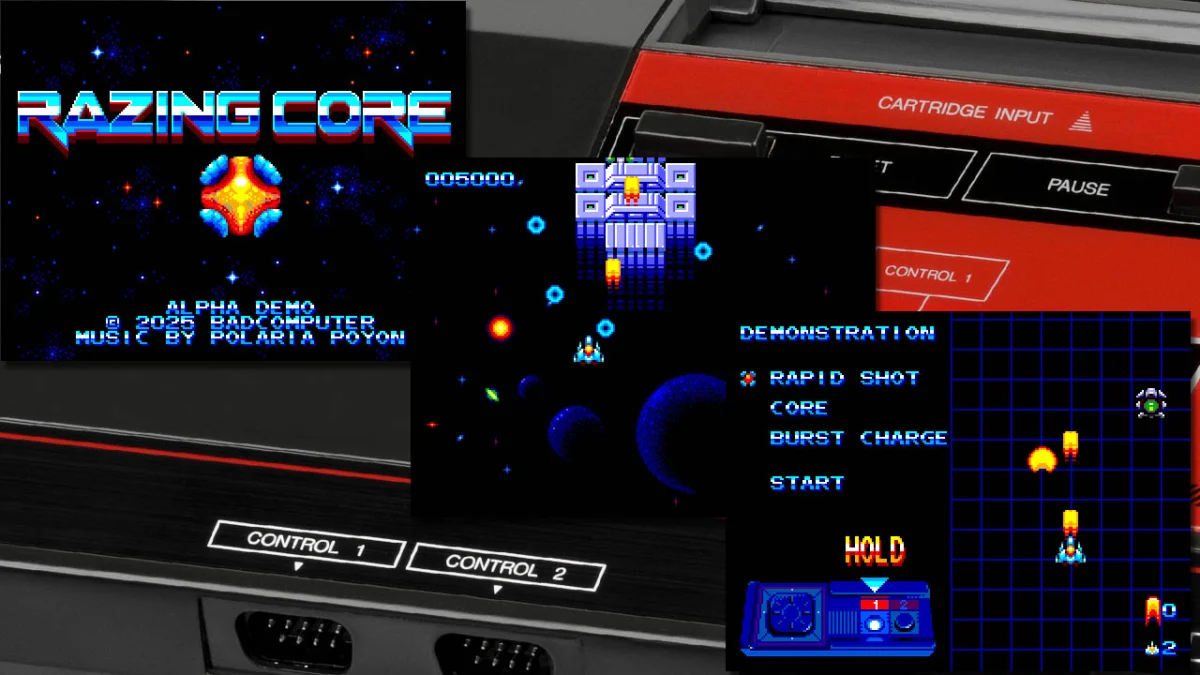
The landscape of retro gaming development continues to thrive decades after original commercial manufacturing ceased, evidenced by the official release of Razing Core, a brand-new top-down scrolling shooter designed specifically for the Sega Master System. Developed by independent programmer BadComputer0, the title represents a complete, feature-rich commercial release for hardware that originally debuted in the mid-1980s. Built utilizing the widely recognized development toolkit devitSMS—created by programmer sverx—and featuring an original chiptune soundtrack composed by Polaria Poyon and Lovepenguin, Razing Core demonstrates the enduring viability of 8-bit architecture and the dedication of modern homebrew developers who continue to breathe new life into legacy gaming platforms.
Main Facts and Commercial Availability
Razing Core is currently available for purchase through the independent digital distribution platform Itch.io. The digital release is priced at $8.00 USD and includes the complete ROM file alongside a comprehensive, fully printable digital manual in PDF format, catering to enthusiasts who appreciate traditional physical documentation. Furthermore, for dedicated hardware collectors and physical media preservationists, a complete-in-box physical cartridge edition has been formally scheduled for release in 2027.
Technical specifications and compatibility notes provided by the developer indicate that while the game is meticulously optimized for original Sega Master System hardware, modern alternative playback methods—such as FPGA-based systems and software emulators—are fully supported. However, early adopters have noted specific configuration nuances regarding FPGA hardware; documentation on the Itch.io storefront advises that users operating certain FPGA devices may need to temporarily disable the system BIOS to ensure proper game execution. Testing across various emulation setups and hardware configurations, such as the MiSTer FPGA platform, reveals that the title functions seamlessly with both internal BIOS settings and disabled states, though standard troubleshooting procedures recommend checking on-screen display (OSD) configurations should any loading anomalies occur.
Chronology and Development Timeline
The path to the commercial release of Razing Core spans several months of iterative development, community feedback, and technical refinement. The project first gained visibility within the retro gaming community through the release of an early alpha demonstration build. This initial proof-of-concept allowed enthusiasts and critics alike to evaluate the foundational mechanics, graphical style, and pacing of the top-down shoot ’em up (shmup) genre as interpreted through the technical limitations of the Sega Master System’s Video Display Processor (VDP) and sound chip capabilities.
Following the positive reception of the alpha demo, BadComputer0 incorporated community feedback, refined enemy bullet patterns, enhanced graphical assets, and polished the overall presentation. The transition from the early testing phase to the final commercial release involved extensive optimization using devkitSMS, a C-language development kit tailored for the Zilog Z80 processor powering the Master System. The integration of Polaria Poyon and Lovepenguin’s audio composition further elevated the project, transforming a technical showcase into a cohesive, atmospheric arcade-style experience. The release of the official launch trailer marked the culmination of this development cycle, officially opening digital storefronts and setting the stage for the physical release planned for 2027.
Supporting Technical Data and Hardware Context

The Sega Master System, originally launched by Sega in 1985 in Japan (and subsequently in international markets through 1986 and 1987), operates on an 8-bit architecture anchored by a Zilog Z80 Central Processing Unit running at approximately 3.58 MHz, alongside a custom VDP capable of handling up to 64 simultaneous on-screen colors from a master palette of 64, and Texas Instruments SN76489 sound hardware handling programmable sound generation. Developing for this hardware requires rigorous optimization of memory management, sprite multiplexing, and CPU instruction cycles to prevent slowdown and graphical flicker during intense gameplay scenarios characterized by numerous projectiles and enemies.
Razing Core effectively navigates these hardware constraints. The top-down shooter genre requires precise collision detection, smooth scrolling backgrounds, and responsive controls—elements that push 8-bit systems to their absolute limits. By leveraging modern development pipelines while strictly adhering to the technical parameters of the Master System, BadComputer0 has produced a title that runs natively on original consoles without requiring hardware enhancements or expansion chips, distinguishing it from later-era software that relied on specialized coprocessors.
Industry and Community Responses
The retro gaming community has responded enthusiastically to the launch of Razing Core, viewing it as yet another milestone in the ongoing renaissance of 8-bit and 16-bit software development. Platforms dedicated to retro hardware preservation, RGB video modifications, and classic console reviews have highlighted the title not merely as a nostalgic novelty, but as a genuinely well-crafted addition to the Master System’s historically sparse shoot ’em up library.
While major commercial publishers abandoned the Sega Master System in Western markets during the early 1990s—and in regions like Brazil well into the 2000s—the homebrew community has steadily stepped in to fill the void. Developers utilizing open-source toolchains such as devkitSMS have democratized software creation for the platform, allowing independent creators from around the globe to publish polished, complete games that rival or exceed the technical achievements of titles produced during the console’s commercial prime. Analysts and community leaders note that releases like Razing Core validate the enduring economic viability of niche retro software markets, where digital distribution models allow creators to reach a global audience of dedicated collectors with minimal overhead.
Broader Impact and Implications for Retro Homebrew Ecosystems
The successful commercial launch of Razing Core carries several notable implications for the broader retro gaming and homebrew development ecosystem. First, it demonstrates the maturation of independent development tools for vintage hardware. Software development kits designed for the Z80 and other classic processors have become increasingly robust, lowering the barrier to entry for programmers interested in retro platforms and resulting in a higher baseline quality for modern homebrew releases.
Second, the dual-release strategy—employing an immediate digital distribution model followed by a long-term physical cartridge release—illustrates a sustainable business model for independent developers operating within micro-niches. Digital sales via platforms like Itch.io provide immediate revenue and broad accessibility, while physical releases scheduled years in advance cater to the high-value collector market, ensuring that production costs for printed circuit boards, cartridges, boxes, and manuals can be accurately forecasted and funded.
Finally, titles like Razing Core contribute significantly to the cultural preservation of gaming history. By creating new content for hardware that has long since exited official production, developers ensure that classic systems remain active platforms for artistic and technical expression rather than static museum artifacts. As the homebrew community continues to expand across various vintage consoles, releases of this caliber underscore the fact that classic hardware remains fertile ground for innovative game design, proving that limitations in processing power often inspire the highest levels of creative ingenuity.