Cecilia Chamidah Nur
In a significant update that has sent ripples through the retro gaming and homebrew communities, popular YouTube personality and game developer Modern Vintage Gamer (MVG) has publicly reversed his long-held skepticism regarding the feasibility of porting id Software’s seminal first-person shooter, DOOM, to the SNK Neo Geo console. After initially challenging the homebrew community to achieve what many considered an insurmountable task, MVG now concedes, "I was wrong," acknowledging that recent breakthroughs suggest a DOOM port on the notoriously challenging platform is, in fact, within the realm of possibility. This dramatic shift in perspective stems from an intense five-week period following his initial video, during which a dedicated cohort of developers unveiled several innovative techniques, effectively redefining the perceived limitations of the Neo Geo hardware.
A Paradigm Shift in Retro Gaming Expectations
The journey to this admission began approximately a month prior when MVG released a video detailing the profound complexities inherent in adapting a game of DOOM‘s sophisticated architecture to the Neo Geo. His initial analysis underscored the console’s fundamental design constraints, primarily the absence of a dedicated framebuffer. "The Neo Geo does not have the concept of a frame buffer," MVG explained, "meaning everything that you see on a screen on a Neo Geo is rendered as a sprite." This architectural peculiarity stood as a colossal barrier, given that modern 3D rendering, including DOOM‘s engine, heavily relies on the ability to draw pixels directly to a contiguous memory region representing the screen.
The Neo Geo, launched by SNK in 1990, was a powerhouse for 2D graphics, renowned for its lavish sprite capabilities and high-quality sound, earning it the moniker "the Rolls-Royce of gaming" due to its exorbitant price point. Its hardware was optimized for arcade-perfect renditions of fighting games and side-scrolling action titles, boasting a Motorola 68000 CPU (running at 12 MHz), a Zilog Z80A co-processor, and a dedicated graphics system capable of displaying 380 sprites simultaneously, with scaling and zooming effects. However, this sprite-centric design, while revolutionary for its era’s 2D games, presented an entirely different set of challenges when confronted with the demands of a 3D renderer like DOOM‘s.
The Initial Challenge: Why DOOM on Neo Geo Seemed Impossible
MVG’s original video meticulously outlined why a direct port seemed implausible. He initially discussed the potential of a raycasting engine, a technique famously employed in early 3D games like Wolfenstein 3D. While a basic raycaster could theoretically run on the Neo Geo by rendering vertical strips as sprites, MVG quickly dismissed its suitability for a true DOOM-like experience. "A raycaster can only handle a grid, which is square blocks, which means everything has to be the same height and all the walls are at right angles," he elaborated. This fundamental limitation starkly contrasts with DOOM‘s engine, which offered a far more complex and dynamic world.
DOOM, released in 1993, was a technological marvel for its time, pushing the boundaries of what was thought possible on consumer-grade PCs. Its engine, later known as id Tech 1, introduced innovations such as varying floor and ceiling heights, non-orthogonal walls, dynamic lighting, and complex level geometry featuring stairs, lifts, and sloped sightlines. These elements are rendered using a sophisticated method involving Binary Space Partitioning (BSP) trees to determine visibility and a sector-based approach to manage the environment. This level of graphical fidelity and architectural complexity demands a rendering pipeline that can efficiently manipulate individual pixels and manage depth information—capabilities that the Neo Geo’s sprite-based hardware, without a framebuffer, inherently lacked.
The core dilemma revolved around how to translate DOOM‘s pixel-oriented, depth-buffered rendering onto a system designed to draw pre-defined graphical assets (sprites) at specific screen coordinates. Each sprite on the Neo Geo has a defined size and position, and the system excels at rapidly drawing and manipulating these. However, constructing an entire 3D scene, pixel by pixel, or even vertical strip by vertical strip, with varying heights and angles, using only sprites, appeared to be an exercise in extreme inefficiency, if not outright impossibility. The CPU would be overburdened, and the sprite limits would be quickly exhausted.
The Community Rises: Five Weeks of Innovation
Despite MVG’s initial pessimistic outlook, his challenge ignited a spark within the global homebrew community. Driven by a passion for retro hardware and a desire to push the boundaries of what is achievable, developers worldwide began to "step up to the plate," as MVG described, exploring unconventional methods to circumvent the Neo Geo’s architectural constraints. The ensuing five weeks saw an explosion of creative problem-solving, culminating in several proof-of-concept projects that forced MVG to re-evaluate his position. These projects, rather than attempting a direct, inefficient port, focused on reinterpreting DOOM‘s rendering principles in ways compatible with the Neo Geo’s unique hardware.
The emergence of these alternative techniques is a testament to the ingenuity and collaborative spirit of the homebrew scene. It highlights a recurring theme in retro computing: that dedicated enthusiasts, often unconstrained by commercial pressures or established paradigms, can unlock unforeseen potential in vintage hardware, breathing new life into platforms long considered obsolete. MVG, in his update video, chose to spotlight three particularly promising projects, each employing a distinct approach to tackle the DOOM problem.
Project Spotlight: Squeezing DOOM 64KB onto the Neo Geo
Two of the highlighted projects focus on porting DOOM 64KB, a highly optimized, compact version of DOOM originally developed for PC. This miniature version, stripped down to fit within a mere 64 kilobytes, offered a more manageable target for the resource-constrained Neo Geo.
FrenkelS’s Real BSP Approach
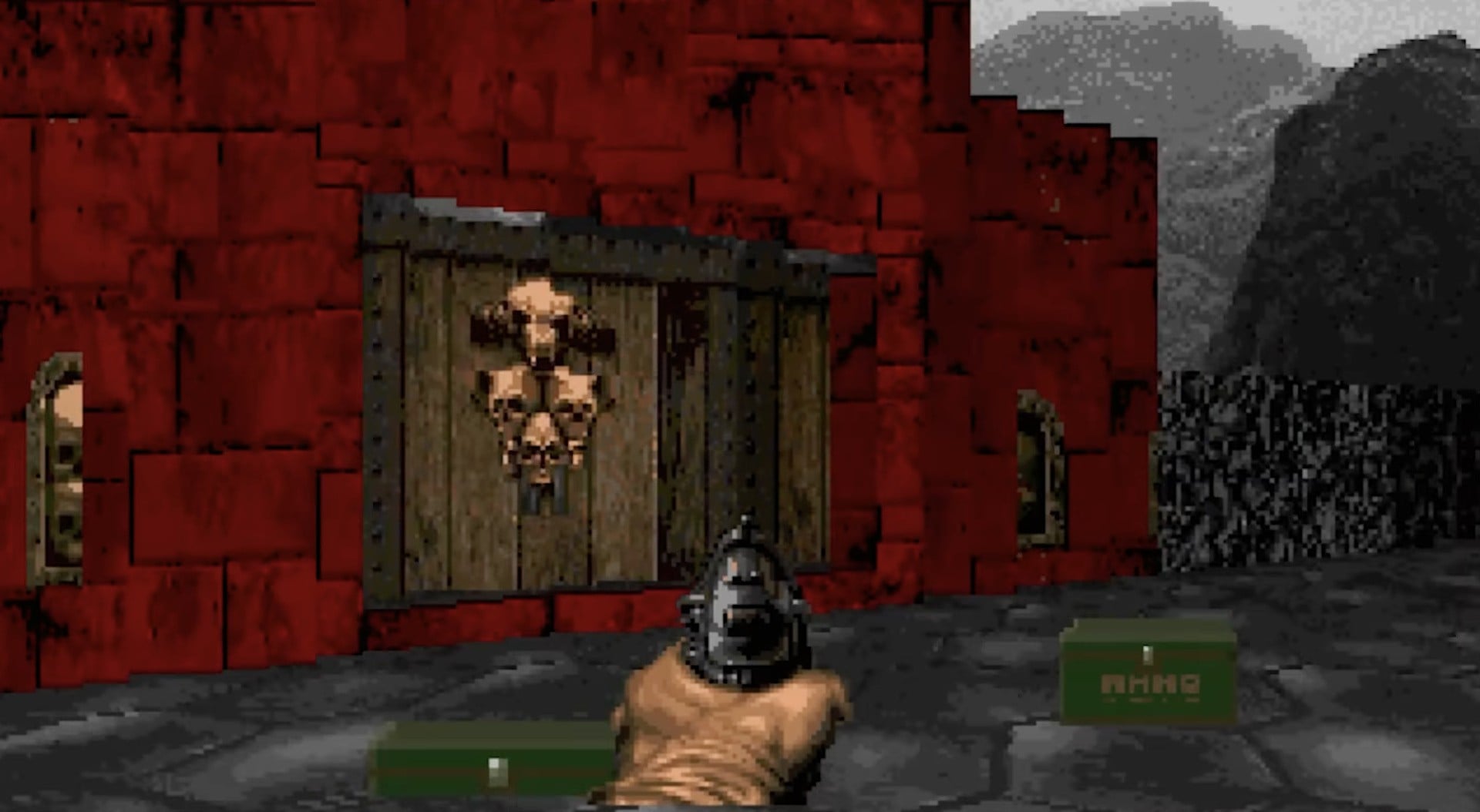
One of the most compelling projects comes directly from FrenkelS, the original author of DOOM 64KB. His approach for the Neo Geo port is particularly noteworthy because it incorporates "real BSP" (Binary Space Partitioning) and "real map geometry." This means it doesn’t simplify DOOM‘s complex level structure into a basic grid but instead processes the actual DOOM map data, maintaining the intricate layouts, varying heights, and angled walls that define the game’s unique environments.
The genius of FrenkelS’s method lies in how it handles the framebuffer problem. Instead of trying to simulate a full-screen framebuffer, his port leverages the Neo Geo’s fixed layer (often used for displaying scores, HUD elements, or static backgrounds) as a "tiny frame buffer." This fixed layer, while limited in resolution and color depth compared to a full-blown framebuffer, provides a contiguous memory area that the CPU can directly write pixels to. By judiciously rendering critical parts of the scene to this small buffer and then potentially scaling or tiling it using the Neo Geo’s sprite capabilities, FrenkelS aims to recreate the DOOM visual experience. This method involves taking the original DOOM rendering code and "squeezing it down small enough" to operate within the Neo Geo’s memory and processing constraints, a monumental optimization challenge. The implications are significant: achieving true DOOM geometry without resorting to raycaster approximations.
Sabino’s Sprite-Based Microframebuffer
Another innovative project tackling DOOM 64KB comes from developer Sabino. His approach diverges from FrenkelS’s by building a "microframebuffer from sprites" rather than relying on the fixed or text layer. This technique essentially creates a virtual framebuffer by arranging numerous small sprites to form a grid, each sprite representing a block of pixels. The CPU then updates the individual sprites to construct the scene.
The advantage of Sabino’s method is its potential for a "less blocky version" of the game. By using sprites, which can be individually scaled and positioned, there’s more flexibility in how the image is composed, potentially allowing for finer detail or smoother transitions compared to a fixed-layer approach. However, this comes at a significant "performance cost." Managing and updating hundreds or thousands of individual sprites per frame places a heavy burden on the CPU and the Neo Geo’s sprite rendering system. The challenge lies in optimizing this process to maintain a playable framerate while still delivering a visually recognizable DOOM experience. Both FrenkelS and Sabino’s efforts demonstrate the diverse strategies developers are employing to navigate the Neo Geo’s hardware eccentricities.
A Novel Rendering Technique: Retro Ports’ Vslice Engine
Beyond the DOOM 64KB adaptations, MVG highlighted a third project that employs a radically different methodology: Retro Ports’ DOOM Neo Geo, developed by 5f9yhmc6cz-spec. This project, rather than porting an existing DOOM variant, focuses on creating an entirely new renderer specifically tailored for the Neo Geo’s sprite-based architecture, dubbed Vslice.
The Vslice engine is described as "taking all the good parts of the Raycaster approach and throws away all the bad stuff." It cleverly leverages the Neo Geo’s inherent strengths while mitigating the typical limitations of simple raycasting. As MVG elaborated, "It keeps the hardware scaler to draw all the pixels, so there’s no frame buffer, and there’s no per-pixel CPU work, just like the raycaster." This means the engine avoids the intensive CPU calculations required for traditional pixel-by-pixel rendering or managing a software framebuffer. Instead, it relies on the Neo Geo’s hardware to perform the scaling, a feature that significantly offloads processing from the CPU.
However, where Vslice truly innovates is in its visibility determination. "But instead of casting rays through the grid to decide what’s visible, it warps through an actual BSP tree… the data structure that builds out the map for you." This is a critical distinction. Traditional raycasters are limited to grid-based environments because they cast rays from the player’s perspective to determine wall intersections on a simple grid. Vslice, by contrast, processes DOOM‘s original BSP tree data structure. A BSP tree efficiently organizes the geometry of a 3D world, allowing the renderer to quickly determine which parts of the scene are visible from a given viewpoint without having to check every single wall or object. By combining the hardware-accelerated sprite scaling (a "good part" of the raycaster approach in terms of efficiency) with the BSP tree traversal (the "good part" of DOOM‘s geometry handling), Vslice aims to achieve a full DOOM visual experience with its complex environments, all while working within the Neo Geo’s sprite-based rendering paradigm and avoiding the need for a framebuffer. This hybrid approach represents a significant leap in technical creativity.
Historical Context: The Legacy of "Impossible" Ports
The effort to port DOOM to the Neo Geo stands as a contemporary example in a rich history of "impossible" ports within the retro gaming community. Throughout the decades, dedicated enthusiasts have repeatedly challenged the perceived limits of hardware, bringing games to platforms that were never intended to run them. Iconic examples include Wolfenstein 3D on the Game Boy Advance, Grand Theft Auto on the Game Boy Color (a demake), or even Super Mario 64 running natively on the Nintendo DS. These projects often require deep understanding of obscure hardware registers, clever optimization tricks, and a willingness to rewrite significant portions of game engines to suit the target system’s unique architecture.
The motivation behind such endeavors is multifaceted. For some, it’s a pure intellectual challenge—a puzzle to be solved. For others, it’s about preservation, ensuring that classic titles can be experienced on a wider array of vintage hardware. And for many, it’s a testament to the enduring appeal of certain games, like DOOM, which continue to inspire new generations of developers to push technological boundaries, even on systems released long before the game itself. The Neo Geo, with its distinct architecture and formidable 2D capabilities, has always presented a unique set of challenges, making any successful 3D rendering project on the system particularly noteworthy.
Implications for Homebrew and Retro Preservation
MVG’s admission and the progress demonstrated by these projects carry significant implications for the homebrew community and the broader field of retro game preservation. Firstly, it reaffirms the power of collective effort and open challenges. A single video from a prominent figure sparked a global response, leading to innovations that might not have emerged otherwise. This collaborative spirit is a cornerstone of the homebrew scene, where knowledge sharing and mutual encouragement drive progress.
Secondly, these developments push the boundaries of what is considered feasible on vintage hardware. Each successful "impossible" port expands our understanding of a system’s true capabilities, often revealing untapped potential that commercial developers, constrained by release schedules and market demands, never explored. This not only breathes new life into classic consoles but also serves as an invaluable resource for future hardware enthusiasts, modders, and preservationists. It means that the Neo Geo, a console primarily known for its stunning 2D arcade experiences, might one day host a recognizable 3D FPS, fundamentally altering its historical perception.
The Road Ahead: Optimizations and the Future of DOOM on Neo Geo
Despite the tremendous progress, MVG clarifies that none of these nascent ports are "finished" products, nor are they expected to be released "anytime soon." The journey from a proof-of-concept to a fully playable, enjoyable game on a system as constrained as the Neo Geo is long and arduous. It will require countless hours of optimization, debugging, and fine-tuning. Frame rates will need to be stabilized, graphical glitches ironed out, and input responsiveness perfected. Sound and music, integral to the DOOM experience, will also need to be integrated within the Neo Geo’s audio capabilities.
However, the current breakthroughs represent a "tremendous progress" regardless of their immediate playability. They have moved the needle from theoretical impossibility to tangible potential. The fact that multiple developers are approaching the problem from different technical angles suggests a robust and diverse set of solutions are being explored, increasing the likelihood of a successful outcome. Whether one of these projects ultimately yields a complete, playable DOOM port, or if elements from each are combined into a new, hybrid solution, remains to be seen. What is clear is that the homebrew community has once again demonstrated its extraordinary capacity for innovation, turning an "impossible" dream into a tangible, if still distant, reality. The prospect of blasting demons on the revered Neo Geo, once a mere fantasy, now appears to be a matter of time and dedicated effort.