Farhan hamdan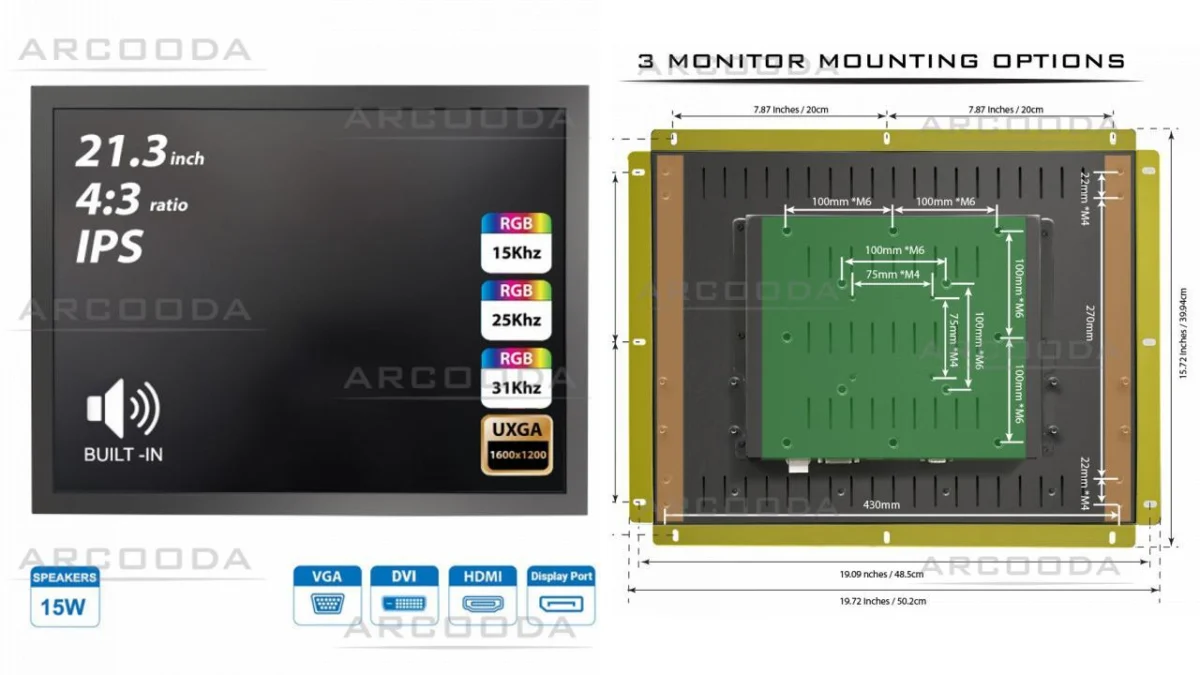
The preservation and maintenance of classic arcade cabinets have entered a new technological phase as display manufacturers continue to adapt legacy hardware standards to modern liquid crystal display architectures. Arcooda, a recognized supplier in the arcade parts and commercial gaming sector, has officially commenced sales of its latest retro-compatible 4:3 LCD monitor. Measuring 21.3 inches diagonally and featuring a native resolution of 1600 by 1200 pixels, this new hardware iteration marks a significant milestone for the company by introducing integrated stereo speakers for the first time within this specific product category. Retailing at approximately $800, the display is currently in stock and available for acquisition through the official Arcooda distribution channels, targeting both commercial arcade operators and high-end retro gaming enthusiasts who demand authentic aspect ratios and low-latency signal processing.
Core Technical Specifications and Video Processing Capabilities
At the heart of the new 21.3-inch Arcooda display is a specialized scaler designed to handle a vast array of legacy and modern video signals without introducing the visual artifacts commonly associated with cheap consumer-grade monitors. The panel operates at a native 4:3 aspect ratio, which remains the definitive standard for classic arcade games released from the late 1970s through the early 2000s, as well as numerous retro home console systems.
Unlike standard office monitors that often struggle or fail entirely when fed non-standard, low-resolution progressive or interlaced video feeds, the Arcooda driver board is engineered to accept signals starting all the way down from 240p up to the panel’s maximum native resolution of 1600×1200. The hardware performs sharp-scaling algorithms to present pixel-accurate representations of retro graphics, avoiding the muddy smoothing filters typical of modern televisions.
Connectivity options are robust, accommodating a wide spectrum of retro and contemporary equipment through dedicated HDMI, VGA, DVI, and DisplayPort inputs. Every input port is fully compatible across the entire supported resolution range, granting users immense flexibility whether they are connecting a vintage personal computer, a modern FPGA-based hardware simulation device like the MiSTer, or an external line multiplier such as the Open Source Scan Converter (OSSC).
Furthermore, latency remains a critical factor for arcade purists and competitive players. Arcooda’s new display maintains the ultra-fast response times characteristic of the company’s broader monitor ecosystem, adding a negligible delay of only about one millisecond to initiate the drawing of an image from the frame buffer. This nearly instantaneous response time ensures that twitch-reaction gameplay—such as that found in classic shoot ’em ups (shmumps) and fighting games—remains entirely uncompromised by display lag.
Evolution of Arcooda’s Retro-Compatible Display Ecosystem
The introduction of the 21.3-inch model builds upon years of research and product development by Arcooda in the arcade monitor replacement market. For decades, arcade operators relied exclusively on cathode-ray tube (CRT) technology to power their cabinets. However, as original CRT chassis aged, suffered from burn-in, or experienced catastrophic component failures such as flyback transformer degradation, the availability of viable replacement tubes plummeted. The scarcity of functional CRT hardware created an urgent demand for drop-in LCD replacements that could replicate the physical and electrical characteristics of traditional arcade monitors without requiring extensive cabinet modifications.
Historically, Arcooda established its reputation in this niche by releasing larger high-definition and ultra-high-definition 4:3 LCD panels, notably their 1080p and 4K variants. These earlier models proved popular among commercial amusement centers seeking to modernize their older cabinets while maintaining the correct screen geometry required for classic titles. However, those legacy iterations lacked integrated audio solutions, requiring operators or hobbyists to source separate amplification boards and speakers to restore sound capabilities within the cabinet.
By integrating speakers directly into the 21.3-inch chassis, Arcooda has streamlined the installation process for specific cabinet configurations, acknowledging feedback from both commercial operators and home arcade builders who desired an all-in-one visual and auditory solution. Although audiophiles generally recommend dedicated bookshelf speakers for optimal sound reproduction, the built-in audio system provides a practical, space-saving alternative that meets baseline requirements for standard arcade deployment.

Intended Use: Drop-In Arcade Replacements Versus Consumer Gaming Monitors
Industry analysts and technical reviewers emphasize that prospective buyers must understand the intended application of the Arcooda display. Priced at approximately $800, the monitor is not marketed as a budget-friendly general-purpose PC gaming monitor. Rather, it is engineered primarily as a robust, professional-grade drop-in replacement for aging CRT arcade monitors housed inside standard wooden or metal cabinets.
When evaluated within the specialized context of arcade restoration, the $800 price point becomes highly cost-effective. Traditional methods of converting a CRT-based cabinet to LCD often necessitate a complicated web of third-party hardware, including custom JAMMA (Japan Amusement Machine and Marketing Association) wiring harnesses, specialized video signal converters, external scalers, and separate power supplies. Purchasing and configuring these disparate components can easily equal or surpass the total cost of the Arcooda monitor while frequently introducing compatibility issues, signal degradation, or unwanted input lag.
Conversely, Arcooda offers streamlined integration pathways. By utilizing a modest $15 RGB JAMMA adapter printed circuit board alongside appropriate mounting brackets, technicians can wire the display directly into an existing arcade chassis. This modular approach significantly reduces installation time, minimizes wiring complexity, and ensures that the video signal retains maximum fidelity from the game board to the glass.
Broad Adoption Beyond Commercial Arcades
Despite being designed with commercial arcade refurbishment in mind, market trends indicate that a substantial portion of Arcooda’s customer base consists of private collectors, home arcade enthusiasts, and retro gaming hobbyists. The demand for high-quality, native 4:3 LCD panels has surged in recent years as the retro gaming community expands and authentic CRT monitors become increasingly rare and expensive to maintain.
Many consumers purchase these industrial-grade displays for custom-built home arcade cabinets, bartop units, or dedicated retro gaming spaces. The inclusion of versatile mounting options allows the monitor to fit seamlessly into custom carpentry and specialized enclosures. Furthermore, the monitor’s native compatibility with low-latency video processors—such as the OSSC and MiSTer FPGA setups—makes it an attractive option for enthusiasts who wish to display multiple retro platforms on a single, high-performance screen without resorting to stretched widescreen formats or inferior scaling methods.
Implications for the Retro Gaming and Arcade Preservation Markets
The continued commercial viability and hardware evolution of products like the Arcooda 21.3-inch LCD monitor highlight an ongoing transition within the retro gaming community. As the pool of functional CRT monitors steadily shrinks due to natural attrition and component aging, the industry is forced to rely increasingly on solid-state display technologies to keep classic arcade culture alive.
While purists continue to advocate for the unmatched motion clarity, deep black levels, and analog geometry of genuine CRTs, industrial solutions from manufacturers like Arcooda bridge the gap between historical authenticity and modern hardware reliability. By providing low-latency performance, comprehensive multi-resolution support, and direct arcade harness compatibility, these displays ensure that classic video games can continue to be played on hardware configurations that respect their original design parameters.
As production continues and adoption spreads across both commercial and domestic sectors, monitors of this caliber will likely remain a cornerstone of modern arcade maintenance and custom retro gaming engineering for the foreseeable future.