
 Farhan hamdan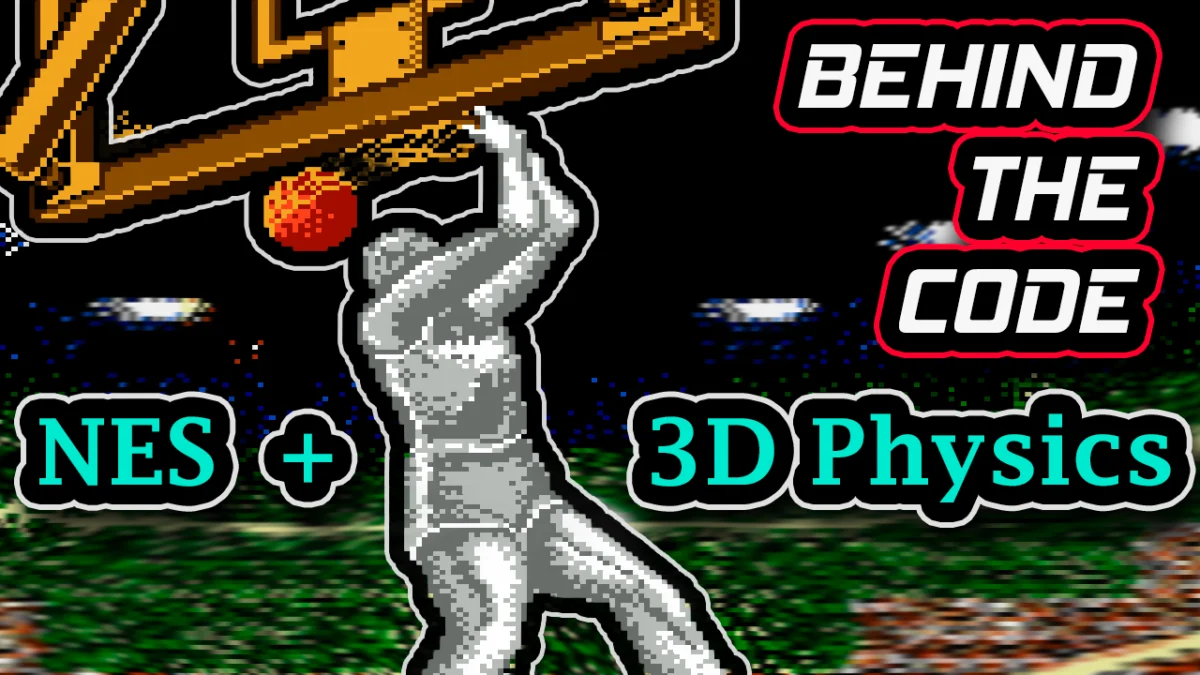
A recent in-depth technical analysis has shed light on one of the most enduring and widely recognized exploits in classic video gaming: the "corner three" shot in Konami’s 1987 Nintendo Entertainment System (NES) title, Double Dribble. This phenomenon, which allows players to consistently score three-point baskets from a specific top-right corner of the court, has transcended its origins as a mere game mechanic to become a celebrated piece of gaming lore, notably featured in popular culture. The analysis, conducted by DisplacedGamers, delves into the intricate 3D ball physics, collision detection, and programming shortcuts employed on the 8-bit NES, revealing the precise reasons behind this infamous bug.
The Genesis of a Glitch: Double Dribble’s Development Landscape
Double Dribble first debuted in arcades in 1986, quickly gaining a reputation for its vibrant graphics, digitized speech, and cinematic cut-scenes that depicted dunks and layups. Konami, a prolific Japanese developer known for pushing technical boundaries on various platforms, brought the title to the burgeoning NES console in 1987. At a time when home consoles were rapidly evolving, Double Dribble stood out among early basketball simulations, offering a more dynamic and visually engaging experience than many of its contemporaries.
Developing games for the NES, however, presented significant challenges. The console was powered by a Ricoh 2A03 8-bit microprocessor (a variant of the MOS Technology 6502) running at approximately 1.79 MHz, paired with a limited amount of RAM (2KB work RAM, 2KB video RAM). Graphics were managed by a Picture Processing Unit (PPU) capable of displaying 64 sprites simultaneously and a palette of 52 colors (out of 48 colors and 5 grays). These constraints meant that developers had to be exceptionally ingenious in implementing complex game mechanics, particularly those involving three-dimensional representations or realistic physics, within a fundamentally 2D hardware architecture.
Konami’s development team, like many others of the era, would have employed various optimization techniques to compensate for these limitations. This often involved pre-calculating values and storing them in "lookup tables" rather than performing complex real-time mathematical operations (like trigonometry) which would strain the CPU. For Double Dribble, simulating ball trajectory, speed, and collisions in a pseudo-3D environment required a delicate balance of abstraction and approximation. The "corner three" exploit is a direct consequence of how these approximations interacted, particularly concerning ball physics and collision detection at the hoop.
Deconstructing the Exploit: A Technical Deep Dive
The "corner three" exploit is straightforward in execution: position a player in the top-right corner of the screen, initiate a three-point shot, and observe an almost guaranteed score. What makes this exploit particularly fascinating is its consistency, which suggests a fundamental flaw rather than a random occurrence. The DisplacedGamers analysis meticulously unpacks this consistency, attributing it to a confluence of factors: the game’s pseudo-3D engine, its collision detection system, and the reliance on lookup tables.
Pseudo-3D Ball Physics: While Double Dribble presents a 2D side-scrolling view of the basketball court, the ball’s movement is simulated in three dimensions. This means the game tracks not just the ball’s X and Y coordinates on the screen, but also its Z-depth, which determines its apparent size and whether it’s "in front" or "behind" other elements. When a player shoots, the game calculates a trajectory that accounts for initial velocity, gravity, and the target’s position (the hoop). Due to the NES’s limitations, this trajectory isn’t calculated using real-time floating-point trigonometry. Instead, developers likely relied on pre-defined curves and incremental adjustments, often fetched from those aforementioned lookup tables. These tables would contain pre-computed values for aspects like arc height, horizontal travel, and vertical drop over time, simplifying complex calculations into memory lookups.
The "Bugged" Collision Detection: A critical element of the exploit lies in the game’s collision detection system, specifically how it determines if a shot goes through the hoop. The analysis suggests that the collision detection for the hoop is not robustly implemented across all possible ball entry angles and positions. In many games of this era, hitboxes (invisible boundaries used for collision detection) were often simplified rectangles or circles, and their interaction with complex trajectories could lead to unexpected results.
The key finding is that the hoop’s collision detection appears to be "bugged" for specific angles of entry. For shots originating from the top-right corner, the ball’s calculated trajectory, combined with its initial position and velocity, aligns perfectly with an entry vector that bypasses or incorrectly triggers the hoop’s collision detection. This means that instead of correctly evaluating whether the ball passes through the net, the system either misinterprets its position, prematurely registers a score, or fails to register a block or rebound scenario that would occur with a correctly implemented physics engine.

The Corner’s Uniqueness: The top-right corner isn’t special due to any unique game logic tied to that specific screen coordinate, but rather because it represents a precise starting point that consistently generates the problematic trajectory. From this exact position, the initial X, Y, and Z coordinates of the ball, along with the predetermined shooting force and angle, combine to create a flight path that reliably intersects the hoop at the exact angle required to trigger the collision detection bug. Other positions on the court would result in different initial conditions, leading to slightly altered trajectories that might not activate the exploit, even if the general physics engine has similar weaknesses. The consistency of the exploit underscores the deterministic nature of 8-bit game engines: given identical inputs, the output is always the same.
Cultural Resonance: From NES to Pop Culture Icon
The "corner three" exploit in Double Dribble transcended its technical origins to become a celebrated piece of video game history, largely due to its prominent feature in popular culture. Perhaps the most famous instance is its appearance in the "Inside Family Guy" episode (Season 11, Episode 17), which first aired on April 28, 2013. In the episode, Peter Griffin and his friends are depicted playing Double Dribble and repeatedly executing the perfect top-right corner three-pointer. The segment humorously highlights the exploit’s predictability and unfair advantage, bringing it to the attention of millions who might never have played the original NES game.
This pop culture reference cemented the exploit’s status beyond the confines of dedicated retro gaming communities. It became a shorthand for "broken but beloved" mechanics in classic games, showcasing how often unintended features become integral to a game’s legacy. For players who grew up with Double Dribble, the Family Guy segment was a nostalgic nod to a shared secret, a testament to the game’s enduring impact. For newcomers, it served as an introduction to the quirky imperfections that often define the charm of early video games.
Beyond television, the exploit has been a subject of discussion in various gaming forums, speedrunning communities, and YouTube channels for decades. Speedrunners, in particular, often exploit such glitches to achieve the fastest completion times, turning what was once a bug into a strategic element. The Double Dribble corner three, however, is less about speedrunning and more about a casual, repeatable advantage that fundamentally alters the game’s balance. Its consistency made it a staple for casual players looking to dominate friends or simply enjoy a guaranteed score.
The Broader Implications: Game Design and Legacy
The Double Dribble corner three exploit offers valuable insights into the complexities of game design, particularly within the constraints of early hardware. It serves as a stark reminder of:
- The Unforeseen Consequences of Optimization: Developers in the 8-bit era were constantly innovating to simulate complex real-world physics and environments with extremely limited resources. Their solutions, such as lookup tables and simplified collision models, were brilliant compromises but occasionally led to unforeseen interactions, like this exploit. The bug wasn’t a result of poor coding but rather the inherent difficulty of perfecting a complex system under severe technical limitations.
- The Power of Community-Driven Discovery: For decades, players intuitively knew about the "corner three" without fully understanding why it worked. The detailed technical analysis by entities like DisplacedGamers exemplifies the vital role of the retro gaming community in preserving, analyzing, and documenting video game history. These efforts go beyond mere nostalgia, offering academic-level insights into the engineering challenges and creative solutions of past generations of game developers.
- The Concept of "Emergent Gameplay": While the corner three is technically a bug, it also represents a form of emergent gameplay – behaviors or interactions that arise from the rules of a game but were not explicitly designed or intended by the developers. These emergent properties often contribute significantly to a game’s replayability and cultural impact, creating unique player experiences that become part of the game’s identity.
- The Enduring Fascination with Retro Mechanics: The continuous interest in dissecting decades-old game mechanics highlights a broader fascination with the history of computing and interactive entertainment. Understanding "behind the code" not only satisfies curiosity but also provides a deeper appreciation for the ingenuity of early game creators and the evolution of game development methodologies.
Modern Context and Retro Gaming Revival
The story of the Double Dribble exploit resonates particularly strongly in the current climate of retro gaming revival. The proliferation of emulation, digital storefronts offering classic titles, and dedicated retro hardware has ensured that games like Double Dribble remain accessible to new generations. This accessibility fuels ongoing curiosity about their inner workings.
Digital preservation efforts by organizations and independent creators are crucial in this context. They ensure that not only the games themselves but also the technical knowledge surrounding their development and unique characteristics (like exploits) are maintained for future study. The detailed breakdown of Double Dribble‘s physics and collision detection is not just an entertaining piece of content; it’s a contribution to the historical record of video game engineering.
The implications extend to modern game development as well. While contemporary engines are vastly more powerful and offer sophisticated physics simulations, the core principles of collision detection, trajectory calculation, and optimization remain relevant. The Double Dribble exploit serves as a historical case study, demonstrating how even seemingly minor inconsistencies in a complex system can lead to significant, player-discoverable advantages.
Conclusion
The "corner three" exploit in Konami’s NES Double Dribble is far more than just a cheat code; it is a fascinating artifact at the intersection of early game development challenges, unintended mechanics, and enduring cultural impact. Through detailed technical analysis, the once-mysterious reliability of this shot has been demystified, revealing the ingenious yet imperfect solutions employed to simulate complex physics on limited 8-bit hardware. From its origins as a casual player’s advantage to its immortalization in popular media, the Double Dribble corner three stands as a testament to the intricate and often surprising ways in which technology, design, and player interaction converge to create iconic moments in gaming history. Its continued study not only enriches our understanding of a specific game but also provides broader insights into the evolution of video game design and the enduring appeal of retro gaming.








