Edi Durjana
The RetroArch project, a free and open-source frontend for the Libretro API, has long served as a universal framework for running emulators, game engines, video games, media players, and other applications. Its modular design, utilizing "cores" for various systems, allows it to support an astonishing array of platforms, from venerable arcade machines to more recent console generations. This latest iteration, version 1.20.0, continues this tradition of innovation, focusing on two key areas: revolutionary visual enhancements through advanced shader technology and unprecedented real-world sensor integration for Linux users. The development team emphasized that the project’s continued existence relies entirely on community support and belief in its mission, urging users to consider donations via Patreon, Github Sponsors, or by purchasing merchandise from their Teespring store to sustain future endeavors.
Revolutionizing Visual Authenticity with Shader Subframes
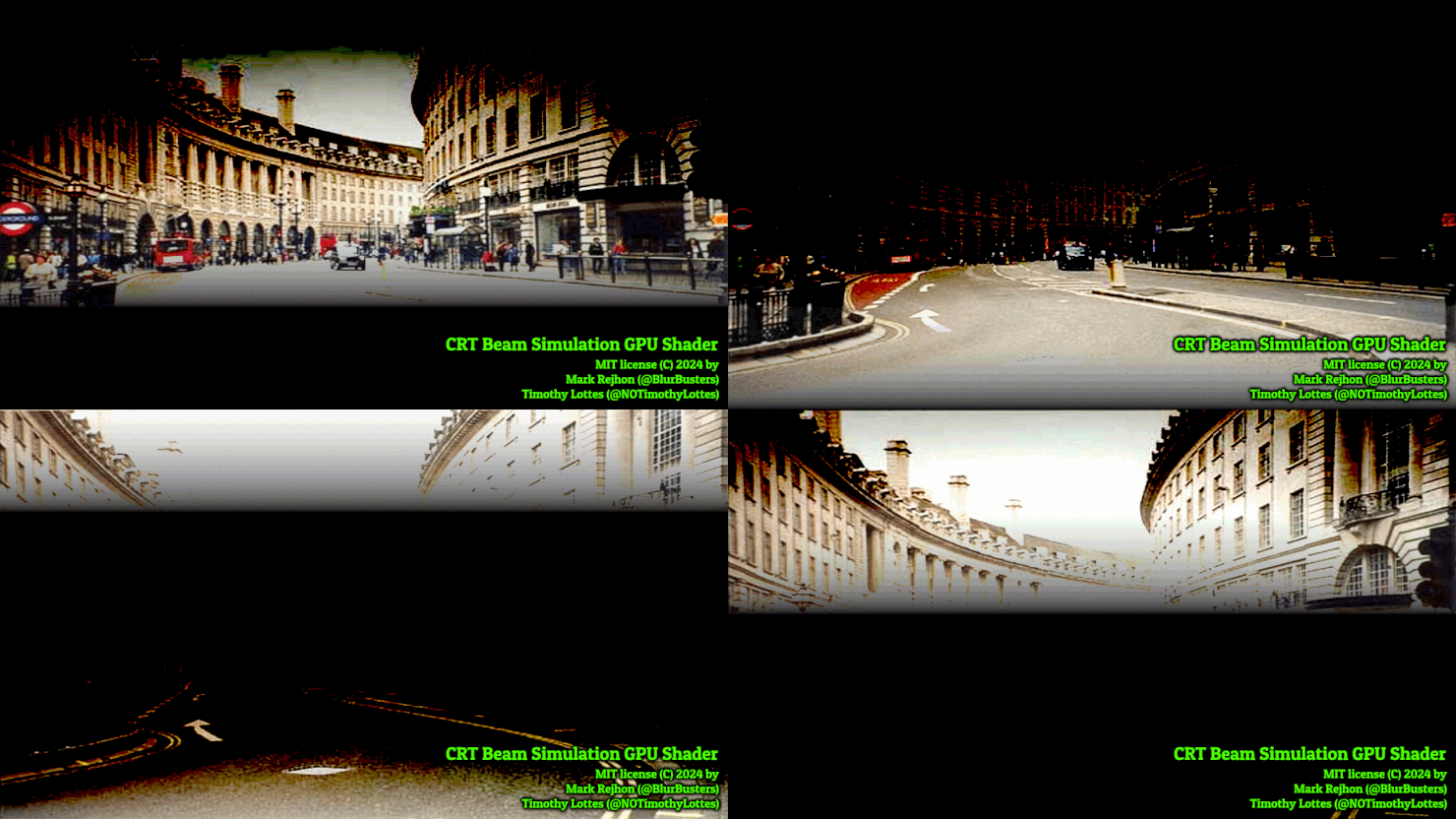
One of the most compelling features of RetroArch 1.20.0 is the introduction of a sophisticated CRT beam simulation shader, a collaborative effort from display technology expert Mark Rejhon of BlurBusters and graphics programming luminary Timothy Lottes. This new shader leverages RetroArch’s recently implemented "subframe" shader capabilities to achieve a level of motion clarity previously unattainable on modern displays without significant compromises.
For decades, retro gaming enthusiasts have grappled with the challenge of accurately replicating the visual experience of cathode ray tube (CRT) displays on contemporary LCD, OLED, and other flat-panel screens. CRTs, with their inherent scanning lines and phosphorescent glow, produced a distinct visual signature that is integral to the aesthetic of classic video games. While various CRT shaders have existed within RetroArch and other emulation platforms, many have struggled to perfectly simulate the motion characteristics of these older displays. A common technique used to improve motion clarity is Black Frame Insertion (BFI), which involves inserting a black frame between game frames to reduce motion blur. However, BFI typically comes with notable drawbacks: a significant reduction in perceived brightness, dulled colors, and a heightened risk of image persistence (often mistakenly called "burn-in") on certain LCD and OLED panels. These limitations have made BFI a less-than-ideal solution for many users seeking authentic retro experiences.
The new CRT beam simulation shader, developed by experts in display technology and graphics, directly addresses these long-standing issues. Mark Rejhon, renowned for his work at BlurBusters in understanding and optimizing display motion clarity, brings invaluable insights into the intricacies of human visual perception and display response times. Timothy Lottes, famous for creating the original FXAA (Fast Approximate Anti-Aliasing) shader and the highly regarded crt-lottes shaders, contributes his profound expertise in real-time graphics rendering. Their combined knowledge has culminated in a shader that capitalizes on RetroArch’s "subframe" capabilities. This innovative approach allows the shader to render multiple intermediate frames or subframes between the main game frames, meticulously simulating the subtle nuances of a CRT’s electron beam scanning across the screen. This technique, often referred to as "CRT beam racing simulator," generates a more fluid and authentic motion perception without the typical penalties associated with BFI. The result is a vibrant, clear image with drastically reduced motion blur, while maintaining original brightness levels and color vibrancy, and eliminating the risk of image persistence. This advancement represents a significant leap forward in the quest for perfect visual emulation, offering a more faithful recreation of classic games as they were originally intended to be seen. Further technical details and demonstrations are available in a dedicated article on the Libretro website, providing a deeper dive into the underlying principles and benefits of this groundbreaking technology.
Real-World Interaction: Illuminance Sensor Support for Linux
Beyond visual fidelity, RetroArch 1.20.0 introduces another groundbreaking feature: illuminance sensor support for Linux, spearheaded by developer Jesse Talavera. This addition directly addresses a unique gameplay mechanic found in specific retro titles, most notably the Boktai series for the Game Boy Advance. The Boktai games, designed by Hideo Kojima, famously incorporated a solar sensor directly into their game cartridges, requiring players to expose the device to real-world sunlight to power their in-game weapons and progress through certain puzzles. This innovative feature was a core part of the game’s identity and challenge, but it presented a significant hurdle for emulation, as the physical sensor could not be replicated digitally.
Jesse Talavera’s work bridges this gap, allowing Linux users to integrate their device’s ambient light sensors directly into RetroArch. This means that games like Boktai: The Sun is in Your Hand, Boktai 2: Solar Boy Django, and Lunar Knights (for the Nintendo DS, which also featured solar sensor elements) can now be played with their intended real-world light mechanics. A compelling demonstration showcased Lunar Knights running on a Steam Deck, with the game dynamically responding as the user adjusted the ambient light around the device. This integration transforms a previously un-emulatable gameplay element into a fully functional feature, significantly enhancing the authenticity and immersion for players.
The implications of this development are far-reaching. It not only breathes new life into specific sensor-dependent titles but also opens the door for future integrations of various real-world sensors. The announcement confirmed that the upcoming update for the melonDS DS core will include solar sensor support, directly benefiting DS titles that utilized similar mechanics. Furthermore, the RetroArch team plans to introduce camera support for more platforms shortly after the 1.20.0 release. This foreshadows a future where emulation extends beyond simply replicating hardware to incorporating and adapting real-world environmental inputs, offering a truly dynamic and interactive retro gaming experience. For instance, games that relied on camera input for augmented reality features or specific gameplay interactions could potentially become fully playable on a wider range of devices. This commitment to physical-world integration underscores RetroArch’s dedication to preserving the full scope of gaming history, including its most experimental and hardware-specific elements.
The RetroArch Ethos: Community, Sustainability, and Open Access
The release of RetroArch 1.20.0 is not merely about new features; it is a reaffirmation of the project’s core philosophy: a commitment to user benefit, open access, and community-driven development. In an era where digital services increasingly rely on aggressive monetization strategies—from intrusive in-app ads and data-harvesting SDKs to paywalled features and subscription models—RetroArch stands as a prominent outlier. The developers explicitly state their intention to never burden users with such mechanisms, prioritizing the end-user experience above all else. This stance has garnered a loyal following and solidified RetroArch’s reputation as a trustworthy and ethical platform in the emulation landscape.
This commitment, however, comes with its own set of challenges. Developing and maintaining a complex, multi-platform application like RetroArch, alongside its vast ecosystem of Libretro cores, requires significant resources: developer time, infrastructure costs for hosting builds and documentation, and ongoing support for a global user base. Without corporate backing or commercial revenue streams, the project relies entirely on the voluntary contributions and financial support of its community. The team actively encourages users to show their support through various channels. Patreon, a popular platform for creators, allows users to provide recurring monthly donations, offering a stable income stream for core development and maintenance. GitHub Sponsors offers another avenue for direct financial support, integrating seamlessly with the open-source development workflow. Additionally, the RetroArch Teespring store provides an opportunity for fans to purchase official merchandise, with proceeds directly contributing to the project’s funding. These diversified funding mechanisms are crucial for the long-term sustainability of RetroArch, enabling developers to dedicate time and effort to new features, bug fixes, and continuous improvement without compromising their foundational principles. The transparency around funding and the explicit rejection of commercial exploitation are central to the project’s identity and appeal.
Broader Impact and Future Implications
The release of RetroArch 1.20.0 has significant implications for the wider emulation community and the broader field of video game preservation. The advanced CRT shader technology sets a new standard for visual accuracy, potentially influencing how other emulation projects approach display simulation. By overcoming the limitations of previous methods, RetroArch provides a compelling argument for prioritizing authentic visual experiences without sacrificing modern display benefits. This could lead to a renewed focus on sub-frame rendering techniques and a deeper understanding of perceptual motion clarity in digital displays.
Similarly, the successful integration of illuminance sensors opens up new avenues for interactive emulation. It demonstrates that even the most idiosyncratic hardware features of classic consoles can be faithfully recreated and adapted for modern hardware. This paves the way for future innovations in emulating other niche peripherals, such as light guns, motion controllers, or even unique console accessories that relied on specific physical interactions. The ability to leverage contemporary device capabilities (like a Steam Deck’s built-in sensors) to replicate historical gameplay mechanics is a powerful testament to the ingenuity of the open-source community.
Moreover, this update reinforces RetroArch’s role as a vital tool for game preservation. By making more games fully playable with their original mechanics and visual intent, RetroArch contributes to a more complete and accurate historical record of video game design. As gaming hardware continues to evolve, the ability to run these titles on modern systems with a high degree of fidelity becomes increasingly important for researchers, historians, and new generations of players alike.
While a detailed changelog for version 1.20.0 was not exhaustively provided in the initial announcement, typical RetroArch releases encompass a wide array of improvements beyond the headline features. These usually include numerous bug fixes addressing reported issues across various cores and platforms, performance optimizations to ensure smoother gameplay and lower resource consumption, user interface and experience enhancements for improved navigation and configurability, and updates to existing Libretro cores to bring them in line with upstream emulator developments. Such continuous refinement is characteristic of the RetroArch development cycle, ensuring that the platform remains robust, efficient, and user-friendly.
In conclusion, RetroArch 1.20.0 is more than just another update; it is a declaration of intent. It signifies a continued dedication to pushing the boundaries of what is possible in emulation, marrying cutting-edge technology with a steadfast commitment to preserving the purity of the retro gaming experience. With its revolutionary CRT shader and real-world sensor integration, RetroArch continues to solidify its position as a cornerstone of the digital preservation and retro gaming communities, all while championing an ethical, user-first approach to software development. The call for community support remains paramount, underscoring that the future of such groundbreaking innovation rests firmly in the hands of its dedicated user base.