Jia Lissa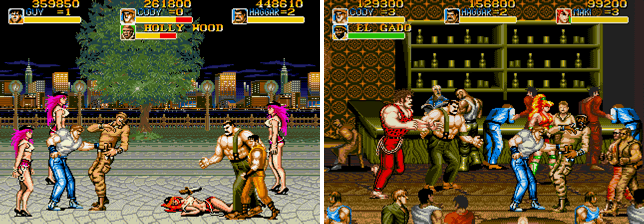
The Sega Genesis homebrew community has reached a significant milestone with the development of Final Fight MD, a comprehensive and technologically advanced port of Capcom’s seminal 1989 arcade brawler. Developed by the Brazilian studio MXRetroDev, led by programmer Mauro Xavier, this project aims to rectify the historical limitations of previous 16-bit console iterations. By leveraging modern programming techniques and a deep understanding of the Motorola 68000 architecture, the development team is delivering a version of Final Fight that not only mirrors the arcade experience but, in many technical aspects, surpasses the highly regarded Sega CD version released in 1993.
Historical Context: The Quest for an Arcade-Perfect Port
When Final Fight debuted in arcades in 1989 on Capcom’s CPS-1 hardware, it redefined the beat-’em-up genre with its large sprites, fluid animation, and visceral combat. However, the transition to home consoles during the early 1990s was fraught with compromise. The 1990 Super Nintendo Entertainment System (SNES) version, while visually impressive, was widely criticized for removing the cooperative two-player mode, omitting the character Guy, and deleting the "Industrial Area" stage entirely.
Sega eventually answered with Final Fight CD for the Sega CD peripheral. While this version restored the two-player mode and all stages, it suffered from a limited color palette and noticeable sprite flickering when the screen became crowded. For decades, the Sega CD version remained the benchmark for 16-bit fans, primarily due to its CD-quality arranged soundtrack and the inclusion of a Time Attack mode. The emergence of Final Fight MD represents a paradigm shift, as it attempts to bring a feature-complete, enhanced version of the game to the base Genesis hardware without the need for the CD-ROM attachment.
Technical Innovations and Performance Optimization
The core of Final Fight MD’s appeal lies in its technical ambition. MXRetroDev has rebuilt the game from the ground up, focusing on maximizing the efficiency of the Genesis hardware. One of the most striking additions is the implementation of three-player simultaneous cooperative play. This feature, which was absent even in the original arcade release (which supported only two players), is made possible through the use of multitap accessories such as the Sega Team Player or EA’s 4-Way Play adapter.
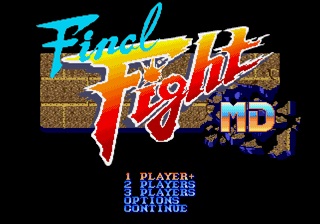
To manage the increased processing load, the developer has introduced a "1 Player+" mode. By accessing this mode via the main menu, the game reallocates system resources to prioritize performance. In this configuration, the engine can render up to seven enemies on screen simultaneously with minimal slowdown, a feat that far exceeds the capabilities of the original SNES and Sega CD ports. Furthermore, the game offers toggleable performance settings, allowing users to choose between 30 and 60 frames-per-second (FPS) modes. The 60 FPS mode is specifically optimized for players using overclocked original hardware or high-end FPGA-based systems like the Analogue Mega Sg.
Expanded Content and Gameplay Refinements
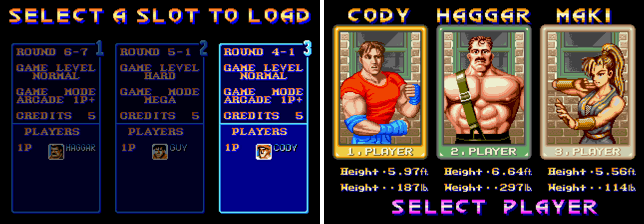
Final Fight MD is not merely a technical exercise; it is a significant expansion of the Final Fight lore and mechanics. The roster of playable characters has been expanded beyond the original trio of Guy, Cody, and Mike Haggar. Players can now select Maki, a fan-favorite character who originally debuted in the SNES-exclusive Final Fight 2. This inclusion bridges the gap between the different entries in the franchise and provides a fresh gameplay dynamic for veteran players.
The development team has also focused on mechanical fidelity. Throughout the production cycle, MXRetroDev has utilized community feedback to refine hitboxes and enemy AI algorithms. The goal is to replicate the specific "feel" of the arcade original—where enemy positioning and frame data are crucial for high-level play—while introducing modern quality-of-life improvements. These include:
- Same-Character Selection: Unlike many 16-bit brawlers, two or three players can now select the same character simultaneously.
- Save Functionality: The game includes three internal save slots that automatically record progress at the conclusion of each stage, a feature rarely seen in the beat-’em-up genre during the 1990s.
- Visual Customization: Players can adjust character color palettes using simple directional inputs, allowing for a personalized aesthetic experience.
The Mega Mode and Achievement System
To ensure long-term replayability, MXRetroDev has integrated an extensive "Mega Mode" and a robust achievement system. The game features 60 unlockable achievements, which serve as a progression system to gate various gameplay modifiers and cosmetic upgrades.
The first 30 achievements focus on standard gameplay milestones and offer rewards such as the ability to use boss themes from Final Fight 2 and 3, or enabling "air combos"—a mechanic more common in modern fighting games than in classic brawlers. Other early unlocks include an "instant knockout" modifier and a boss rush mode.
Upon reaching the 30-achievement threshold, the game introduces more radical "Nightmare" difficulty settings and experimental modes. These include:
- Vampire Mode: Players regain health by dealing damage to enemies.
- Lunar Gravity: Alters the physics of jumps and knockbacks.
- One Punch Man: A high-stakes mode where enemies (and potentially the player) can be defeated with a single blow.
- God Mode: Provides invulnerability for casual exploration of the game’s assets.
To maintain the integrity of the challenge, the developer has implemented a lockout system: as soon as these game-breaking modifiers are activated, the player is barred from earning further achievements until the game is reset to standard parameters.
Licensing Challenges and Development Hurdles
Despite the high quality of the project, Final Fight MD faces significant hurdles regarding a commercial physical release. Mauro Xavier has been transparent about his frustrations regarding the licensing landscape. In statements shared via his Patreon page, Xavier noted that while several publishers and distributors expressed interest in securing an official license from Capcom to produce physical cartridges, these deals have repeatedly collapsed.
"I have held back the development of the game countless times at the request of supposed publishers and distributors," Xavier stated. "I can no longer stand being stuck and unable to move forward with other projects definitively because of this pending promise."
Without an official license, the project remains in the realm of "homebrew" or "fan-work," preventing it from receiving the same high-profile physical launch seen by other retro projects like Retro-Bit’s release of Mega Man: The Wily Wars. Consequently, Xavier has shifted his focus to completing the game at his own pace, prioritizing the satisfaction of the community and his Patreon supporters over the pursuit of a commercial publishing deal.

Broader Implications for the Retro Computing Scene
The development of Final Fight MD is emblematic of a broader trend in the retro gaming industry, often referred to as the "Neo-Retro" movement. As modern development tools become more sophisticated, independent programmers are proving that 35-year-old hardware still has untapped potential. This project demonstrates that the Sega Genesis, often maligned for its lower on-screen color count compared to the SNES, can outperform its rival through superior CPU throughput and clever memory management.
Furthermore, the project highlights the importance of community-funded development. Through platforms like Patreon and Itch.io, developers like MXRetroDev can bypass traditional gatekeepers, allowing for the creation of "dream projects" that would never be greenlit by large corporations in the current fiscal climate.
Future Prospects and Availability
While the game is already in a highly playable state, MXRetroDev continues to polish the experience. Future updates are expected to include full compatibility with the Sega CD soundtrack, allowing players with the hardware or appropriate emulators to enjoy the high-fidelity audio of the 1993 version alongside the superior visuals and features of the MD port. There is also ongoing discussion regarding the inclusion of additional content inspired by Final Fight 3.
Currently, a functional demo of Final Fight MD is available for free on Itch.io, allowing the public to experience the "1 Player+" mode and the three-player mechanics firsthand. For the Sega Genesis enthusiast, this project represents the ultimate version of a classic, proving that with enough dedication and technical skill, the "console wars" of the 1990s are still being fought—and won—in the modern era.