Edi Durjana
The independent virtual console Vircon32, a brainchild of its creator Carra, has reached a significant milestone with its official integration into RetroArch, the widely acclaimed multi-system emulator. This development marks a pivotal moment for the burgeoning platform, significantly expanding its reach and accessibility to a global audience of retro gaming enthusiasts and independent developers. The integration not only solidifies Vircon32’s presence within the expansive emulation landscape but also signals a new era for accessible 32-bit 2D game development.
Vircon32, conceived and designed from the ground up by Carra, represents a unique entry into the realm of virtual hardware. Unlike traditional consoles, Vircon32 exists purely as a software-defined system, offering a simplified yet robust development environment. Its architecture draws inspiration from the 32-bit console generation, specifically referencing iconic systems like the PlayStation, Nintendo 64, and Sega Saturn. However, Carra’s vision for Vircon32 distinctly pivots away from the complex 3D rendering capabilities of its forebears, instead focusing entirely on 2D graphics. This strategic design choice aims to mitigate the inherent complexity of 3D engines, making the console more approachable for independent developers while retaining enough power to facilitate "interesting games."
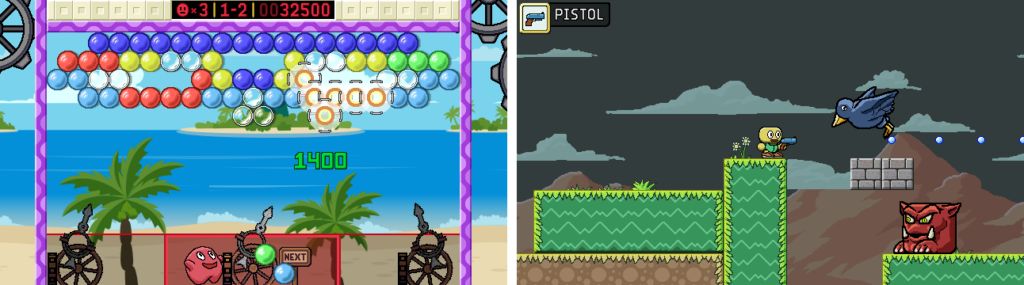
A key "quality of life" feature distinguishing Vircon32 from its retro inspirations is its native support for a 16:9 aspect ratio. This modern concession ensures that games developed for the platform will seamlessly integrate with contemporary displays, avoiding the letterboxing or stretching often encountered when playing older titles. While roughly comparable to the graphical power of an original PlayStation, Vircon32’s dedicated 2D focus means developers can concentrate on intricate pixel art, fluid animations, and sophisticated 2D gameplay mechanics without the overhead of 3D pipeline management. This philosophy is rooted in the open-source nature of the console, making its specifications and development tools freely available to foster a collaborative community.
The motivation behind Vircon32 stems from a perceived gap in the indie game development scene. Carra identified a desire among players for new games with a retro aesthetic, yet acknowledged the formidable challenges of developing for actual vintage hardware. Even seemingly simple systems like the Nintendo Entertainment System possess complexities that can deter modern developers. Concurrently, the landscape of "fantasy consoles" – simplified, often 8-bit virtual machines like Pico-8 and TIC-80 – while popular, often proved too restrictive or short-lived for Carra’s aspirations. Many fantasy consoles, despite their initial promise, either see early abandonment or struggle to amass a substantial library of games. Furthermore, their typically extreme retro aesthetic, often confined to 8-bit limitations, did not align with the creator’s ambition for "polished, full-fledged games" that transcend mere experimental projects. Vircon32 was thus born as a middle ground, offering a more contemporary retro experience without the daunting complexities of actual historical hardware or the severe limitations of ultra-minimalist fantasy consoles.
The decision to pursue integration with Libretro and, by extension, RetroArch, was a strategic imperative to achieve universal accessibility. Carra’s goal was for Vircon32 and its games to be enjoyed by the widest possible audience, aligning with its free and open-source ethos. While native emulators for Windows, Linux, and macOS were successfully developed, the limitations of PC-only availability became evident. The modern gaming landscape extends far beyond desktop computers, encompassing smartphones, tablets, and a burgeoning market of dedicated emulation handhelds. To bridge this gap, developing a Libretro core emerged as the most efficient and effective pathway to multi-platform compatibility.
Libretro is a robust programming interface that standardizes the interaction between a "front-end" application and various "back-end" emulators or game engines, known as "cores." This architectural design delegates system-specific tasks—such as initialization, timing, and event handling—to the front-end, liberating cores from the intricacies of platform-dependent code. This fundamental abstraction renders Libretro cores highly platform-independent, allowing them to run across a vast array of devices supported by Libretro-compatible front-ends. RetroArch stands as the most prominent example, offering a unified user interface across Windows, Linux, macOS, Android, iOS, various game consoles, and single-board computers like the Raspberry Pi. Other front-ends, such as Kodi and EmuVR, also leverage the Libretro API.
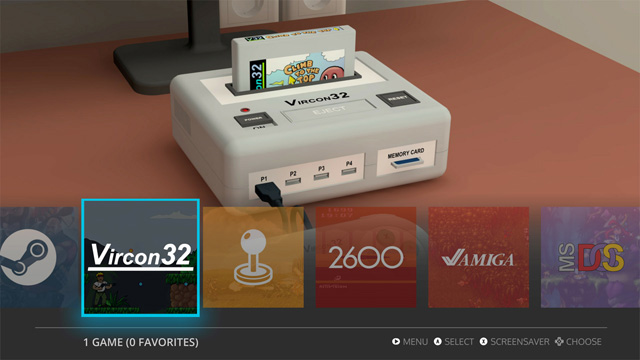
For Vircon32, this integration means its games can now be played seamlessly on virtually any device capable of running RetroArch. From a user’s perspective, this translates to unparalleled convenience, providing access to an ever-expanding library of content, including Vircon32 titles, all within a single, familiar application. Beyond basic compatibility, the Libretro framework also bestows a suite of advanced features upon integrated cores. Many of these, such as sophisticated screen filters and shaders, are available "for free" without additional core-specific development. With relatively modest effort, developers can also implement powerful functionalities like savestates, game rewinding, and netplay, significantly enhancing the user experience for Vircon32 games. The image of Vircon32 seamlessly integrated into EmulationStation, a popular front-end often used with RetroArch, vividly demonstrates this enhanced accessibility and user convenience.
However, the journey to becoming a fully integrated RetroArch core is not without its challenges. Carra’s personal experience highlights a steep learning curve for those new to Libretro API development. While programmers, particularly those with game development experience, may find the underlying concepts comprehensible, the initial phase of understanding the basic message flow and core structure can be daunting. A key hurdle identified is the scarcity of comprehensive introductory guides explaining the general workings of a minimal core. Developers are often compelled to dissect and "reverse-engineer" existing, often complex, cores available on GitHub. This process is further complicated by the fact that the extensive libretro.h header file, while containing detailed comments, requires prior knowledge of what specific features to look for. Furthermore, there’s no guarantee that every existing core adheres to the "intended way" of implementation, with some potentially employing "weird hacks" that complicate the learning process for newcomers.
The integration into RetroArch’s official repositories represents an even more substantial undertaking than merely developing a functional Libretro core. Most users rely on RetroArch’s automatic core downloader, making official integration essential for broad adoption. This process demands an online code repository capable of being mirrored, alongside significant adaptations to the core’s build system to conform to Libretro’s YAML templates. Extensive cross-platform testing is mandatory, often requiring validation across numerous operating systems and hardware architectures to ensure stability and performance. A dedicated core info file must also be prepared and merged into the main RetroArch project. This multi-faceted process often involves collaboration and communication with various members of the Libretro development team.
Carra’s integration journey was particularly arduous because it involved introducing an entirely new game system to RetroArch, rather than simply adding another core for an already recognized console. This necessitated additional foundational work, including the creation of a comprehensive game database, development of specific thumbnail assets for Vircon32 titles, and, where applicable, the management of BIOS requirements. The Libretro Buildbot, a critical automated build system, plays a central role in compiling and distributing cores for the vast array of supported platforms, and navigating its intricacies is a core part of the integration challenge.
Looking ahead, the roadmap for Vircon32’s future is clear, focusing on both core functionality enhancements and, critically, game development. The current Vircon32 core already boasts full compatibility with all existing console games, but Carra plans to introduce more advanced features. High-priority additions include frameskipping, essential for maintaining smooth performance on lower-end hardware, and savestates, a highly valued feature for user convenience. Eventually, the ambition extends to implementing game rewinding and netplay, which would significantly elevate the user experience by offering modern emulation conveniences and multiplayer capabilities.
From the perspective of the Vircon32 console itself, its fundamental design is now finalized, thoroughly documented, and supported by functional emulators and development tools. While these components will undoubtedly undergo continuous refinement and improvement, the paramount focus for Vircon32’s long-term success is the expansion of its game library. The growth of the platform hinges entirely on attracting and enabling developers to create "more games, and better games!" This emphasis underscores the collaborative, community-driven spirit behind the project.
The integration into RetroArch provides a stable and widely accessible foundation, positioning Vircon32 as an attractive platform for indie developers seeking to craft 32-bit 2D retro-style experiences without the burdens of legacy hardware or the extreme limitations of minimalist fantasy consoles. For players, it promises a continuous stream of new, quality retro-inspired titles accessible across a multitude of devices. The ecosystem’s health will be a direct reflection of developer engagement and the creative output of its community.
In a further move to enhance accessibility and reach a broader gaming audience, the Vircon32 core is also available directly on Steam. This distribution channel allows users to easily download and integrate Vircon32 through the popular PC gaming platform, complementing the wider multi-platform availability offered by RetroArch. This dual approach maximizes the potential user base, ensuring that both dedicated emulation enthusiasts and casual PC gamers can readily experience Vircon32 and its burgeoning library of titles. The concurrent launch on Steam and integration into RetroArch underscores Carra’s commitment to making Vircon32 a truly universal and user-friendly platform.