Arya Paningal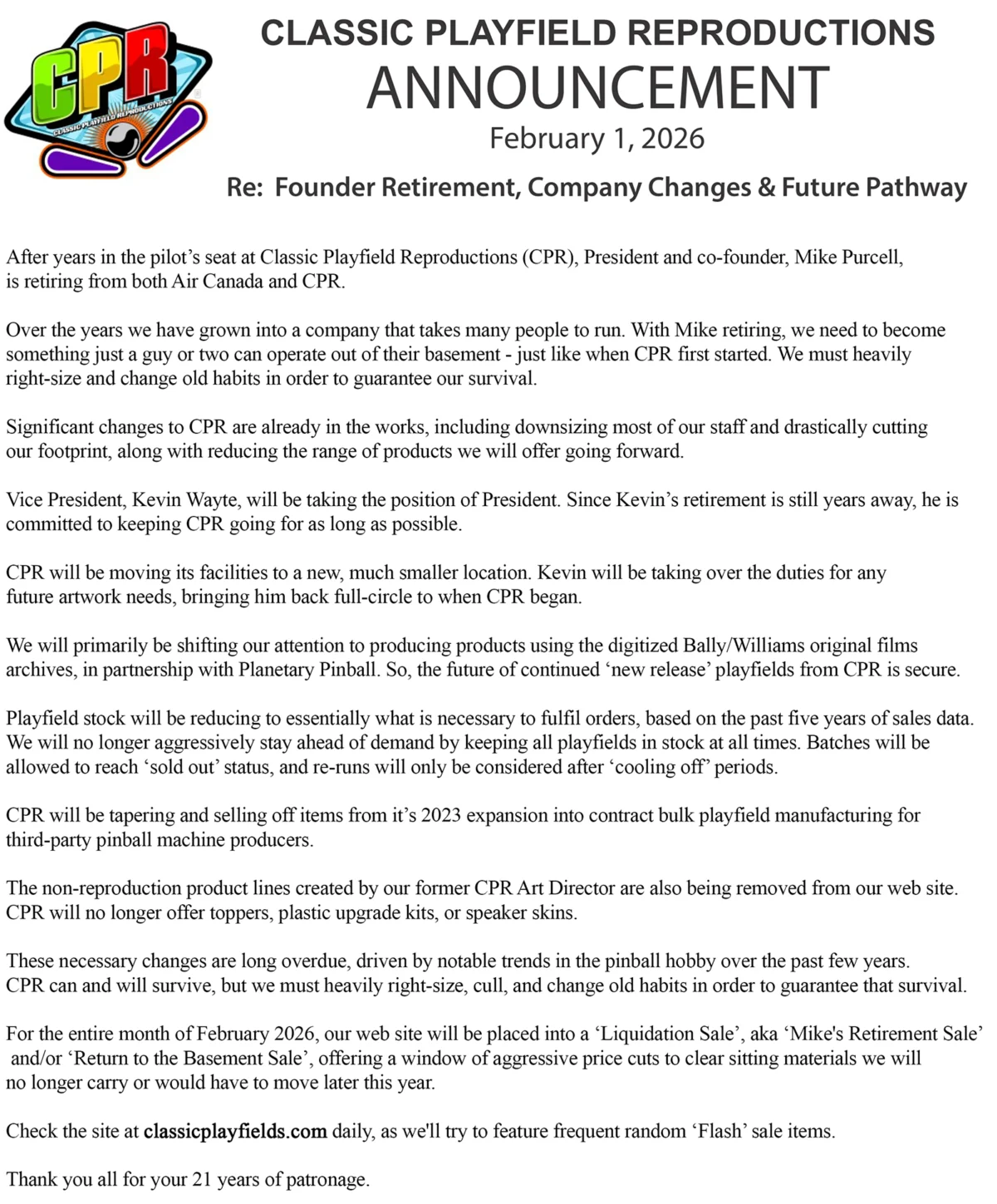
Classic Playfield Reproductions (CPR), a cornerstone in the pinball community for its high-quality reproduction parts, is entering a new chapter characterized by significant restructuring and a strategic downsizing. This pivotal transition follows the retirement of co-founder Mike Purcell and is driven by evolving market dynamics within the vintage pinball industry, alongside a shift away from contract manufacturing. The company, renowned for breathing new life into classic machines, is adapting its operational model to ensure continued viability and profitability in a changing landscape.

The Genesis of a Pinball Restoration Pioneer
CPR’s story began in 2005, forged in Halifax, Nova Scotia, Canada, by the collaborative vision of Mike Purcell and Kevin Wayte. This venture was not an overnight creation but rather an evolution from an earlier enterprise, Halifax Pinball. Halifax Pinball, managed by Purcell and Greg Walker, had already established a reputation for its meticulous reproduction of playfields, notably for the iconic Bally game Fathom. This initial success laid the groundwork for what would become a leading supplier of essential parts for pinball enthusiasts worldwide.
Following the Fathom project, the partnership evolved. Greg Walker moved on to found Fantastic Pinball, while Mike Purcell, alongside Kevin Wayte, established Classic Playfield Reproductions. Their initial commission as CPR was a significant undertaking: producing reproduction Centaur playfields for Gene Cunningham’s Illinois Pin Ball (IPB). This project demanded not only the ability to precisely cut and route playfields but also the meticulous use of original Bally artwork screens, acquired from IPB, to ensure unparalleled accuracy in replicating the original aesthetic. This early success underscored CPR’s commitment to authenticity and quality, setting a high bar for future endeavors.

Expanding the Repertoire: From Playfields to a Full Spectrum of Parts
The success of the Centaur project propelled CPR to tackle an ever-expanding catalog of reproduction parts. In instances where original silk screens were available, CPR utilized them to maintain the integrity of the artwork. When these were unavailable, the company demonstrated remarkable resourcefulness by engaging with the collector community, sourcing high-quality original playfields to serve as precise references for their reproductions. This dual approach—leveraging original assets and community collaboration—allowed CPR to achieve a remarkable level of fidelity in its products.
As the technology of reproduction advanced, CPR transitioned from traditional silk-screening to digital printing. This technological leap was facilitated by securing crucial licensing agreements. Partnerships with Planetary Pinball for Williams and Bally titles, and with Mondial Group for Gottlieb games, were instrumental in expanding their offerings. These agreements empowered CPR to produce a wider array of authorized reproductions, further solidifying their position as a central supplier for the pinball restoration market.

Beyond playfields, CPR diversified its product line to include a comprehensive range of components essential for restoring vintage machines. Numerous backglasses, meticulously recreated to match original specifications, became available. Similarly, reproduction plastics sets, often brittle and broken on aging machines, were produced, along with speaker panels that completed the visual restoration of the game’s cabinet. Furthermore, CPR demonstrated its innovative spirit by designing and manufacturing in-house original toppers and other bespoke game enhancements, catering to enthusiasts seeking to personalize and elevate their pinball experience. The company’s commitment to a full-service approach made it an invaluable resource for collectors and operators alike.
Navigating Market Shifts and Contract Manufacturing
The growth of CPR’s product range was mirrored by an expansion in its workforce. At its peak, the company employed a dozen full-time staff, supplemented by two or three part-time individuals, reflecting the significant demand for their products. However, the market for reproduction playfields began to exhibit signs of saturation. As Kevin Wayte, co-founder and now President, explained to Pinball News, "A finite population of surviving ‘legacy’ games eventually leads to an inevitable decline in demand for reproduction parts." He elaborated that the most critical replacement needs for many older games had already been addressed over the years. "You only need and swap a reproduction playfield once," Wayte noted, highlighting the inherent cyclical nature of the replacement parts market.

Recognizing the evolving demand for reproduction parts, CPR strategically leveraged its manufacturing expertise in 2023 by venturing into contract manufacturing for full pinball machine manufacturers. This diversification included collaborations with prominent companies such as Euro Pinball Corp. in Italy and Barrels of Fun in the United States. This expansion required significant investment in additional equipment and an increased workforce to manage the higher production volumes. While contract manufacturing offered the potential for steady demand and volume, it also presented its own set of challenges, particularly with lower per-unit margins. Vulnerability arose when either volume or consistent demand began to falter, as indeed happened.
A New Chapter: Downsizing and a Return to Core Competencies
The winding down of contract manufacturing projects, coupled with the persistent slowdown in the sales of reproduction products, necessitated a critical re-evaluation of CPR’s future direction. This period of introspection coincided with a significant personal milestone for co-founder Mike Purcell, who is retiring from his full-time career as a pilot for Air Canada and stepping down from his role as President of CPR.

Taking the helm as President, Kevin Wayte is spearheading a series of sweeping changes aimed at streamlining operations and ensuring the company’s profitability. The most immediate and visible change is a substantial reduction in the company’s physical footprint. CPR will relocate to a smaller facility, remaining in Halifax, but reducing its workforce to a core team of two or three employees working alongside Wayte.
Wayte articulated the stark reality of the reproductions market’s current state: "Back in the early years, with large playfield batches being 100-300 per run, those would be all snatched and shipped within a few months. Today in 2026, those same titles have tapered down to selling a few a year." He further illustrated this shift with a striking anecdote: "There is now the phenomenon of releasing a first-time-reproduction playfield title in 2025 – and it sells six. Yes, six. Then it goes dead quiet. Ten years ago, shipping 100 immediately after a run was standard fare. There was never a doubt that you could at least get 100 copies out. Not today." Wayte underscored the increased risk associated with production runs, noting that "In recent years, we launched first-time-available playfields with a debut batch of only twenty pieces, tops. Now that number is usually only ten. The risk has been too high to pile on more. This is the new normal in 2025/2026."

Strategic Product Pruning and Future Outlook
In line with the downsizing strategy, CPR is undertaking a significant pruning of its product range. The company will focus exclusively on its three foundational reproduction lines: playfields, backglasses, and plastics sets. This strategic decision means that in-house developed products such as toppers, plastic upgrade kits, and speaker skins will no longer be offered for sale. This move allows CPR to concentrate its resources and expertise on the core offerings that have defined its legacy.
Despite the reduction in product categories, CPR remains committed to innovation and expansion within its core lines. Wayte confirmed that new reproduction products will continue to be developed and released. "We’ll hold up the titles we’ve been known for, plus add a couple new ones every year as new artwork gets developed here," he stated. "We already know what our next ten new-release playfields are going to be, across the next three years. That’s plenty to keep us busy now." This forward-looking approach indicates a strategic intent to continue serving the market with fresh, high-quality reproductions while managing production scales according to current demand.

Liquidation Sale and a Return to Roots
As a direct consequence of the downsizing and restructuring, CPR is currently conducting a comprehensive sale of surplus stock and equipment. This event, referred to with a touch of humor as the "Liquidation Sale," "Mike’s Retirement Sale," or the "Return to the Basement Sale," commenced today with a public announcement on social media platforms.
Kevin Wayte clarified the whimsical nature of the sale’s titles: "We cheekily use the meme ‘Back to the Basement’ as more of a signal of returning to our roots years ago. We no longer need the gigantic business-park commercial unit anymore. It doesn’t mean CPR is literally going back into Kevin’s basement." The sale is an opportunity for collectors and enthusiasts to acquire a wide range of items at significantly reduced prices, marking a tangible transition for the company.

The sale is currently live on the Classic Playfield Reproductions website, offering a chance to acquire a piece of CPR’s history. Further insights into these significant changes and the broader dynamics of the pinball reproduction market will be featured in the January 2026 edition of the Pinball Industry News PINcast. This upcoming episode will feature an in-depth discussion between Pinball News Editor Martin Ayub and Pinball Magazine Editor Jonathan Joosten, providing listeners with a comprehensive overview of CPR’s new direction and the industry trends shaping its future. The podcast will be available on Spotify, YouTube, and Pinball News.